dailynewsnblog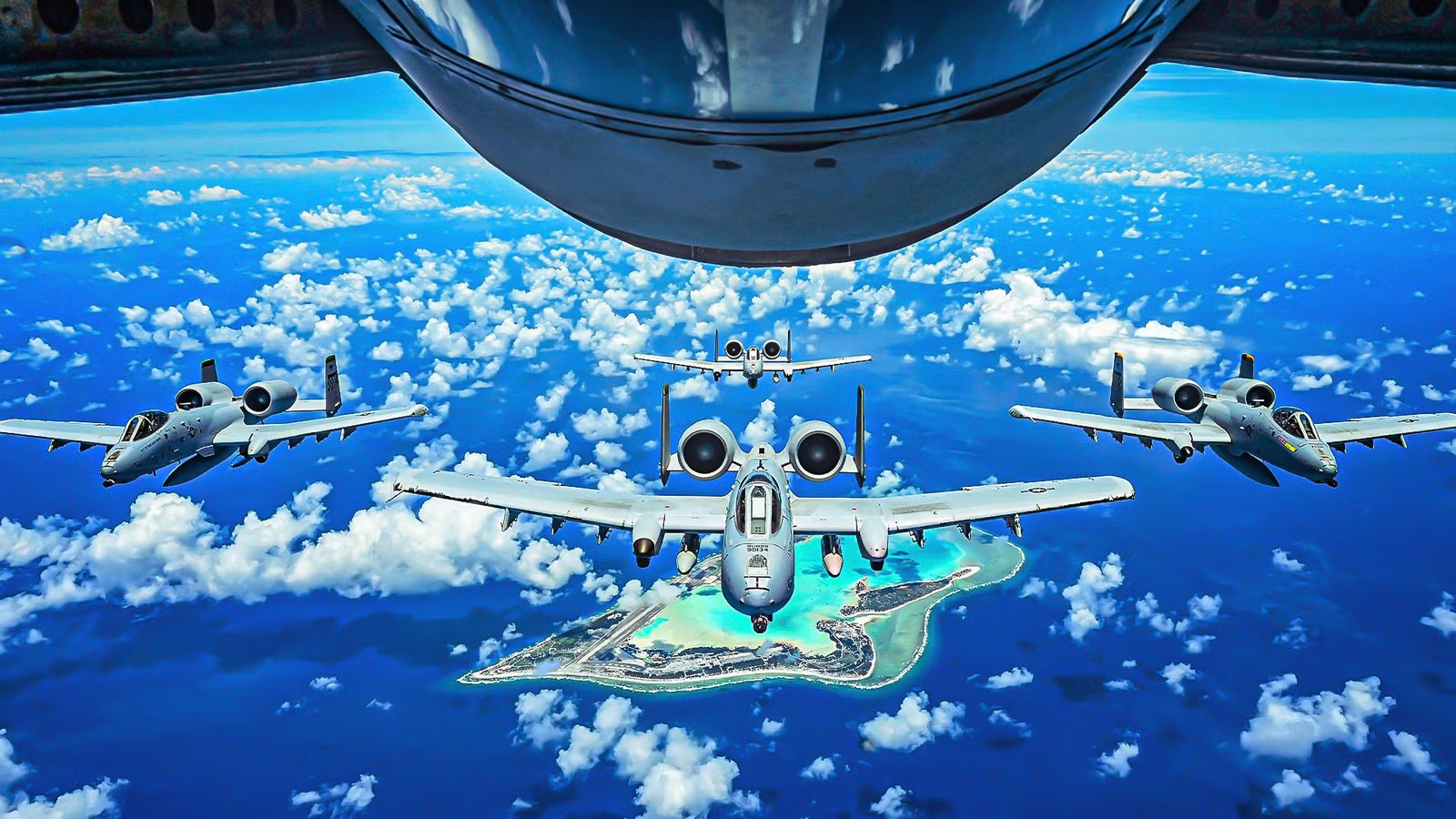
Despite its fearsome reputation and longstanding legacy, the US Air Force has been working toward finally phasing out the Fairchild Republic A-10 Thunderbolt II in favor of the new F-35 Lightning II stealth fighter. The Air Force recently reversed its plan to retire the entire A-10 Warthog fleet by 2026, opting instead to extend the service life of a portion of the fleet through 2030.
Following a strong performance in an anti-drone role during Operation Epic Fury over Iran, the USAF has updated its 2027 plans. The new fleet structure would leave 54 aircraft to support three operational squadrons through 2030, according to Air & Space Forces Magazine. This comes as welcome news to analysts who consider the F-35 as a kind of ‘glass cannon’ compared to the Warthog.
Add to that, the A-10 has shown itself to be a highly efficient platform to dispatch the low-cost unmanned weapons used by Iran against American, Israeli, and other partner-nation forces in the Gulf region. The Warthog has found a new purpose as a cost-effective counter to one-way attack drones. Its ability to loiter for hours at low altitudes allows it to intercept slow-moving aerial threats more economically than high-speed stealth fighters.
The Warthog’s Fleet Wind Down

The A-10 has endeared itself to pilots, maintenance personnel, and the public. The aircraft is deemed antiquated by most standards, but it is still in service decades after politicians and top Air Force brass first urged its retirement. Despite its modest initial production numbers and the fact that no export models were produced, the tried-and-true design has survived as a specialist platform.
The year 2025 was slated to see a large divestment of Warthogs despite its enduring popularity, with the USAF scheduled to decommission 56 of the type. Prior to renewed calls for the A-10 to remain in the inventory, more squadrons were planned to transition to the Boeing F-15EX Eagle II, Lockheed Martin F-35, or Lockheed Martin F-16 Fighting Falcon. The Air Force originally planned to completely divest the A-10 fleet by 2029 before announcing plans to retain a select number until 2030.
|
Fiscal Year |
Total A-10 Inventory |
Mission Ready A-10s |
|---|---|---|
|
2025 |
162 |
140 |
|
2026 |
103 |
93 |
|
2027 |
54 |
45 |
The Air Force’s approach to the CAS mission is evolving as fourth- and fifth-generation platforms become more competent and lethal as technology develops. Some argue that the marketing department was the most successful aspect of the A-10 program, as it was repeatedly cut but always survived the annual budget war.
Operation Epic Fury: The Flying Tank Fights Again

Since the United States launched a joint attack on Iran in support of Israel, the A-10 fleet has seen markedly increased demand. It has reportedly flown a wide range of missions, including drone hunting, maritime strikes, and combat search and rescue. The US has also relied on it to protect US personnel and embassy facilities in the region, including in Iraq, where it provided close air support against Iranian-backed militias.
The ability of the A-10 to adapt to contemporary threats that more sophisticated jets find difficult to economically handle is becoming increasingly important to its survival. Unguided 2.75-inch Hydra 70 rockets can be transformed into precision-guided munitions with the new APKWS II, an inexpensive laser-guidance kit. With the anti-drone mission in mind, a laser-guided rocket system that was initially intended for air-to-ground strikes was converted into an air-to-air weapon.
How The Fairchild Republic A-10 Warthog’s Titanium Bathtub Protects Pilots From Ground-Level Ballistics
The story behind America’s flying tank buster.

The A-10 uses its targeting pod or external data links to locate and laser the drones so that the APKWS seeker can follow them because it does not have an internal radar. Because the rockets are so compact in comparison to a traditional air-to-air missile, which takes up a full hardpoint per munition, the entire system also increases the aircraft’s flying magazine capacity.
The A-10 and APKWS II are critical platforms in the strategy to protect the United States’ defense industrial base, which has been strained by the massive expenditure of high-end munitions during Operation Epic Fury in early 2026. The conflict exposed a cost-exchange crisis, with expensive, low-inventory missiles being depleted to counter cheap Iranian drones.
A rocket pod containing seven projectiles can be mounted on the same hard point as a single missile. A single rocket costs between $25,000 and $40,000, while an AIM-120 AMRAAM costs more than $1 million. According to the war zone, the A-10 equipped with APKWS II enables the US to counter drone swarm tactics without exhausting expensive missile inventories.
Can An A-10 Warthog Destroy A Tank?
The epic A-10 Warthog is known for its 30mm cannon, but can it really turn enemy tanks into flaming wreckage so easily?
The Missile Crisis: America’s Need For Budget Air Support

During the initial air campaign, the US and its allies spent nearly $30 billion on munitions and operations in just three weeks. In just seven weeks of fighting, America has deployed approximately 45% of its Precision Strike Missiles, 50% of its THAAD interceptors, and nearly 50% of its Patriot missiles. Replacement of these complex missiles, such as the PAC-3 or SM-3, can take between three and eight years due to slow production lines. Unlike specialized interceptors, APKWS kits are constructed by attaching a guidance section to existing, mass-produced Hydra 70 rockets.
By using the APKWS to counter low-speed drone threats, the US saves its limited stocks of AIM-9X and AIM-120 missiles for high-end threats such as manned fighters and cruise missiles. Like the A-10, the F-15E Eagle can carry more than six times as many munitions for the anti-drone mission as it can in a traditional anti-air configuration, and it can even mount three rocket pods on a single hard point. There is even a plan to upgrade the system for simultaneous ‘fire and forget’ targeting.
During recent operations in and around Iran, the A-10 also proved uniquely effective at destroying naval targets like fast-attack boats and providing close air support in permissive or messy environments. While it is much harder to hit, a single lucky piece of shrapnel or a small-arms round could potentially compromise the F-35’s stealth coating or sensitive electronics. All of these factors have combined to stay the Warthog’s retirement just a little longer.
Here’s Why Air Forces Are Expanding Their Stealth Fighter Programs
The global race for the ultimate stealth jet.
The US Air Force’s Future Close Air Support

Despite the A-10’s proven capability, the USAF has been investing in stealth technology and unnamed platforms to completely change the way CAS is executed on the battlefield. In the future, it plans for advanced jets and drones tol hunt over the enemy airspace, immune to air defenses, while pinpointing targets for other platforms to destroy.
The F-35A can loiter in contested airspace and designate targets for loyal wingman drones or 4.5-Gen jets like the F-15EX to swoop in and destroy with its bigger payload and higher performance under the new high-low fleet mix. The US Armed Forces envision air assets responding to requests for air strikes from troops in action with virtually instant turnaround times in the future.
5th-Gen aircraft have displaced the A-10C and other older systems like the F-15C/D and F-16C/D for reasons other than stealth. Every linked asset receives real-time information from the digital network created by the sensors and data-link technologies on board. This allowes for unprecedented cooperative and allied interoperability.
A stealth fighter can paint a target for a land or sea-launched cruise missile, even a standoff weapon fired from a strategic bomber like the B-52 Stratofortress or stealth B-2 Spirit. We have to wait and see if an unmanned platform replaces the A-10 and Su-25 on the battlefield or if they are the last of a dying breed and the CAS attack plane class dies with the retirement of these grizzly old warbirds.

Before The F-35 Vs. After: How Air Combat Changed
Examining a paradigm shift in air warfare.
Battle Tested: The Warthog’s Bulletproof Reputation

While several A-10s have survived extreme wing damage, the most famous incident from the 2003 Operation Iraqi Freedom actually involved a missile strike that shredded the aircraft’s tail and rear fuselage, rather than half a wing, though other pilots in earlier conflicts have survived major wing losses. Flying over Baghdad, Captain Campbell’s A-10 took a direct hit from a Surface-to-Air Missile in the tail, as Military.com covered.
Shrapnel riddled the fuselage with hundreds of holes. A subsequent battle damage check by her wingman revealed a football-sized hole in the right horizontal stabilizer and that large sections of the tail were missing. Despite losing all flight-control fluid and having massive holes in her stabilizers, she engaged Manual Reversion.
With no hydraulic pressure, the jet became unresponsive to the control stick and began to dive. Campbell flipped the switch to manual reversion mode, a last-resort mechanical backup that uses physical cables and pulleys to move flight surfaces. She wrestled the 50,000-pound jet for over an hour, flying nearly 100 miles back to base. Despite having no brakes, steering, or flaps, she performed a rare and successful manual landing.
On April 8, 2003, just one day after Campbell’s incident, Major Wolf’s A-10 was hit by a SAM over Baghdad. He successfully flew his heavily damaged aircraft 120 miles to an emergency landing at Tallil Air Base. During the 1991 Gulf War, an A-10 piloted by Captain Robert Swain also famously returned to base after a SAM hit blew a large portion of its right wing clean off.