dailynewsnblog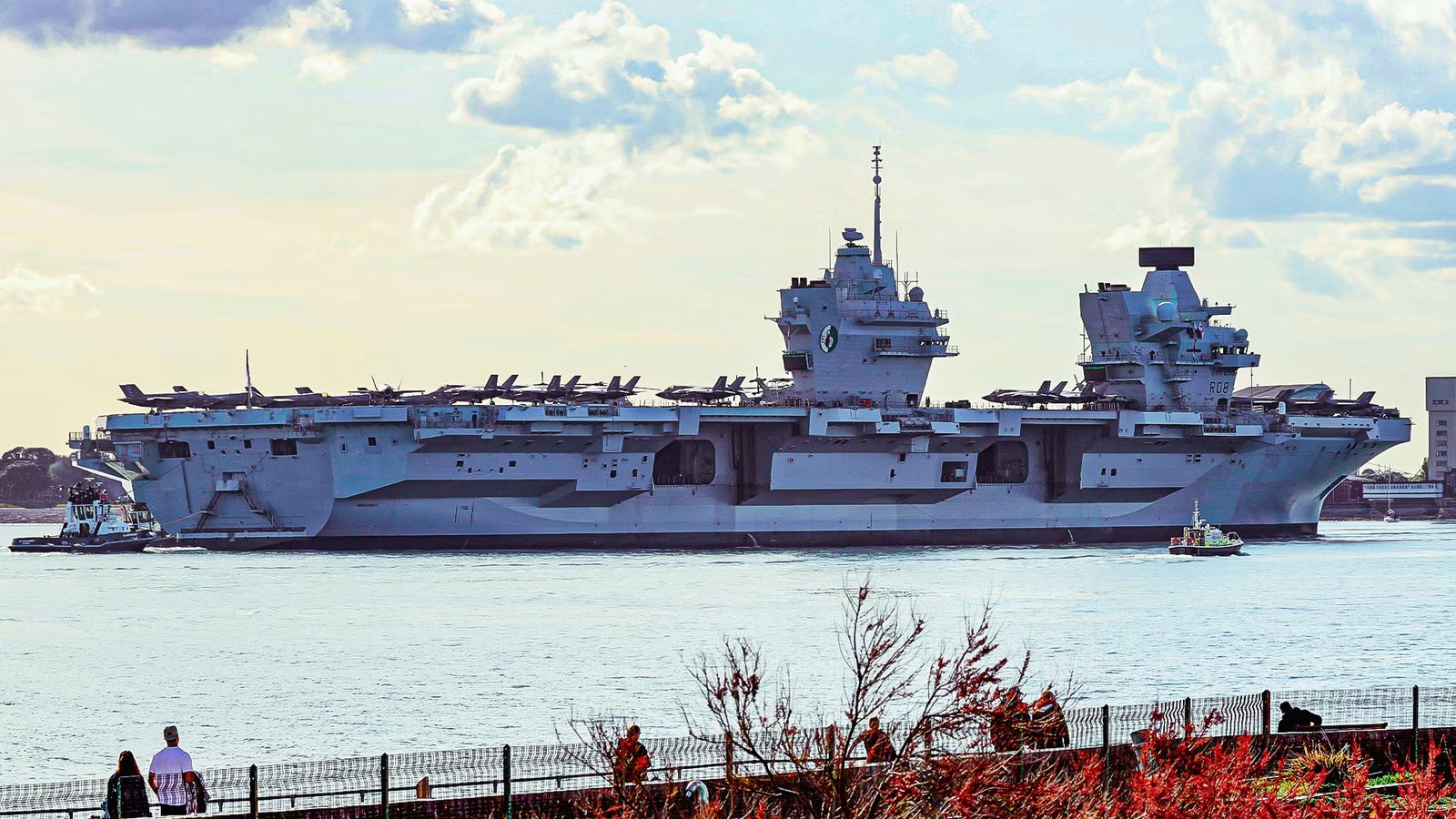
The UK Joint Lightning Force

The parent organization governing the UK’s F-35 operations is the Joint Combat Air Task Force. It pools resources from both the Royal Air Force and the Royal Navy’s Fleet Air Arm. Because the jets belong to a joint pool rather than a single service, the RAF frequently draws aircraft for land-based operations, like deployments to Cyprus, thinning out the number available for carrier strike groups.
To salvage their independent land-attack capabilities amid budget cuts, the RAF lobbied for and secured a planned purchase of 12 conventional take-off F-35A variants. Out of the 75 total planned aircraft by 2033, only 63 will be carrier-capable. These will be divided between RAF 617 and RN 809 Squadron as well as the training unit 207 Squadron. There will always be some deep maintenance downtime and test aircraft. So the JLF will only have enough operational jets to consistently generate one full carrier air wing of roughly 24 to 36 jets at a time.
With Donald Trump back in the White House, the UK is also hyper-aware of his ‘America First’ foreign policy and transactional approach to NATO. This has produced a major flashpoint over digital sovereignty, with the UK and many other allied partners fearing that a US ‘kill switch’ could cripple their fleet in a moment over a mercurial diplomatic decision in the US.
This is the UK increasingly looking to push funding toward the BAE Tempest, Global Combat Air Program. Co-developed as an equal partnership with Japan and Italy, it guarantees the UK 100% sovereign control over software, upgrades, and operational deployment. The UK is also reinvesting in extending the fleet life of a Eurofighter Typhoon, which has a bridge to the Tempest, which simultaneously keeps the BAE assembly lines working. A Tempest supersonic flight demonstrator is scheduled to fly in 2027, showing a strong preference toward cutting losses with the JSF.
Not So Exquisite: The Disappointing Stealth Fighter

Delays in rolling out Lockheed Martin’s Technology Refresh Three software upgrades have pushed the integration of crucial British weapons like the Meteor beyond-visual-range missile and Spear 3 cruise missile into the 2030s. Earlier this month, the Pentagon assessment categorized the TR-3 software infrastructure as predominantly unusable and slashed US F-35 procurement in half for the rest of the year. TR-3 is a strict prerequisite for integrating the crucial Meteor missile, advanced electronic warfare suites and enhanced internal weapons racks needed for the F-35 to reach its full capability.
The TR-3 package is now expected to be delayed as long as 2031 to reach full combat readiness due to delays with both Skunk Works and Pratt & Whitney. Another bottleneck within the JLF is a severe human resource shortage. A UK Defense Committee investigation revealed that the JLF possesses an extreme shortage of trained pilots relative to the size of the fleet. Meanwhile, the National Audit Office reports reveal that the fleet suffers from an acute shortage of qualified engineering supervisors, technicians, and flight instructors as well.
Many RAF technicians lack specific carrier-flight-line servicing experience. The UK has only managed 14 personnel per jet compared to the US Marine Corps standard of 25. Furthermore, because RAF and Royal Navy maintainers are forced to share responsibilities at RAF Marham, cross-training delays have restricted availability. This has capped aircraft availability rates, meaning only about one-third of the active jets are mission-capable at any given time.

Canada Is Secretly Paying For F-35 Parts While Threatening To Buy Sweden’s Gripen Instead
Inside the troubled RCAF modernization program.
A Question Of Cost For The RAF

The F-35 program is cannibalizing the MoD budget. Prime Minister Keir Starmer announced the intent to purchase 12 F-35A models for the RAF. Procuring a Tranche 2 batch of F-35s costs billions upfront, but the true burden is lifetime maintenance. The F-35A has a 15% lower purchase price, 8% lower running costs, longer range, and a larger payload than the B variant. However, because the F-35A requires a traditional runway, these aircraft cannot operate from the ski-jumps of the Queen Elizabeth-class carriers.
This would change the strategy for the Royal Navy, as only one carrier can deploy with a full air wing at a time. But by capping the F-35 fleet at roughly 75 aircraft by 2033, the UK can redirect £16.2 billion directly into developing the Tempest, ensuring that high-tech manufacturing, intellectual property, and over 20,000 defense jobs remain within the UK economy. To offset the lack of crewed jets on flight decks, the Royal Navy is also heavily investing in uncrewed options under initiatives like Project Vixen, also known as Project Vanquish.
Budgets are being heavily balanced away from expanding the F-35 platform toward the development of the Tempest sixth-generation fighter via GCAP. The projected lifetime cost of the UK’s F-35 fleet has ballooned from its early estimates of up to £71 billion to £91 billion. To manage a massive fiscal black hole, the UK government has deliberately slowed down procurement. The UK can likely continue to fill its excess carrier deck space through joint deployment with US Marine Corps F-35B squadrons alongside British squadrons in the meantime.

Here’s Why The Marines Corps Is Scattering F-35Bs Across Tiny Pacific Islands In 2026
Going back to Raider ops for the pivot to the Pacific.
The Fleet Air Arm Of The Future

The original goal of 138 aircraft is now widely viewed as dead. Current projections aim for 75 aircraft by 2033, according to UK Defence Journal. That includes a mix of 63 carrier-capable F-35Bs and 12 land-based F-35As. However, these may be the last examples of Fat Amy, as the F-35 is also called, to be delivered to the Royal Air Force or Royal Navy.
The F-35A was selected over more Eurofighter Typhoons because it is both a stealth platform and dual-capable, meaning it is certified to carry US B61-12 nuclear gravity bombs. This allows the RAF to resume an airborne nuclear role for the first time since the Cold War, strengthening NATO’s collective deterrent. The F-35A is approximately 25% cheaper to operate and maintain than the carrier-capable F-35B. It also has a greater combat radius and payload.
With the fulfillment of the initial order of 48 F-35B jump jets for the Fleet Air Arm, it now looks very unlikely that any will be purchased for the Royal Air Force and land-based roles. Although the BAE Aerospace Systems assembly line for the Eurofighter Typhoon has been officially shut down, a recent commitment of $871 million (£650 million) to upgrade the fleet to a 4.5 gen standard appears to be creating a bridge to the 6th generation era.
If the UK were to instead extend the life of its existing Typhoon fleet instead of ordering more F-35 jets, it could potentially avoid a capability gap until the 6th-generation Global Combat Air Program can manifest production-grade stealth fighters. The joint program with Italy and Japan would create a sovereign fighter supply chain and industrial base. This would also push the RAF toward a manned-unmanned teaming model with more drones, as the Royal Navy is now considering for its future fleet composition.
Here’s Why The Royal Navy May Never Fill Its Aircraft Carriers With F-35s
Will the UK’s Fleet Air Arm be cut down to size?
Tomorrow’s Uncrewed Flight Deck: Project Vanquish

The UK will still rely on the F-35 as its primary carrier-borne fighter, but significant dissatisfaction with program costs and evolving concerns regarding long-term US reliability have led to a major strategic pivot. At the same time, the Royal Navy is potentially moving away from relying primarily on manned STOVL fighters and instead increasing investment in a hybrid air wing that utilizes domestic drone and unmanned technology to reduce reliance on the US.
The Royal Navy’s primary alternative is not another manned aircraft, but a suite of autonomous systems designed to operate alongside a smaller fleet of F-35Bs. Project Vanquish was established in 2026 with the goal of demonstrating jet-powered autonomous drone capability that is compatible with the Queen Elizabeth aircraft carrier. Like the US Navy and US Air Force pursuing the Collaborative Combat Aircraft, or Loyal Wingman drone, the UK is now reprioritizing unmanned options for its Lightning carrier force.
The fleet recapitalization strategy seeks to employ drones that can perform intelligence, surveillance, and reconnaissance as well as strike and air-to-air refueling. This program aims for the integration of ‘uncrewed where possible’ and ‘crewed where necessary’ to achieve the highest capability per dollar for the Royal Navy by leveraging the rapid progression of unmanned aerial vehicle technology in recent years.