dailynewsnblog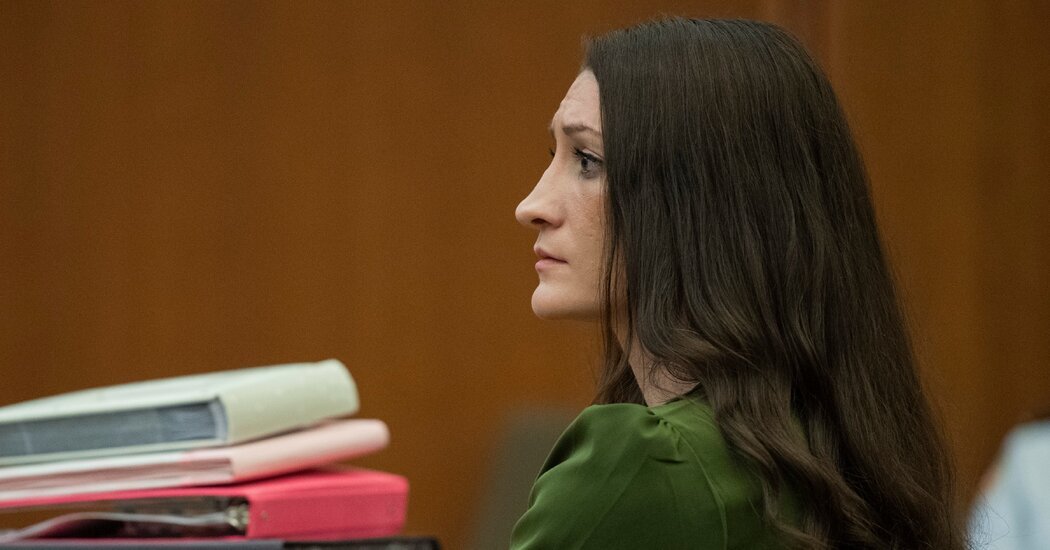
Tasha Kenney woke up at 4 a.m. on Thursday, donned a pink T-shirt and drove to the courthouse in Plymouth, Mass., to show support for Lindsay Clancy, the mother on trial for killing her three young children.
Ms. Kenney, a teacher who lives 90 minutes away, joined hundreds of other pink-clad women gathered on the courthouse lawn because she had suffered from severe postpartum depression after the birth of her daughter a decade ago. And she believes the Clancy children could have been saved if the warning signs had been heeded.
As Americans have been riveted by the televised trial of a woman accused of the most incomprehensible of crimes, the Clancy family’s tragedy has also become a case in point for all manner of perceived societal ills.
For many, it is evidence that the United States neglects new mothers and fails to properly care for maternal mental health. Others are outraged that the methodical killing of three innocents could be treated as anything other than murder. They see the nearly $1 million that has been donated to a fund for Ms. Clancy’s parents as evidence of “cultural rot.”
Jonathan Hatami, a child abuse prosecutor in Los Angeles County, said in an interview that he was disturbed that people seemed more worried about Ms. Clancy than the children — ages 5, 3 and 8 months — that she has admitted to having killed.
While there are important issues that need attention, he said, “We can’t be killing children and then say, ‘Oh, I’m happy now that mental health is being discussed.’”
Perhaps all the gnashing of teeth should come as no surprise. The question of how mothers who kill their children should be dealt with is perennially unsettled, and the Clancy case has been supercharged by cultural divides and clickbait.
“We can’t really look away,” said Michelle Oberman, a legal scholar who has studied cases of mothers who kill. “It is just stunning and epic, in the magnitude of loss and the unthinkability of the crime.”
Twenty-five years ago, the country was equally riveted by a strikingly similar case. Andrea Yates, who like Ms. Clancy was a nurse, drowned her five children in the bathtub. Like Ms. Clancy’s defense, Ms. Yates’s centered on the claim that she was suffering from profound psychosis.
Ms. Yates wanted to be executed because she believed that the Devil lived within her, her lawyer, George Parnham said on Thursday.
The jury found her guilty, but she was granted a new trial. The second jury acquitted her by reason of insanity.
Since then, mental illness has become less stigmatized, Ms. Oberman said. “We don’t think about people who struggle mentally as automatically just not tough enough, malingerers — just fakers — in the way that we might have 20, 30 years ago,” she said.
Voices across the political spectrum have taken it as a given that mental illness was a driving factor in the Clancy case, and should be weighed by the jury, though some complain Ms. Clancy’s supporters have conflated postpartum psychosis, a rare and severe condition, with far more common postpartum disorders like depression and anxiety.
But the office of the district attorney, Timothy Cruz, has taken the position that Ms. Clancy’s actions were “selfish” and “calculated.”
“In contrast to pictures you’ll see of the doting mother, the dedicated nurse, you’ll also see a side of Lindsay Clancy that’s different,” said Shanan Buckingham, the assistant district attorney who gave the opening statement. “Somebody extremely controlling, meticulous, and manipulative.”
Even as the stigma attached to mental illness has faded, the question of whether it diminishes culpability remains a subject of heated debate.
In cases of infanticide, the argument boils down to whether the crime is so heinous that insanity cannot excuse it, or so heinous that only insanity can explain it.
In the American legal system, experts say, the insanity defense has become progressively more difficult to use, but the international picture is quite different, at least for postpartum crimes.
Some three dozen countries offer juries an option between murder and insanity, one that recognizes the particular mental vulnerabilities that can arise after birth and sets a significantly lower penalty for mothers who kill an infant.
Several such laws have been proposed in the United States, but only one has passed, in Illinois in 2018.
A vocal contingent of Americans view the deaths of the Clancy children as a product not of individual depravity but of a broken medical system.
Hundreds of women have posted on social media about their own postpartum struggles, including impulses toward harming themselves or their infants. They have expressed empathy for Ms. Clancy, a labor and delivery nurse who repeatedly sought psychiatric help after giving birth to her third child.
Her husband, Patrick Clancy, who has divorced Ms. Clancy, has defended her and is suing the clinicians who treated her.
Allie Beth Stuckey, a conservative Christian commentator and a fan of Health Secretary Robert F. Kennedy Jr., told her viewers that she had a split reaction when she heard about the case.
She felt “immediate disgust and anger,” she said, but also a recognition of “how dark and how out-of-control for some women postpartum can be.”
Then she listed the 13 medications Ms. Clancy had been prescribed in the months leading up to the killing and their effects, adding: “This is what happens when you only listen to your doctor.”
Back on the courthouse lawn, Ms. Kenney said Ms. Clancy was clearly in a state of psychosis and should never have been charged with first-degree murder.
“I honestly feel like the way they treated her this entire trial was disgusting,” Ms. Kenney said.
The demonstrators on the lawn understood that the Clancy trial was not a process aimed at improving mental health outcomes for women. Renee Kimball, the organizer, said she still deals with the aftereffects of her own postpartum anxiety and depression, and could imagine herself ending up as Ms. Clancy did.
“It should not take tragedy for people to pay attention to mental health,” she said.
Megyn Kelly, the former Fox News host, has taken issue with the outpouring of support for Ms. Clancy. “Who are these soft people?” she asked on her YouTube show. “I don’t look at her and feel sorry for her. I realize she had a mental health crisis going on — three kids are dead!”
Such debates are but a sliver of the vast tranches of commentary on the Clancy case. The pundits include true-crime aficionados experimenting with blood trace patterns, domestic violence survivors who identify with Ms. Clancy despite a lack of evidence that she was abused and practitioners of something called forensic astrology. One alternate theory of the crime was illustrated using Bratz dolls and a shoe box.
What these commentators lack in rationality they make up for in energy and commitment, at a level that suggests they are more about mythic archetypes than criminal statutes.
One particularly active school of thought is devoted to the unsubstantiated notion that Mr. Clancy was actually the one responsible for the children’s deaths.
The Daily Wire, a right-wing website, has blamed this excess on liberals. The site has decried “The Wine Mom Delusion of Turning Real Murder Into Internet Content,” even as it used Ms. Clancy’s name in at least a dozen headlines of its own. (A sample: “Lindsay Clancy Defenders Are Just As Sick As She Is.”)
For a jury that must make a real-life assessment, acquitting someone by reason of insanity can be particularly agonizing because they may believe that doing so will result in the defendant’s freedom. In most jurisdictions, juries are not informed of the potential consequences of their decisions because they are supposed to base their verdict solely on the facts.
In the Yates case, Mr. Parnham, who is 85 and still consulting on cases, recalled that he told the jury: “You have to trust me that this will not happen ever again. Just trust me.” Ms. Yates, now 62, remains at the Kerrville State Hospital today.
For Ms. Clancy, an insanity finding would also mean indefinite commitment to a mental hospital. But Massachusetts is special in that juries there are likely to be informed of that fact, said Peter Elikann, a defense lawyer based in Boston.
Cases like the Yates and Clancy killings are rare, and it is hard to track any trends in their outcomes. A 2012 study of 34 cases in which a woman was charged with killing her baby found that insanity defenses were successful in almost half of them.
Ms. Clancy’s own story tracks the public’s slow reckoning with postpartum mental health concerns. Over a decade ago, when she joined the maternity ward staff at Massachusetts General Hospital, she had never heard of the bathtub drownings.
A co-worker testified that the subject had come up when a pregnant patient expressed an intention to harm herself. Ms. Clancy was bewildered.
“I asked her if she had ever heard of the Andrea Yates case, and she hadn’t, and I explained that to her, and she cried,” the co-worker, Margaret Hamp, recalled. “And she said, ‘How could a mother hurt her children?’”
Maya Shwayder contributed reporting. Kitty Bennett contributed research.