dailynewsnblog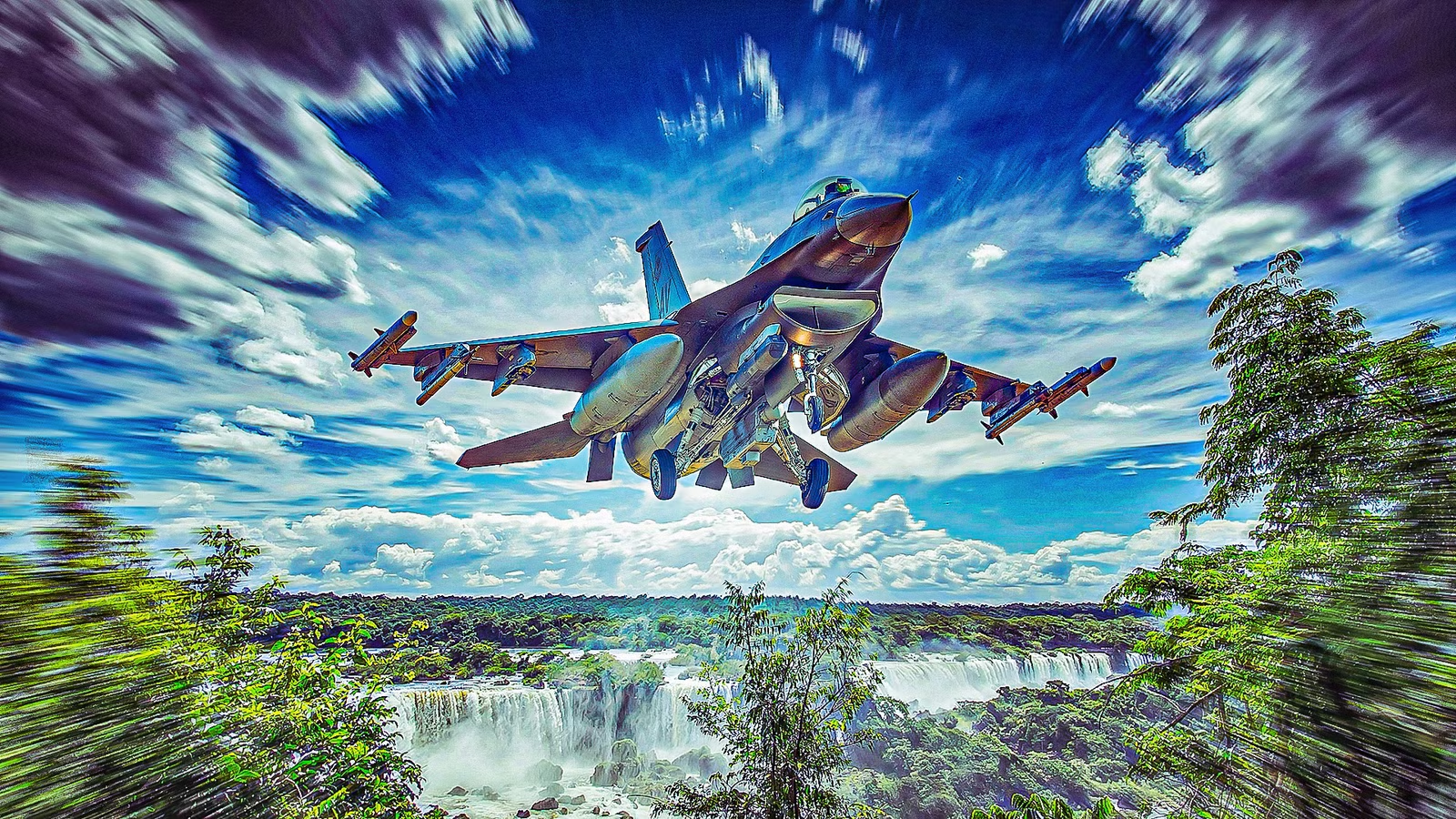
The Lockheed Martin F-16 Fighting Falcon, also known as the Viper, is no longer the premier lightweight fighter jet of the US Air Force, but it is far from irrelevant. As a much less expensive airframe than the more exquisite F-35 Lightning II, the Viper continues to roll off the assembly line. It is the most mass-produced supersonic fighter jet still in production today, with more than 4,500 examples having been delivered. Now, the existing fleet is also getting a major lethality upgrade in the form of the Northrop Grumman AN/APG-83 Scalable Agile Beam Radar.
This has unprecedented range and detection speed compared to the legacy sensors on older F-16 blocks. They also have a much larger target bandwidth that can allow pilots to track dozens of targets simultaneously and dramatically improve their situational awareness on the battlefield. The new radar is equally effective at both air-to-air and air-to-ground targeting to support multirole mission sets as required by the USAF and other international operators.
The new radar will also make it a much more valuable member of the joint ‘kill web’ as more and more exquisite next-gen platforms are part of the joint data network. Although this doesn’t change the fact that the Viper will never be more than a 4.5-gen airframe at best, considering its far lower price point and higher level of readiness in comparison to successor jets, that’s not a bad trade-off.
The F-16 Gets A New SABR

There are a number of key advantages of this radar that make the F-16 more relevant on the future battlefield. The low-cost and relatively simple upgrade process introduces new combat capabilities to the US fleet as well as others, which are currently struggling with technological delays to their F-35 fleet, intended to succeed the F-16. Lessons learned from the invasion of Ukraine by Russian forces, which began in 2022, as well as the 2026 operation Epic Fury, have shown that these threats are greater than ever to conventional air forces.
The hardware footprint of the SABR radar is designed to fit directly into the existing nose configuration of legacy F-16s without requiring expensive airframe modifications or altered cooling systems. It isolates and tracks tiny, low-flying, or slow-moving modern threats, like drones and cruise missiles that completely blind older radar arrays. The superiority of the new radar also makes it much more effective at tracking and targeting small, low-flying, or slow threats like drones and cruise missiles.
The system is also optimized for near-peer conflict, in which the F-16 is highly vulnerable to more advanced land and air base systems. It can track far more targets than the pilot will ever be able to engage, and has much greater jamming resistance thanks to superior frequency-hopping technology.
“Retrofitting F-16s with SABR replaces aging mechanical radars with a modern, fifth‑generation–derived AESA. The upgrade delivers longer detection ranges, more simultaneous tracks, high-resolution ground mapping, moving target indication and stronger resistance to jamming with lower radar emissions. The result is a sensor suite that matches today’s weapons, tactics and threat environment for U.S. and international F-16 operators.”
SABR simultaneously increases the total force while improving the F-16’s survivability. By sharing a massive amount of high-fidelity battlefield data with other joint forces, the Viper can pass off a target it can’t tackle on its own to another platform that can. In correspondence, the company commented on the aircraft.
“SABR’s real power and impact comes when its high-quality radar data is shared across tactical data links. By pushing precise tracks and targeting cues into the network, the F-16 becomes a fully connected node in the kill chain, enabling cooperative targeting, faster engagements and a more accurate common operational picture. That connectivity drives joint and coalition effectiveness far beyond the radar’s standalone performance.”
A Stopgap For 21st Century Air Power

The F-35 program has become notorious for delays and deficiencies under the Technology Refresh Three package that was intended to roll out a massive Block Four upgrade but has yet to be delivered. Expected in 2025 for the global fleet, most capabilities will not be available until 2029, and the full list of Joint Strike Fighter enhancements under Block 4 is not expected to mature until 2031. With the F-35 global fleet over 1,300 strong now, the capability gap that its low readiness levels are creating has become a critical issue for air forces around the world.
There are 20 nations, including the US, which now operate the F-35. The JSF directly replaced F-16s in many of these air forces around the world, and given its current deficiency, some have decided to delay the retirement of their Vipers. The upgrade from Northrop Grumman will provide a rapid means of making these F-16s relevant on the battlefield once again after they were sidelined by a successor that has yet to take up the mantle.
Northrop Grumman commented on the tactical advantages provided by the SABR upgrade.
“SABR functions as a key component within a broader family of systems we are focused on here at Northrop Grumman-including IVEWS and LITENING LA. We designed SABR for seamless integration across multiple platforms to deliver networked sensor fusion, cooperative targeting, and adaptable warfighter solutions that meet evolving modernization priorities. We are deeply invested in delivering next‑generation solutions that give the US military and our allies every advantage in an increasingly complex, rapidly evolving battlespace. We build these systems with the clear purpose of helping warfighters accomplish their missions and come home safely.”
For global militaries, this radar upgrade turns the F-16 into an insurance policy. Instead of keeping squadrons grounded or operating blind while waiting for Lockheed Martin to patch the F-35’s TR-3 architecture, they can rely on modernized F-16s that already possess near-peer electronic warfare resistance and cruise missile detection capabilities. It brings the F-16 back up from a vulnerable legacy asset into an indispensable, budget-friendly frontline fighter once again.
Catch what other flight trackers miss
Emergency squawks, holds, NOTAMs — live signals, no signup.
Open tracker
Catch what other flight trackers miss
Emergency squawks, holds, NOTAMs — live signals, no signup.
Open tracker
Northrop Grumman Delivers

The program delivered its 1,000th SABR radar in May of this year, according to Army Recognition. So far, the vast majority have gone into the Block 70/72 F-16 fighters of the US Air Force and Air National Guard. However, there have been several other international operators that have adopted the SABR radar. Taiwan fully retrofitted its legacy fleet of 130 F-16s, while South Korea and Singapore also followed suit.
Poland invested a massive $3.8 billion into a modernization program that transformed its entire fleet of 48 Block 52 aircraft. The SABR upgrade for these earlier iterations brought them up to the F-16V standard and represents a major air power enhancement for the nation. Under another major modernization program, Pakistan was approved by the US government for a $488 million foreign military sales contract to upgrade its fleet in May 2026. The PAF has between 75 and 85 examples of various F-16 variants, all of which would be significantly improved by the new AESA radar.
Greece and Turkey have also upgraded some of the older planes in their fleets, and others are still considering upgrades as well. Peru is exploring a multi-billion-dollar Block 70 program, and several Eastern European nations are looking at purchasing brand-new F-16s equipped with the Northrop Grumman SABR. This continued demand will keep the assembly line moving, reinforcing the Viper’s status as the most prolific fighter jet of the current era of air power.
The Viper’s Role In The Air Force Of The Future

The SABR radar is very important to the F-16’s role in the new Hi-Lo fleet mix that the US Air Force is assembling with the F-35 and the upcoming Next Generation Air Dominance. Alongside the Boeing F-47, which will be the first sixth-generation fighter jet ever produced, the USAF is also looking to acquire 1,000 collaborative combat aircraft. Also known as loyal wingman drones, these jets will fly alongside NGAD and every other aircraft in the joint battlespace to enhance the survivability and lethality of every other airframe.
Instead of being a low-tier filler aircraft that is sidelined by next-gen fighters in a near-peer conflict, the SABR-upgraded F-16 is a highly capable battle management node. Its radar makes it an excellent ‘quarterback’ for targeting and coordinating the CCA drones in more permissive airspace to support troops on the ground or other missions where advanced integrated air defense systems are not present. This frees up the ‘exquisite’ airframes to take down the most lethal threats in a joint air campaign over contested skies.
Northrop Grumman expanded on the force readiness enhancements delivered by the SABR radar package.
“With more than 1,000 SABR radars delivered worldwide, the system is proven, reliable and designed to reduce maintenance and increase aircraft availability. This directly enhances force readiness. Because SABR is software-upgradable, operators can quickly adapt radar modes and refine threat responses as adversaries evolve. It keeps fourth‑generation fleets combat-relevant against modern threats without requiring new aircraft.”
Autonomous drones will fly deep into dangerous territory to act as forward eyes. The F-16’s APG-83 radar has the high-speed data-processing capability to receive raw target tracks from multiple drones simultaneously and organize them into a unified cockpit display for the pilot. While the F-16 manages the airspace, the CCAs can perform aggressive electronic warfare jamming or act as kinetic decoys to protect the crewed fighter.
F-16: Linebacker On The Battlefield Of Tomorrow

When the F-47 enters service, it will be a highly advanced multispectral stealth fighter jet with Mach 2 performance and an arsenal that includes directed energy weapons, or lasers, as well as hypersonic missiles and the ability to command over half a dozen CCAs. The F-16 will still be in an important support role for this incredibly advanced airplane even as it becomes even more obsolete by comparison. Among its most important future missions will be managing the armada of CCAs being assembled by the USAF as it aims for 1,000 combat-ready units.
Two mature prototypes are moving into the low-rate production stage this year as the US Air Force approved both General Atomics’ FQ-42A Dark Merlin and Anduril’s FQ-44A Fury. Autonomy and artificial intelligence do not eliminate the need for a human in the loop for battlefield decisions and mission coordination. Because the Air Force splits drone autonomy software from the hardware, the AESA-equipped F-16, the F-35, and the F-47 all share the same modern threat database. The two aircraft can seamlessly exchange information instantaneously and even hand off loyal wingman drones on the fly.
Controlling multiple drones and analyzing massive swathes of quantum radar data strains a pilot’s ‘cognitive bandwidth.’ By equipping the F-16 with a 5th-generation radar, it can take over frontline scanning, data routing, and missile defense duties, freeing the F-47 to focus entirely on its deep-strike drone command missions. This means that the Viper remains an integral asset in the ‘kill web’ even decades into the future.