dailynewsnblog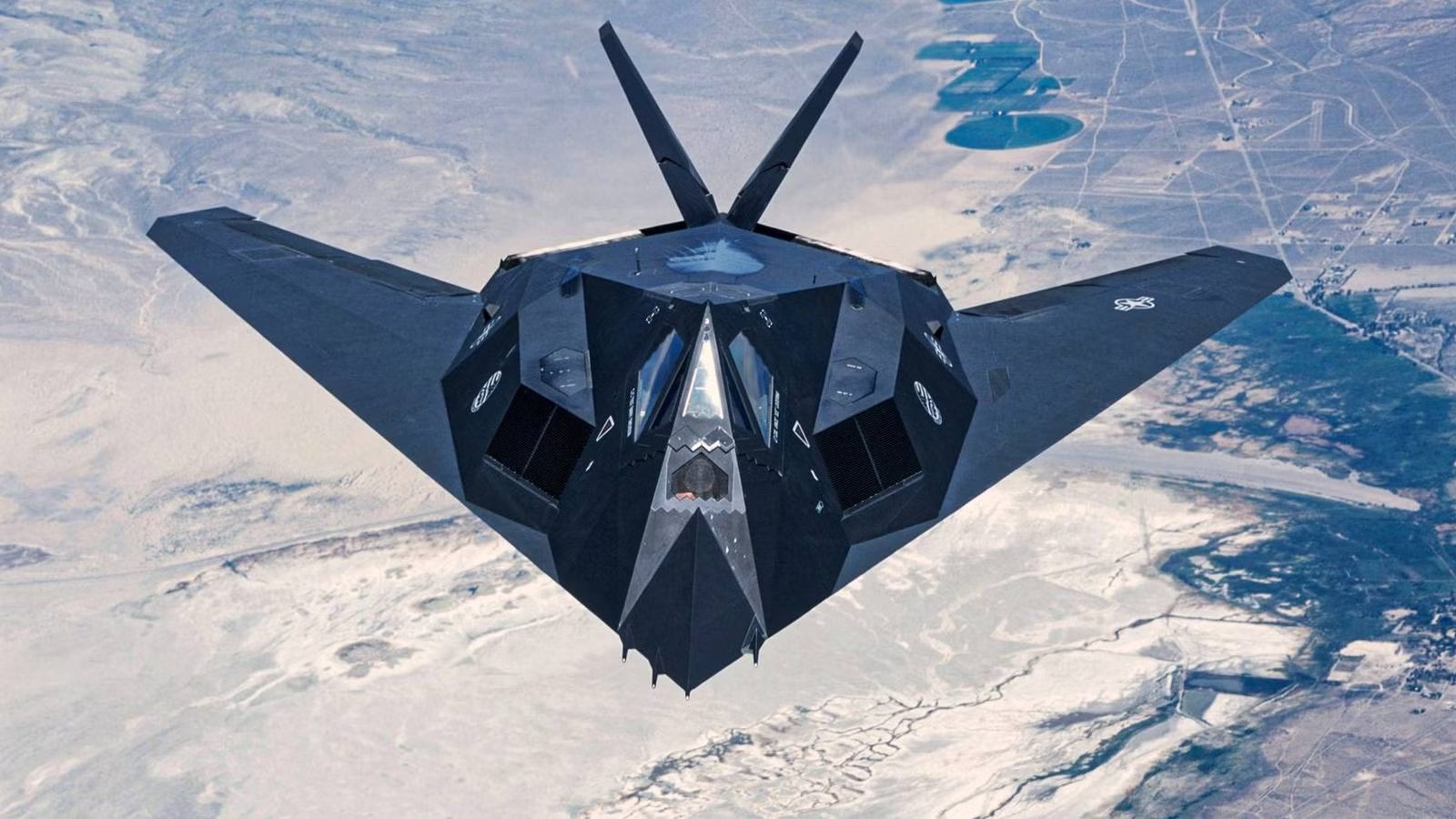
The Lockheed F-117 Nighthawk looks like a paper airplane folded by someone who had never seen a wing. Yet this bizarre-looking 65-foot-11-inch (20.1-meter) attack jet could return a radar echo of just 0.011 to 0.032 square feet (0.001 to 0.003 square meters), small enough to transform how far away a fire-control radar could detect it. The strange part is that the shape behind that result wasn’t the product of a futuristic computer designing the perfect stealth aircraft. It came from a much more restrictive set of calculations.
This article follows that shape from the drawing board to the battlefield. It explains what Lockheed’s engineers could actually compute, how flat panels turn a radar problem into a mirror problem, and which radar frequencies the design was built to defeat. It also covers what the facets cost the pilot, and why the physics that protected the Nighthawk over Baghdad in 1991 handed a Serbian missile crew an opening in 1999. The story starts with a Soviet physics paper and an early test model by its own designers called the Hopeless Diamond.
1970s Computers Forced Lockheed To Build A Jet From Flat Panels

According to Lockheed Martin, the F-117’s angular panels were deliberately positioned to send radar energy away from the transmitting radar rather than back toward it, with radar-absorbent material added to further reduce the return. But the decision to build the aircraft from flat panels came before stealth itself. Lockheed Martin’s history of Skunk Works innovation explains that, with the computers available in the 1970s, engineers could calculate radar reflections from flat surfaces far more reliably than from continuously curved, three-dimensional shapes. The F-117’s strange geometry was therefore as much a solution to a computing problem as it was a solution to a radar problem.
The mathematical breakthrough came from an unlikely source. Soviet physicist Pyotr Ufimtsev had published work on how radio waves scatter from flat shapes and their edges, research that was treated as academic in the Soviet Union. At Skunk Works, radar specialist Denys Overholser and mathematician Bill Schroeder turned Ufimtsev’s work into a computer program called Echo 1, which could predict the radar return from an aircraft made of flat triangles. That work led to the Have Blue demonstrator, of which Lockheed built two examples, each weighing roughly a quarter as much as the F-117.
HistoryNet’s account of the program notes that during outdoor testing, even a bird landing on a model caused its radar signature to bloom visibly, illustrating just how small the intended signature had become. The calculations gave Lockheed a way to design the shape on paper. The bigger question was whether that shape would work in the real world. Could an aircraft built from what were essentially radar mirrors actually become difficult for a radar to see, and just how much would those facets reduce its detectable range?
Flat Panels Turned A Radar Return Into A Miss

Think of a billiard ball hitting a cushion at an angle. It bounces away from the cue rather than straight back. Radar waves behave similarly when they hit a flat surface. A curved surface scatters energy in many directions, and some of it inevitably returns to the antenna. A flat panel, by contrast, reflects most of the energy in a more predictable direction. Tilt the panel correctly, and you can direct that energy toward the sky or the ground instead of back toward the radar.
That principle shaped the F-117. Its wing leading edges were swept 67.5 degrees, while the aircraft’s flat panels were carefully aligned to control where radar energy was reflected. Rather than producing a broad return, the shape concentrated the reflected energy into a few narrow spikes. The trade-off was that a radar positioned directly inside one of those spikes could still receive a brief, strong return. The goal was therefore not to make the aircraft invisible from every angle, but to make it extremely difficult for radar to detect and track from the angles that mattered.
The payoff becomes enormous once you run the numbers: A fighter in the McDonnell Douglas F-15 class is estimated to have a radar cross-section of 108 to 270 square feet (10 to 25 square meters). The F-117, meanwhile, is credited with about 0.032 square feet (0.003 square meters) in a 2019 Air Force Magazine infographic, while other estimates put the figure closer to 0.011 square feet (0.001 square meters). These figures normally describe the aircraft from a particular angle, typically head-on, so they are better treated as indicators than absolute values.
It also helps to remember what Air Force Materiel Command stresses in its F-117 history: the aircraft was never 100% invisible, although its shaping and coatings greatly reduced its radar cross-section. There is one important catch: different frequency bands interact differently with an aircraft’s shape and materials, so the F-117’s carefully calculated signature depended on what kind of radar was looking for it. So, which radars did Lockheed actually design the F-117 to elude?
The Nighthawk Was Built To Evade 1980s Fire-Control Radars

The threat Lockheed primarily worried about was the fire-control radar: the system responsible for tracking an aircraft accurately enough to support a missile engagement, whether mounted on a fighter or paired with a surface-to-air missile battery. Many of the relevant radars operate in the X-band, roughly 8 to 12 GHz, with wavelengths of just 1.0 to 1.5 inches (2.5 to 3.75 cm). That wavelength is tiny compared with a panel several feet across. To the radar wave, the panel therefore presents a large, flat surface with a well-defined angle, allowing the F-117’s designers to control where much of the incoming energy was reflected. This was the frequency range in which the aircraft’s faceted shaping provided its greatest advantage.
Lower frequencies follow different rules. Early-warning radars operating in the L-band and VHF use wavelengths measured in inches and, at the lower end, feet. Some of those wavelengths were large enough to become a significant fraction of the F-117’s 43-foot, 4-inch (13.2-meter) wingspan. At those scales, the aircraft’s overall dimensions and electrical characteristics mattered more, reducing the advantage provided by its shaping and radar-absorbing materials.
Band | Frequency | Wavelength | Effect on the F-117 |
X–band | 8-12 GHz | 1.0-1.5 inches (2.5-3.75 cm) | Optimal range for wavelength scattering. |
L–band | 1-2 GHz | 6-12 inches (15-30 cm) | Shaping still helps, but at certain angles and with a thinner margin. |
VHF | About 150 MHz | About 6 feet, 6 inches (2 meters) | Wavelength is comparable to the aircraft dimensions: shaping and coatings lose much of their benefit. |
In the 1980s, that limitation was considered an acceptable part of the design. Large, low-frequency radars could indicate that an aircraft was present, but their lower resolution made them less suitable for the precise tracking needed to guide a missile. Soviet-style air-defense networks combined different types of radar, however, so the challenge was not simply whether a low-frequency radar could detect the F-117. That was only one side of the F-117’s design challenge. Reducing the aircraft’s radar signature was one problem; building an operational jet around that requirement was another.
The Faceted Shape Came At A Cost For The Pilot

Lockheed Martin’s Skunk Works history states that the F-117’s shape brought aerodynamic instability, and that the aircraft needed fly-by-wire flight controls to be manageable. The F-117 used a flight-control system based on the General DynamicsF-16, including its flight-control hardware, but the control laws were developed specifically for the Nighthawk. The computers constantly corrected an aircraft that was deliberately shaped with little regard for conventional aerodynamic efficiency, earning the F-117 the nickname “Wobblin’ Goblin” among its crew.
Pilots also had to fly gently: F-117 pilot Greg Feest, who dropped the first bomb on Operation Desert Storm, told National Security Journal that any turn changed the aircraft’s radar cross-section, so crews avoided excessive maneuvering. Everything else bent to the radar signature as well. Power came from two non-afterburning General Electric F404 turbofans, buried in the behind-screened intakes that keep radar waves away from the fan blades, and flat exhaust slots that spread the hot gas to cut the heat signature.
The jet topped out at Mach 0.92 and carried just two bombs, inside an internal bay, because any external store would negatively affect the radar cross-section. By the time Northrop built the B-2 Spirit Bomber, the constraints had eased: Simple Flying’s look at why the B-2 Spirit has such a flat architecture explains how designers aligned edges and surfaces, so radar waves can be scattered sideways or absorbed, an approach far more refined than the F-117’s simple facets. The F-117 accepted compromises in stability, maneuverability, propulsion, and weapons carriage to protect the radar signature. Whether those compromises were worthwhile depended on what happened inside the defended airspace. Iraq provided one answer, but Yugoslavia provided another.
The Faceted Gamble Worked In Combat – Until March 27, 1999

Over Iraq, the Nighthawk design worked spectacularly. Air Force figures cited by PBS Frontline show that 42 F-117s were deployed, just 2.5% of the allied fighter and attack aircraft, yet they logged nearly 1,300 combat sorties and struck close to 40% of the strategic targets. On the opening night, January 17, 1991, they hit Baghdad’s command-and-control sites in some of the most heavily defended airspace on the planet, and not a single one was lost.
Eight years later, the aura cracked. On March 27, 1999, the third night of NATO’s Operation Allied Force, a Yugoslav crew under Colonel Zoltán Dani shot down an F-117 flying as Vega 31, using an S-125 missile whose design dated back to the early 1960s. The Aviation Geek Club’s analysis says NATO had flown the same routes repeatedly, that the crew’s VHF P-18 “Spoon Rest D” early-warning radar could pick up an F-117 at short range when set to its lowest frequency, although it could not provide targeting-quality data, and that the job of the SAM’s fire-control radar was facilitated by the lack of the Grumman EA-6B Prowler and catching the F-117 with the bomb bay open. Defence Aviation reports the jet was only about eight miles (13 km) away when it was hit. Pilot Dale Zelko ejected and was rescued.
Physics and tactics had caught up with a shape frozen by 1970s mathematics. Designers now faced a different problem: how to keep the radar waves scattering without building an airplane out of reflective panels.
How Modern Stealth Left The Facets Behind

Once computers could handle curves, the flat panels disappeared. Modern stealth jets blend their surfaces smoothly and hide almost everything inside. Simple Flying’s breakdown of the design choices behind the Lockheed Martin F-22 Raptor and F-35 notes that the Raptor’s four external pylons exist mainly for ferry flights and fuel tanks, since using them operationally would compromise its low-observable profile. It is the same principle that limited the Nighthawk’s load to two internal bombs.
The next test is the F-47. In March 2025, the United States Air Force awarded  Boeing a $20 billion Engineering and Manufacturing Development contract for it, beating Lockheed Martin, as Simple Flying reported on the F-47’s rise from a classified test flight to a contract. What will decide if it succeeds where the Nighthawk stumbled is how it behaves across wavelengths the F-117 could never evade. Sixth-generation programs are chasing broadband, all-aspect low observability rather than a single lucky number. The Nighthawk’s real lesson is that stealth is a race between shape and wavelength, and no shape wins every lap. Lockheed Martin describes the F-117 as nearly invisible to radar, while the Air Force’s own history is blunter and says it never was. Both statements are true, and the space between them is the same where Colonel Dani operated.