dailynewsnblog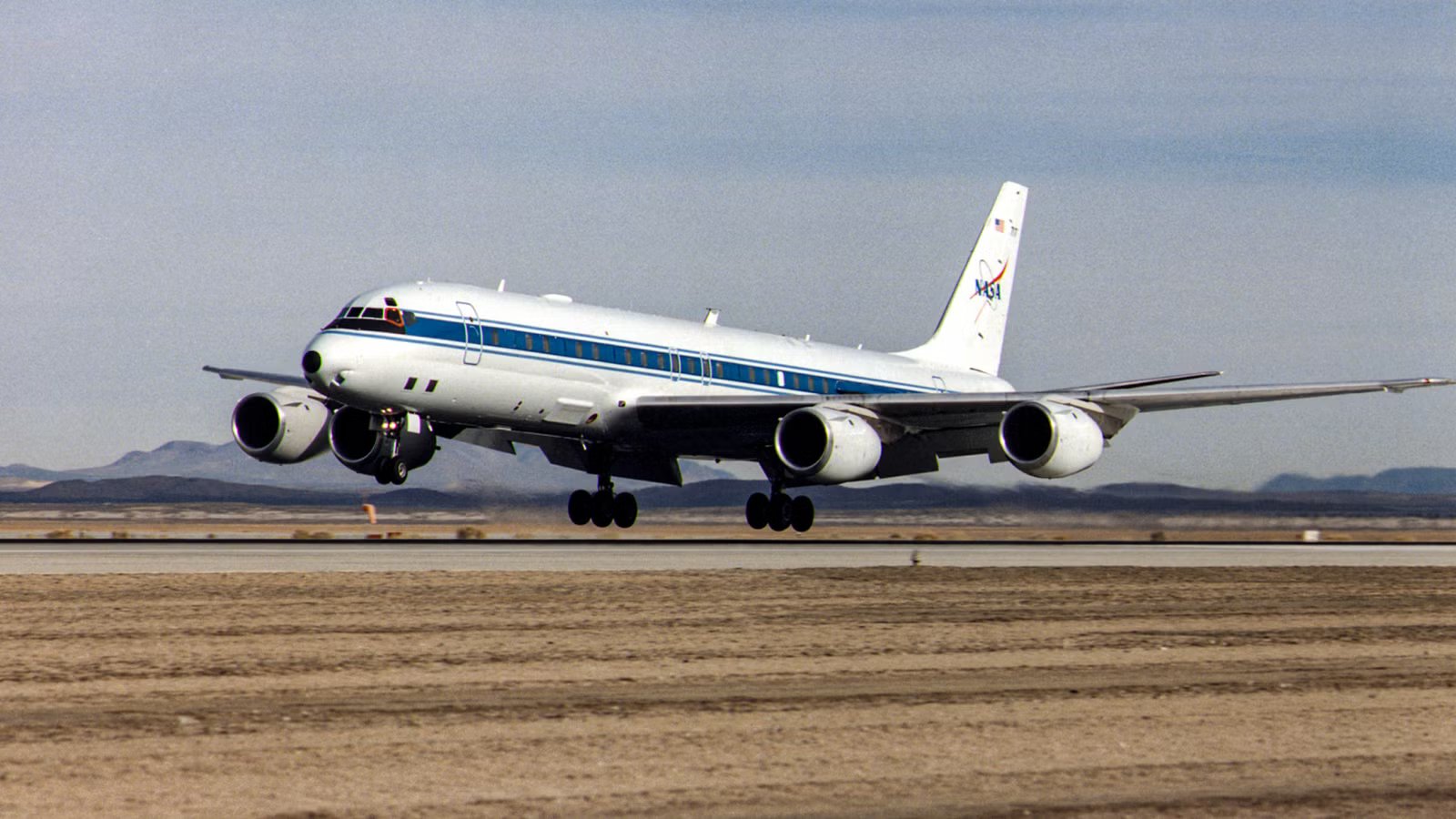
When Samaritan’s Purse retired its McDonnell Douglas DC-8 freighter N782SP after a final humanitarian mission to Jamaica in late 2025, aviation lost more than just another aging cargo aircraft. The retirement marked the near-complete end of the first-generation jetliner era, a period when four-engine aircraft symbolized the future of global aviation. Built on December 24 in 1968, the aircraft accumulated nearly 99,000 flight hours across a 57-year lifespan.
Its career included service with Finnair, the French Air Force, and eventually one of the world’s best-known humanitarian organizations. Instead of heading for the scrapyard, the jet now lives on as a static display and educational platform at Liberty University. What makes the DC-8 story remarkable is not nostalgia, but survival. While its rival, the Boeing 707, largely disappeared from civilian skies decades ago, the DC-8 continued hauling cargo well into the 2020s.
The reasons were deeply technical: an overbuilt airframe, extraordinary structural durability, and one of the most successful re-engining programs in aviation history. In many ways, the DC-8 became the ultimate example of how smart engineering and adaptability can extend the life of an aircraft far beyond what its designers ever imagined.
The Rivalry That Defined The Early Jet Age

The DC-8 emerged during one of the most competitive periods in aviation history. In the late 1950s, aircraft manufacturers raced to dominate the rapidly expanding jet travel market across the world. Boeing launched the 707 first, establishing an early advantage with airlines eager to modernize their fleets. Douglas responded with the DC-8, entering service in 1959 as a direct competitor in the long-haul jetliner market.
Although the two aircraft appeared similar at first glance, they reflected different engineering philosophies. Boeing focused heavily on commercial momentum and rapid airline adoption, while Douglas emphasized structural robustness and long-term operational reliability. Airlines ultimately favored the 707 in greater numbers, giving Boeing a decisive commercial victory during the passenger jet boom of the 1960s.
However, the story changed dramatically decades later. While the 707 rapidly disappeared from civilian service, the DC-8 continued flying cargo operations across the world. What initially looked like a commercial defeat for Douglas gradually evolved into one of aviation’s most unexpected endurance stories.
Why The DC-8 Was Exceptionally Durable

One of the biggest reasons for the DC-8’s longevity was its incredibly strong structure. The aircraft was engineered during an era when manufacturers still lacked extensive long-term fatigue data for jetliners. As a result, Douglas engineers designed the airframe with significant structural margins and conservative safety tolerances.
That overbuilt design became a major advantage later in life. Cargo operations place enormous stress on aircraft through repeated loading cycles, high utilization rates, and frequent takeoffs and landings. The DC-8 handled these demands exceptionally well, allowing operators to keep the aircraft economically viable long after passenger airlines retired them.
Maintenance crews also appreciated the aircraft’s relatively straightforward systems and accessibility. Compared to newer jets filled with increasingly complex electronics, the DC-8 remained comparatively simple to maintain and repair. For cargo carriers and humanitarian operators, reliability and serviceability often matter more than cutting-edge technology.
The Most Influential Airliner Ever Built: Inside The Boeing 707
A deep dive into the Boeing 707.
The CFM56 Engines Changed Everything

The true turning point for the DC-8 came in the late 1970s, as tightening international aircraft noise regulations began reshaping global aviation. Airports across Europe and North America increasingly restricted first-generation jetliners because of their high noise footprints, particularly during takeoff and climb-out phases. At the same time, fuel prices were rising sharply after the oil crisis, exposing another structural weakness in early jet design.
Specifically, these aircraft were built for performance in an era when fuel was cheap, not for efficiency in a world that was becoming increasingly cost-conscious and environmentally conscious. Without a major intervention, the DC-8 would likely have been phased out, out alongside many of its contemporaries. The response was the ‘Super 70’ conversion program, which was one of the most significant retrofit efforts ever applied to a commercial airliner.
This program replaced the DC-8’s original engines with modern CFM56 high-bypass turbofans, fundamentally transforming its acoustic and performance profile. The difference was immediately noticeable: noise levels dropped dramatically, fuel efficiency improved substantially, and the aircraft became compliant with evolving international airport standards. The DC-8 went from being a restricted legacy jet to a viable operator in a modern regulatory environment simply by changing its propulsion system.
This modernization effectively gave the aircraft a second life. The DC-8-70 series that emerged from the program burned significantly less fuel, required fewer operational compromises, and gained access to airports that had previously restricted operations for older jets. For cargo operators in particular, these improvements were transformative because freight economics depend heavily on both fuel costs and regulatory flexibility. The Super 70 program didn’t just extend the DC-8’s lifespan: it redefined its role.
Why The Boeing 707 Couldn’t Keep Up

Ironically, Boeing explored a similar re-engining path for the 707. In 1979, it flight-tested a modified version known as the 707-700 equipped with CFM56 high-bypass turbofan engines, aiming to bring the aircraft in line with emerging noise and efficiency standards. The results proved that the concept was technically viable, with dramatic reductions in noise and fuel burn compared to the original configuration.
However, despite the engineering success, Boeing ultimately chose not to proceed with full-scale commercialization of the upgrade program. The decision was driven largely by strategy rather than performance. At the time, Boeing was heavily committed to developing its next-generation narrow and wide-body aircraft, including the 757 and 767, which represented the future of its commercial lineup.
A modernized 707 risked prolonging the life of an older platform that could compete internally with these newer, more profitable designs. In contrast, Douglas had fewer competing priorities and a greater incentive to extend the DC-8’s life, making the Super 70 program a central part of its survival strategy. The DC-8 also held a subtle but important physical advantage that made its conversion more practical. Its main landing gear sat higher relative to the wing and fuselage.
This provided better ground clearance for the larger-diameter CFM56 engines. This reduced the amount of structural modification required when compared to the 707, lowering engineering complexity and overall conversion cost. In the end, this seemingly small design difference helped tip the balance in favor of the DC-8, allowing it to successfully transition into a long-lived, economically viable cargo aircraft while its rival faded from the skies.
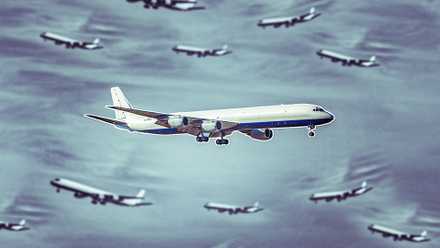
The Last Douglas DC-8s Still Airworthy
The early long-range narrowbody jetliner is on its last legs.
How Cargo Operators Kept The DC-8 Alive

As passenger airlines transitioned to newer twin-engine jets, cargo carriers discovered the DC-8 still had enormous value. The stretched Series 60 variants offered excellent cargo volume, and the upgraded engines kept operating costs manageable. For freight operators, acquiring older DC-8s was often far cheaper than purchasing brand-new aircraft.
Companies such as United Parcel Service and Air Transport International used the aircraft extensively during the 1980s and 1990s. The DC-8 became particularly popular for routes where acquisition cost mattered more than maximum fuel efficiency. Even as aviation technology advanced, the aircraft continued proving itself as a reliable workhorse.
Humanitarian organization Samaritan’s Purse gave the aircraft one of its most meaningful final chapters. After being rescued from storage in Roswell in 2015, N782SP flew more than 200 relief missions worldwide, transporting millions of pounds of humanitarian cargo into disaster zones and crisis areas.
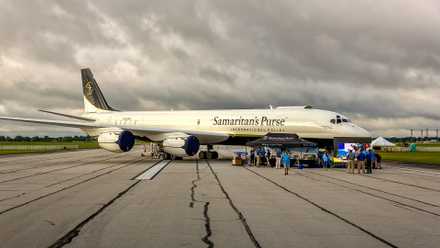
This Airline Just Retired The Last US DC-8
Decades of service: The incredible journey of a humanitarian hero.
The Final Flight For The DC-8

By the 2020s, the Douglas DC-8 had become a true aviation rarity. Most surviving examples had already been retired, dismantled, or placed in museums, making N782SP unusual not only because it was still flying, but because it continued carrying out demanding humanitarian missions around the world.
More than 50 years after entering service, the aircraft was still transporting relief supplies, medical equipment, and emergency cargo into disaster zones, a role few would have imagined for a jetliner designed in the 1950s. N782SP’s final retirement in late 2025 marked the end of an important chapter in aviation history. Samaritan’s Purse replaced the aircraft with a Boeing 767-300F, a far more efficient twin-engine freighter capable of carrying larger payloads with lower fuel and maintenance costs.
Still, the DC-8 leaves behind an extraordinary legacy. It outlived nearly every aircraft of its generation through a combination of structural durability, successful modernization, and adaptability to cargo operations. More than just an aging airliner, the DC-8 became proof that strong engineering and smart upgrades can keep an aircraft relevant for decades beyond its original design life.
Catch what other trackers miss
Emergency squawks, holds, NOTAMs — live signals, no signup.
Open tracker
Catch what other trackers miss
Emergency squawks, holds, NOTAMs — live signals, no signup.
Open tracker