dailynewsnblog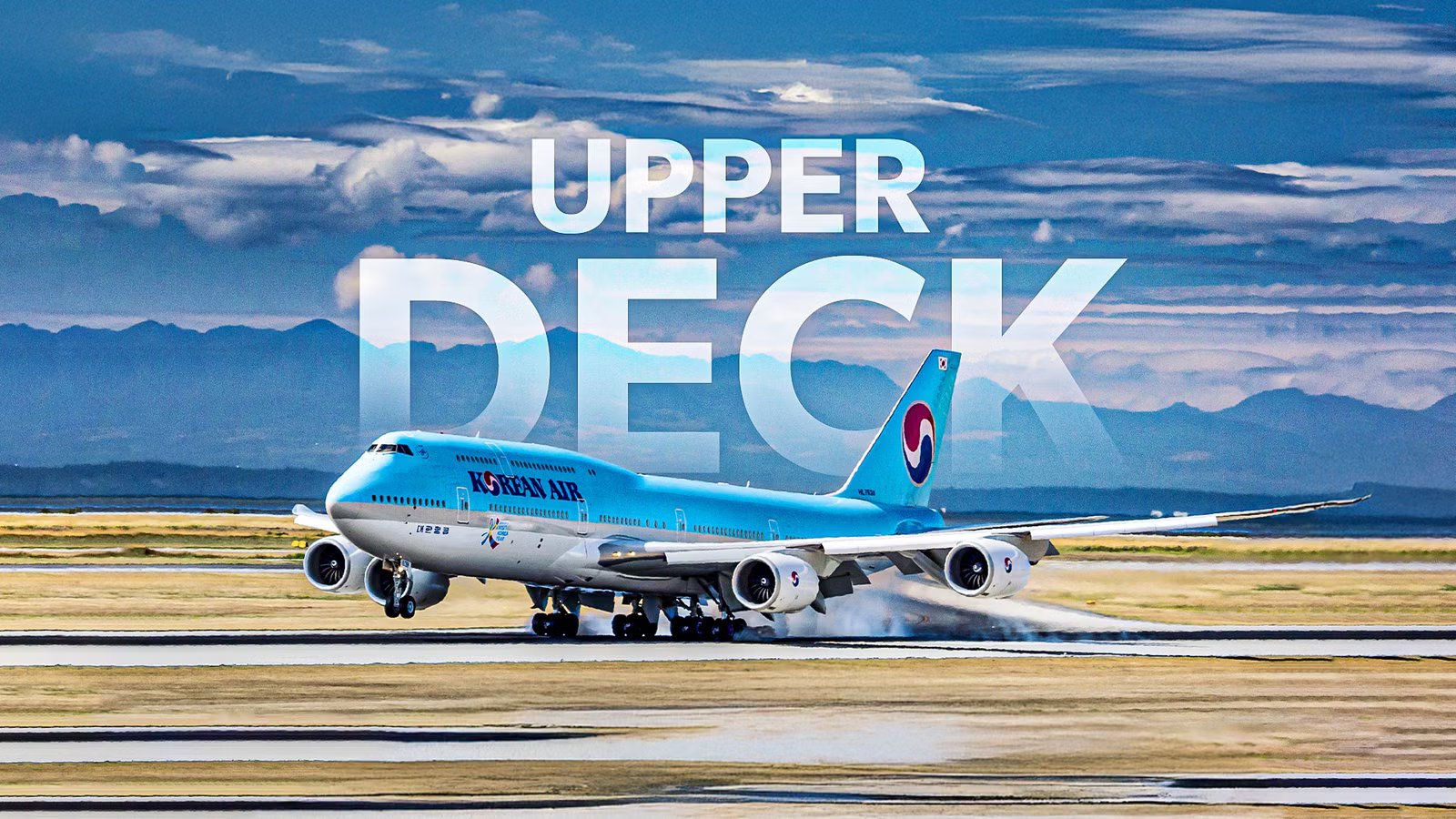
The upper deck hump of the Boeing 747 is one of commercial aviation’s most recognizable shapes. Even outside aviation circles, people know the silhouette: the cockpit perched high above the nose, the roofline rising before flowing back into the fuselage. The upper deck hump made the jumbo jet feel special in a way few airliners ever have. Yet for all its fame, no modern passenger jet has seriously tried to recreate it.
That is because the hump was never really about style. It was born from a specific set of priorities that made sense when Boeing launched the 747 in the 1960s: freight flexibility, the possibility of nose loading, the economics of a very large four-engine aircraft, and an airline industry centered on giant hub-to-hub flows.
Modern jets are built for a different world. They are sold on fuel burn, operating cost, range flexibility, and clean-sheet efficiency. In that world, a hump is not impossible to draw. It is just extremely difficult to justify.
The Hump Was Built For Freight

The 747’s upper deck exists because  Boeing wanted the aircraft to serve a dual purpose as both a passenger aircraft and a freighter. The distinctive profile originated in the early 1960s when the US Air Force issued requirements for the CX-HLS (Cargo Experimental, Heavy Logistics System): a military transport with a 180,000-pound load capacity, 5,000-nautical-mile range, and a speed of Mach 0.75. Boeing submitted a bid for this contract — and lost to Lockheed Martin, whose design became the C-5 Galaxy.
But the engineering work wasn’t wasted. Boeing carried the nose door and raised cockpit concepts directly over to the design of the 747. In order to optimize the 747 for cargo duties, Boeing gave the aircraft a nose that could open upwards for easy cargo loading and unloading, and since the cockpit could not be split in half to accommodate a swing-nose door, it was placed in a raised pod on an upper deck behind the nose, creating the iconic hump.
That made perfect sense at the time. Boeing and its airline customers believed the 747 might spend much of its life hauling freight, especially if supersonic aircraft took over premium long-haul passenger flying. As it turned out, Boeing would go on to produce over 1,500 examples of the 747, which has flown for nearly 60 years. But that is the first reason the idea is so hard to repeat today. Modern widebodies are not built around the expectation of nose-loading freight capability, and without that original requirement, the logic for moving the cockpit upstairs becomes much weaker.
How A Workaround Became An Icon

What Boeing did brilliantly was turn that compromise into something airlines could sell. Once the cockpit moved upward, the space behind it became usable cabin real estate. On early 747s, that often meant lounge space, and later, premium seating. Over time, the hump ceased to look like an engineering compromise and started to look like the most exclusive part of the aircraft. That transformation is a big reason the 747 became so beloved.
The important thing is that the hump was never a full second deck. It sat in a sweet spot: large enough to be useful, small enough to remain manageable, and striking enough to define the airplane’s image. Boeing then stretched that upper deck across later variants, making it progressively more valuable. In other words, the hump worked due to the fact that Boeing found ways to monetize the shape without turning the 747 into a full double-deck certification headache. The table below shows how that evolution played out.
Variant | Upper Deck Length | Notes |
|---|---|---|
747-100; 747-200 | 20 ft / 6.1 m | Originally produced with three windows for a lounge, but later expanded to ten for premium seating. |
747-100/200 SUD |
43 ft / 13.1 m | First stretch of the upper deck for 14 examples that would fly for KLM, Japan Airlines and UTA |
747SP | 39 ft / 11.9 m | The upper deck was stretched proportionately to the shortened fuselage. |
747-300 | 43 ft / 13.1 m | The SUD becomes a standard feature with the -300 series, and includes exit doors. |
747-400 | 54 ft / 16.5 m | A further stretch of the upper deck to increase passenger capacity. |
747-8I | 73 ft / 22.2 m | The longest upper deck, which now had grown to a total of 24 windows. |
The key takeaway is that Boeing really created three hump eras: the original short upper deck, the stretched upper deck introduced on later classics and carried through the 747-400, and the 747-8I’s longest-ever passenger upper deck. In each instance, Boeing was taking a suboptimal design for passenger aircraft and executing a trade-off to create more seating space. But eventually, that trade-off ran out.
Modern Jets Chase Cleaner Shapes

Modern widebodies are designed around a very different philosophy. Boeing and Airbus now sell aircraft based on fuel burn, operating costs, range flexibility, and network economics. That matters because a hump is not just a visual flourish. It means extra structure, more wetted area (the surface in contact with the airflow), more contour changes, and more complexity. All of these things are much harder to justify in an era when efficiency is king.
To illustrate the point, let’s take the Boeing 747-400 is the best benchmark, as it was the definitive passenger jumbo for most airlines and became the backbone of long-haul fleets across the world. It is also the version that most carriers eventually replaced with today’s large twinjets. When you compare modern aircraft against the 747-400, the direction of travel becomes obvious: airlines have gained huge fuel-burn improvements without needing the 747’s unusual architecture.
Aircraft | Fuel Consumption | Advantage vs 747-400 |
|---|---|---|
Boeing 747-400 | 3.24 L/100 km per seat | baseline |
Airbus A330-300 | 2.98 L/100 km per seat | 8.0% lower |
Boeing 777-300ER | 2.90 L/100 km per seat | 10.5% lower |
Airbus A330-900 | 2.42 L/100 km per seat | 25.3% lower |
Boeing 777-9 | 2.41 L/100 km per seat | 25.6% lower |
Airbus A350-900 | 2.39 L/100 km per seat | 26.2% lower |
Boeing 787-9 | 2.31 L/100 km per seat | 28.7% lower |
The first twinjets, culminating in the Airbus A330-300 and Boeing 777-300ER, already delivered significant savings over the 747-400. But when the next generation came along, the combination of aircraft design and newer engines delivered fuel savings of 25% or more in every case. To put that in context, a flight from New York (JFK) to Tokyo (HND) with a Boeing 787-9 versus a 747-400 will save approximately $100,000, or approximately $340 per seat.
Clearly, an upper deck hump no longer fits in this world. It adds structural weight, aerodynamic complexity, and design compromises that would need to be repaid by a very clear revenue or operational advantage. On a giant four-engine flagship in the 1970s and 1980s, those penalties could be absorbed. On a modern long-haul twin designed to beat the 747-400 decisively on economics, they are much harder to defend. That is why today’s replacements look cleaner, smoother, and more ruthlessly optimized.
Upper Decks Bring Certification Pain

There is another major obstacle: certification. Once there is meaningful passenger space on an upper deck, evacuation gets more complicated. US transport-aircraft rules require rapid emergency evacuation capability, and regulators pay extremely close attention to passenger movement, exit ratings, stairways, and flows between levels. That matters because a hump is not just an exterior shape. It creates a vertical cabin architecture.
The 747’s hump worked partly because it stayed limited. FAA special conditions for the 747-8 upper deck capped occupancy at 110 passengers with one pair of Type A exits. Reduce the exit rating and the allowable passenger count drops sharply. That is an important clue to why the hump was so effective: it was big enough to be useful, but not so big that it became an evacuation nightmare.
Exit type | How big it is | Seat limit per exit | Where you’d usually see it |
|---|---|---|---|
Type A | Very large floor-level door | 110 | Main doors on large widebodies like the 747, 777, 787, A350, and A380 |
Type B | Narrower floor-level door | 75 | Less common on today’s mainline long-haul jets |
Type C | Mid-size floor-level door | 55 | Smaller main-cabin door arrangements |
Type I | Smaller floor-level door | 45 | Smaller transport aircraft and some older jet layouts |
Type II | Small floor-level or overwing exit | 40 | Smaller aircraft layouts |
Type III | Overwing exit | 35 | Common on narrowbodies |
Type IV | Small overwing hatch | 9 | Regional and smaller aircraft |
The A380 shows what happens when you go much further. A true full-length upper deck demands heavier certification logic, including multiple stairways and more demanding passenger-flow assumptions. That is why the 747 sat in such a useful middle ground. It had some of the benefits of going upstairs without triggering the full penalties of becoming a true double-decker. However, Boeing today would not be willing to go through the certification of a new upper deck design when it’s neither warranted nor demanded by its airline customers.
Airlines Don’t Need It Now
-Boeing-747-436-G-CIVI.JPG?q=49&fit=crop&w=500&dpr=2)
Even if a hump could be made to work technically, the airline market has moved on. The 747 was born in the age of giant hub-and-spoke flying, when airlines expected very large aircraft to dominate long-haul trunk routes. Today, carriers value flexibility far more: thinner long-haul markets, more nonstop city pairs, lower trip risk, and simpler fleet planning. That is exactly why aircraft like the 787 and A350 have become the standard-bearers for modern long-haul flying.
The shift becomes especially clear when you look at some of the former 747-400 giants that never moved into the 747-8 passenger market.  British Airways was the largest 747-400 operator, but chose the 777 as its replacement.
  United Airlines operated its 747-400s until 2017, but since then has been leaning into the 787, and currently operates all three of the variants. Indeed, the only airlines that did move from the -400 to the Boeing 787-8 were
  Lufthansa, Korean Air, and
  Air China.
Airline | 747-400s Operated | Widebody Twins Today | Widebody Twins On Order |
|---|---|---|---|
British Airways | 57 | 119 | 68 |
United Airlines | 44 | 166 | 115 |
Singapore Airlines | 43 | 91 | 34 |
Qantas | 36 | 32 | 25 |
Japan Airlines | 36 | 82 | 33 |
That is perhaps the most telling point in the whole story. Airlines did not merely retire the 747-400. They replaced its mission with simpler, more efficient aircraft families. The hump was iconic, but the market decided it no longer needed what the hump represented.
A Solution For Another Era

The 747 hump is what made the aircraft so brilliant. It was not just beautiful, and it was not simply a premium-cabin flourish. It solved several problems at once: preserving nose-loading cargo utility, giving Boeing extra usable cabin space, creating an upstairs premium halo, and doing so in a way that fit the economics of its era. Great engineering often looks elegant in hindsight because it solved multiple challenges at once. The 747’s hump did exactly that.
But great ideas in aviation are often trapped by the conditions that make them rational. The industry that created the 747 was willing to accept architectural drama because the airplane’s freight logic, jumbo scale, and market role made it worthwhile. The industry that buys widebodies today wants lower fuel burn, cleaner aerodynamics, lower trip risk, and fleet flexibility. Those priorities do not leave any room for a hump.
That is why the 747’s hump will be nearly impossible to replicate in a modern jet. Not because engineers have forgotten how to create a distinctive silhouette, and not because regulators would refuse the concept outright, but because the hump no longer answers the right question. It was the perfect solution for a bygone era.