dailynewsnblog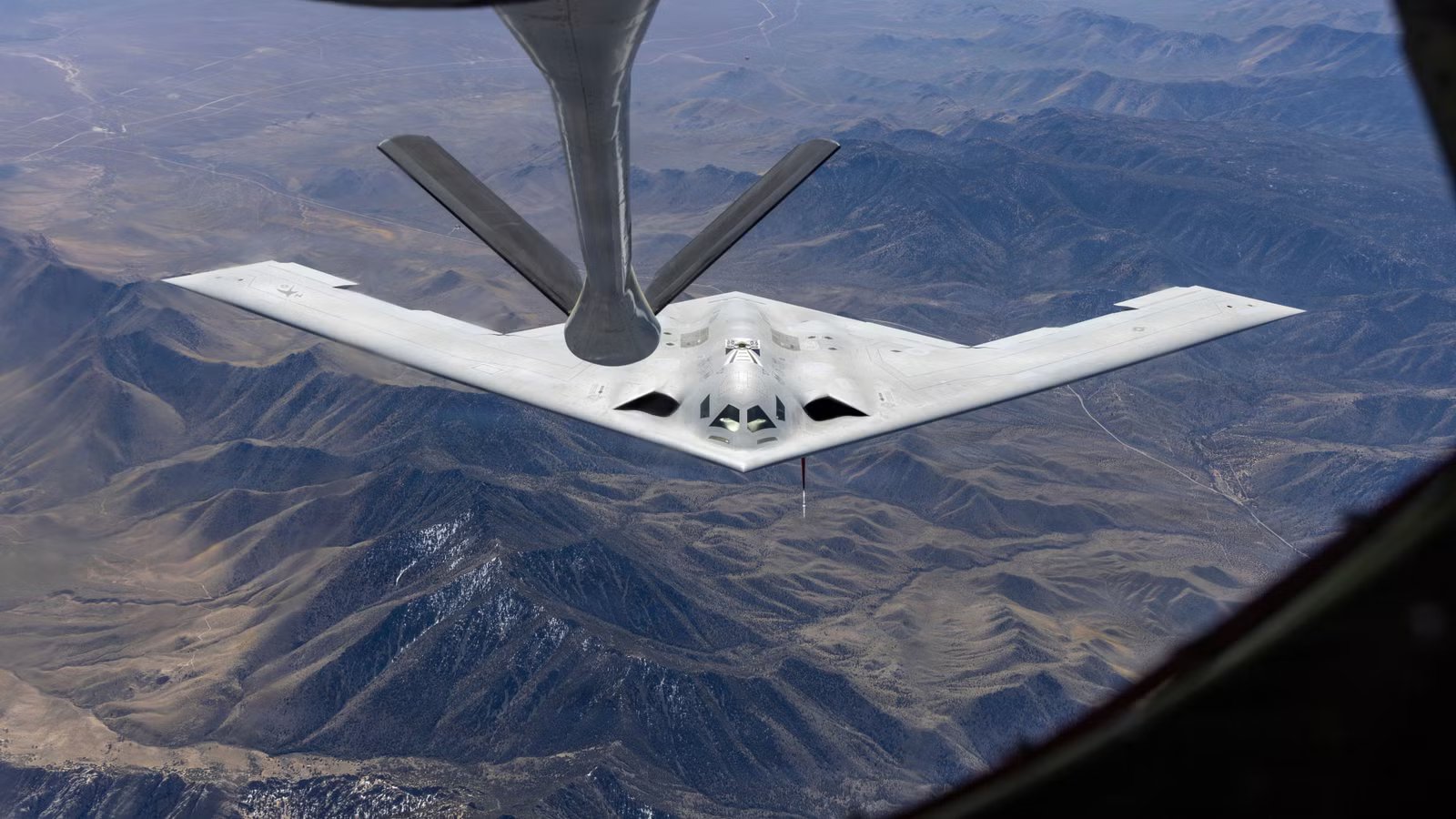
While it may be counterintuitive for many, the best tool for a job is not necessarily the most advanced or high-tech. For the US Air Force, the best aircraft is likely to be a consideration of cost, payload capacity, available munitions, survivability, range, integration, mission type, availability, and other considerations. The Northrop Grumman B-21 Raider will be the most survivable bomber, but it may not have the best payload capacity or the lowest cost or the most favorable availability.
The Air Force’s future strategic bomber wing is believed to need both a ninja and a boxer. Or to use another analogy, the B-21 will be the Air Force’s special forces team infiltrating enemy territory, while the B-52 will be an artillery battery delivering overwhelming firepower from afar. Let’s examine why the Air Force wants the B-52J to operate alongside the B-21 Raider.
The Limits Of Internal Carriage

Having a well-equipped air force is not just about having the most cutting-edge and advanced weapons: it is about having the right balance of weapons and systems. The B-21 Raider will be a generational leap over the B-2 Spirit. It is intended to be much more affordable, to be able to generate a higher sortie rate, and will be able to operate from a greater range of forward airbases. However, it will still be a very expensive platform with inherent limitations.
One of the Raider’s limitations is one of its key strengths. That is carrying its munitions internally. Carrying munitions internally dramatically increases stealth as well as range, but it also limits how many munitions an aircraft can carry. The B-21 Raider has an unclassified payload capacity of around 30,000 lbs (13,600 kg), or less than half of the B-52’s payload capacity of 70,000 lbs (31,751 kg). However, it’s not just weight: munitions have to physically fit into its internal bays.
This is a similar dynamic between the F-35 and the F-15EX. The F-35A can carry only 5,700 lb (2,585 kg) of munitions internally, while also requiring those munitions to fit into its rather tight internal bays. The F-35A can carry up to 27,700 lb (12,565 kg) with external stores (called beast mode), but this compromises stealth. In practice, this rarely happens, with the first publicly reported combat beast mode sortie taking place in 2025 by the Israeli Air Force.
The B-2 Spirit’s Limited Role

The Raider is built to be a cutting-edge but more survivable, versatile, and conventionally useful update of the B-2. The B-2 was designed primarily as a nuclear bomber to deliver nuclear weapons deep behind heavily defended airspace. Conventionally, it was mostly intended as a first-day striker launching initial raids against time-sensitive targets and air defense targets.
The idea was that after enemy air defenses were weakened, the B-1B and B-52 bombers would enjoy higher survivability and would be able to enter the fray. Neither of these doctrines required the Spirit to have a high sortie rate. This aircraft is known as the ‘Hangar Queen’ due to its high maintenance and need for climate-controlled hangars.
The Spirit offers a high-end capability, but struggles to provide a high tempo of sorties. This is an issue compounded by its low numbers (19 in service) and its famously long missions from its home bases. The B-2 has repeatedly flown combat sorties non-stop from its base in the continental United States and back. These missions take time, require extensive maintenance, and exhaust crews. The B-21 is designed to be more flexible with forward deployment and generate greater sorties.
The Intended Role Of The B-21

The B-21 Raider is designed to be more affordable to operate, penetrate the most heavily defended airspace, and be a highly-networked node in a much larger kill chain. That chain is expected to eventually include Collaborative Combat Aircraft. It is also intended to lean much harder into the multirole category (such as electronic warfare). However, being more affordable and having higher sortie rates and lower maintenance than the B-2 is relative.
The B-21 is intended to overcome modern surface-to-air SAMs (such as the S-400, S-500, HQ-9B, and HQ-19) as well as long-range fighters, electronic warfare, space-based sensors, long-range radar networks, and passive detection systems. They will be able to deliver munitions closer to the target, allowing the US to use a greater number of plentiful stand-in munitions as well as limiting the chance that those munitions are intercepted.
US’s future strategic bombers (per USAF) | Northrop Grumman B-21 Raider | Boeing B-52J Stratofortress |
|---|---|---|
Entered service | 2027 (planned) | 1955 (2033 B-52J planned) |
Number planned | More than 100 | 76 |
Payload | 20,000 to 30,000 pounds (9,100 to 13,600 kg) | 70,000 pounds (31,751 kg) |
Crew | Two | Five |
Put another way, it is intended to replace a small number of exquisite stealth bombers with a large, sustainable fleet of penetrating strike aircraft that can fight a prolonged war against a peer adversary. The Raider will still be one of the most expensive aircraft in the US Air Force inventory, it will still require extensive maintenance, and its sortie rates will still be limited. The Raider will likely be focused on delivering precision munitions against high-priority targets rather than providing mass.
The Niche For A Delivery Truck

Not every mission requires a high-end stealth bomber. Some missions against lower-level threats may be survivable enough for the B-52 to come in with large numbers of stand-in munitions like JDAMs. This was possible in Operation Epic Fury after Iran’s air defense was heavily degraded. The B-52 can also help fill the nuclear role by carrying the AGM-181 Long-Range Stand Off (LRSO) missile being designed for both aircraft.
The upgraded B-52J will be able to carry many more stand-off missiles in a single sortie than a B-21. While the B-52J will never be survivable in a functioning modern integrated air defense system, it could still be incredibly useful in launching stand-off strikes, especially after enemy air defenses are degraded a few days into a conflict. A single B-52J may be able to carry a large salvo of long-range cruise missiles from a safe distance that it would take several B-21s to carry.
Another issue is that while the Air Force plans to acquire at least 100 B-21s and possibly 150 or more, they will still be limited. These stealth aircraft will require more specialized maintenance and may be in very high demand for missions only they are capable of. Having a complementary fleet of B-52Js allows the Air Force to leverage its B-21s and not use them for missions that don’t require stealth.
The Need For A Testbed & Mothership

While the B-52J’s primary operational role is as a stand-off missile truck, part of its enduring value lies in its role as a testbed. Large bombers make ideal testbeds as a weapons integration mothership. It is much easier to perform test flights of new air-launched weapons on a spacious and robust bomber like the B-52. It is able to carry oversized prototypes, while a bomber like the B-21 might only be able to carry the scaled-down finalized missile.
The clearest contemporary example is the development of air-launched hypersonic weapons. Programs such as the AGM-183A ARRW used the B-52 as the launch jet throughout testing before any consideration of integration onto operational stealth platforms. The B-52 has been used in the development of cruise missiles, electronic warfare systems, and new sensors. It also tested the GBU-57 Massive Ordnance Penetrator, despite the weapon ultimately being operationally integrated only on the B-2.
The large bomber also provides more options. For example, it might be used as a drone mothership, or it could be used for early versions of next-generation cruise or ballistic missiles before they are able to be integrated into the B-21. One of the uses of the B-52 over the years has been as a mothership. It was the B-52 that acted as a mothership and carried the X-15 rocket plane aloft, setting unbroken hypersonic speeds for human flight.
Upgrades Are Integrating The B-52 Into The Kill Chain

The B-52 airframes are now around 70 years old and are in need of an overhaul. The B-52J upgrade will replace the aging TF33 engines with new F130 Rolls-Royce engines, dramatically cutting back on maintenance and future downtime. As these engines are also much more fuel efficient (20–30%), they will also help extend the ferry range by around 1,000 nautical miles.
However, it is also to receive a range of other upgrades and integration suites. For example, the Combat Network Communications Technology is already being partially integrated into the B-52Hs. Networking will allow the B-52 to work with the B-21 and other systems. The B-21 can detect a target, satellites can confirm it, other aircraft track it, and the B-52 launches missiles at it.
The B-52 has also received modifications like the Internal Weapons Bay Upgrade to allow it to carry a broader range of modern munitions. A planned upgrade will give it new weapons pylons to carry large hypersonic, very long-range, anti-ship, and other missiles. It will receive a new AESA radar allowing it to have better situational awareness and navigation. It will also receive upgraded electronic warfare and defensive systems to improve survivability in a more contested electromagnetic environment.