dailynewsnblog
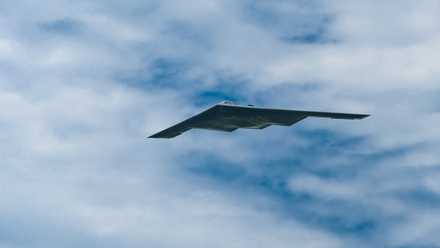
To this day, no other air force has ever successfully produced a crewed aircraft with a tailless, flying wing airframe. On top of that, no other nation has successfully fielded a 5th-generation stealth bomber anywhere in the world. The Northrop Grumman B-2 Spirit made history in 1988 by achieving both of those historic firsts when it was unveiled at Air Force Plant 42 in Palmdale, California.
The iconic shape of the B-2 is paired with advanced radar-absorbent material that coats the skin of the jet to make it America’s most lethal strategic strike platform. Not only is the aircraft completely invisible to every known radar system on Earth, but it is also the only aircraft capable of delivering the 30,000-lb (13,607 kg) GBU-57 Massive Ordnance Penetrator bunker buster in combat. The four powerful General Electric jet engines buried inside of its single enormous lifting wing allow for a cavernous bomb bay, which allows it to carry 40,000 lb (18,000 kg) of ordnance on rotating racks.
Another performance quality of the B-2 that makes it an incredibly powerful strike platform is its exceptionally long range. The fleet of Spirit bombers is famous for routinely flying over 40-hour missions to strike targets anywhere on the Earth. This is largely enabled by the fact that the plane can fly over 6,000 nautical miles (11,112 km) without refueling.
That means the B-2 can get gas far away from enemy lines and cruise at subsonic speeds deep within hostile airspace to deliver its payload and return to friendly skies for aerial refueling or a safe landing. This level of immunity to air defenses has never been equaled by any other combat platform in existence, that is, until its successor, the B-21 Raider, took flight in 2023.
Jack Northrop’s Dream And The Flying Dorito

The B-2 Spirit would very likely have never come into existence if it were not for one man, Jack Northrop. His singular obsession with developing the perfect airplane was to build a pure flying wing as he envisioned. By the late 1970s, Northrop was in failing health, unable to walk or speak, and had spent decades bitterly over the 1949 cancellation and literal scrapping of his YB-49 flying wing prototypes.
During the 1940s, Jack’s wings, the XB-35 and YB-49, were aerodynamically efficient but inherently unstable. It was only decades later when quadruple-redundant fly-by-wire computer avionics made his dream possible. In April 1980, the Air Force granted him special security clearance. He was taken to a secret room and presented with a scale model. Air and Space Forces Magazine recounted how, as he held the model in his hands, he said with tears welling in his eyes:
“Now I know why God has kept me alive for the last 25 years.”
He died just ten months later, finally knowing that the impossible shape he championed was not only viable but was the future of American airpower. The very thing that made the wing hard to fly, the lack of vertical tails and a bulky fuselage, was also the best way to hide from radar. Vertical surfaces act like mirrors for radar beams, and by removing them, the B-2 became nearly invisible to enemy systems.
In a lighter story that comes on the tail of the emotional birth of the B-2 is how Northrop’s unique shape would later earn the B-2 an endearing nickname. Dubbed the ‘Flying Dorito,’ it has been lightheartedly known as such ever since, and while its successor, the B-21 Raider, has not yet been given its own moniker, we can only speculate that it will be along the lines of ‘Son of the Flying Dorito’ in honor of its trailblazing predecessor.
Price As No Object: America’s Most Exquisite Warbird

It’s no mistake that the B-2 continues to be untouchable to even the finest weapons that the adversaries of America and its allies can produce. It is notoriously the most expensive aircraft ever made, so far, with its unit production price tag at a staggering $2 billion per frame. The price tag included research and development that led to breakthroughs in stealth technology, which have continued to keep the US decades ahead of its enemies in airpower technology.
The B-2 Spirit remains one of the most sophisticated machines ever created. Its capacity to remain ‘invisible’ is not due to a single ‘cloaking technology,’ but rather to a clever integration of shape, materials, and electronic management designed to defeat the kill chain of Integrated Air Defense Systems.
The most important aspect is the continuous curvature of the airframe. Radars operate by emitting radio waves and measuring the energy reflected to the receiver. The B-2’s leading and trailing edges are at identical angles. This focuses all radar reflections into a few very small ‘spikes’ of energy. The engine intakes are serrated and hidden deep within the wing to obscure the engines’ highly reflecting rotating fan blades.

The Real Reasons Why The B-2 Spirit Won’t Be Retiring Before The B-1 Lancer
The USAF’s Flying Dorito is outlasting the mighty Bone.
Powered By Technology To Overcome Human Limitations

The B-2 was created as a distinct flying wing, a design that had never taken flight with any true success prior to the Spirit. The stealth-optimized bomber relies on advanced automation to allow its small crew to not only complete long missions, but also fly. The 172-foot wingspan bomber remains one of the most exotic aircraft ever built, and it can only be flown using computer aids.
The pilots’ seats in the aircraft are side by side, with a minimalist panel of displays and controls in front of them. Screens have replaced hundreds of buttons on older planes like the Boeing B-52 Stratofortress. The Vertical Situation Display is the primary interface, providing the pilot with essential baseline flying data such as altitude, speed, direction, and attitude. The Horizontal Situation Display comes next, and it shows mission data, nearby aircraft positions, and flight paths.
The Weapons Systems Support Center of the Air Force Life Cycle Management Center oversees the Spirit Realm, a software factory that provides iterative updates to the control systems. Updates to the Spirit’s software keep it both safe to fly and at the forefront of weaponry. Every Spirit sortie’s overall mission success depends just as much on the Active Electronically Scanned Array, data networks, communication systems, and fly-by-wire avionics as it does on the exterior radar-absorbent paint.
Why The B-2 Spirit Can’t Handle The Rain
Monsoon season takes out the world’s most expensive piece of military hardware: how Mother Nature struck down the cutting-edge flying wing.
By The Numbers: Anatomy Of A Stealth Bomber

As a high-altitude ‘quarterback’ in the Allied combat network, the B-2 Spirit uses a combination of traditional and modern data connections to share target data while maintaining stealth. Its role in the Joint All-Domain Command and Control structure has evolved from a lone-wolf penetrator to that of a central node. The B-2 uses Link 16, the main tactical data link for US and NATO troops.
Modernization projects like Spirit Realm One have implemented Link 16 and Advanced EHF Satellite Communications. This allows the B-2 to receive real-time targeting data from other platforms, like the RC-135 Rivet Joint or the EA-18G Growlers. By using data from external ‘eyes,’ the B-2 can keep its own radar completely silent, making it nearly impossible to detect through electronic emissions.
Specification | Northrop Grumman B-2 Spirit |
|---|---|
Powerplant | Four General Electric F118-GE-100 engines |
Thrust | 17,300 lb (7,847 kg) each engine |
Wingspan | 172 feet (52.12 meters) |
Length | 69 feet (20.9 meters) |
Height | 17 feet (5.1 meters) |
Maximum takeoff weight | 336,500 lb (152,634 kg) |
Fuel capacity | 167,000 lb (75,750 kg) |
Payload | 40,000 lb (18,144 kg) |
Ceiling | 50,000 feet (15,240 meters) |
The B-2 is able to see without being ‘seen’ in hostile skies because its frequency-hopping and spread-spectrum signal management technologies conceal its radar. The bomber can engage without ever activating its own radar because Allied assets can locate a target and send the coordinates straight to the B-2’s mission computer. Because Link 16 is omnidirectional, B-2 pilots frequently use it in receive-only mode when they are deep within enemy territory to prevent radio emissions from revealing their position.
For long-range, secure communication that isn’t limited by line-of-sight, the B-2 utilizes Advanced EHF satellite constellations. This provides a jam-resistant ‘nuclear-hardened’ link back to high-level command centers. Through the Integrated Airborne Mission Transfer, the B-2 can receive complex mission updates mid-flight, which are digitally transferred directly into the aircraft’s weapons system.

The B-21 Raider Is Rewriting The Rules Of Stealth Flying
Breaking down the USAF’s new school of 6th-Gen air power.
Air Force Global Strike Command: Stealth Bomber Country

The USAF’s Air Force Global Strike Command is charged with the responsibility of operating the mighty B-2 on combat missions that can be anywhere on Earth. The B-2 has an astounding unrefueled range of 6,000 nautical miles (9,600 kilometers), but its real range is limited only by its human crew since it is capable of aerial refueling. Air & Space Forces Magazine reported that during the 2001 air campaign of Operation Enduring Freedom, USAF crews flying the B-2 recorded the longest continuous airborne mission in history at 44 hours from takeoff to touchdown.
As Air & Space Forces Magazine also reported, the USAF strives to maintain the most robust and efficient maintenance program possible to give AFGSC the most mission-capable aircraft available at all times. The USAF home site may list 20 B-2s, but the actual number is 19 after one crashed in Guam and one was written off from a mishap at Whiteman Air Force Base. That leaves a total of 19 in flying condition, but as the bombers have to undergo depot maintenance, the available number drops again.
Whiteman AFB in Missouri is home to AFGSC and the B-2 fleet, as well as the Fairchild Republic A-10 Warthog and a number of unmanned aerial vehicle units. AFGSC is responsible not only for long-range conventional strike missions, but also for maintaining nuclear deterrence by remaining constantly prepared to respond to the worst-case scenario. The command controls the USAF’s share of the nuclear arms stockpile, which accounts for roughly one-third of the total nuclear weapons in the United States’ possession.