dailynewsnblog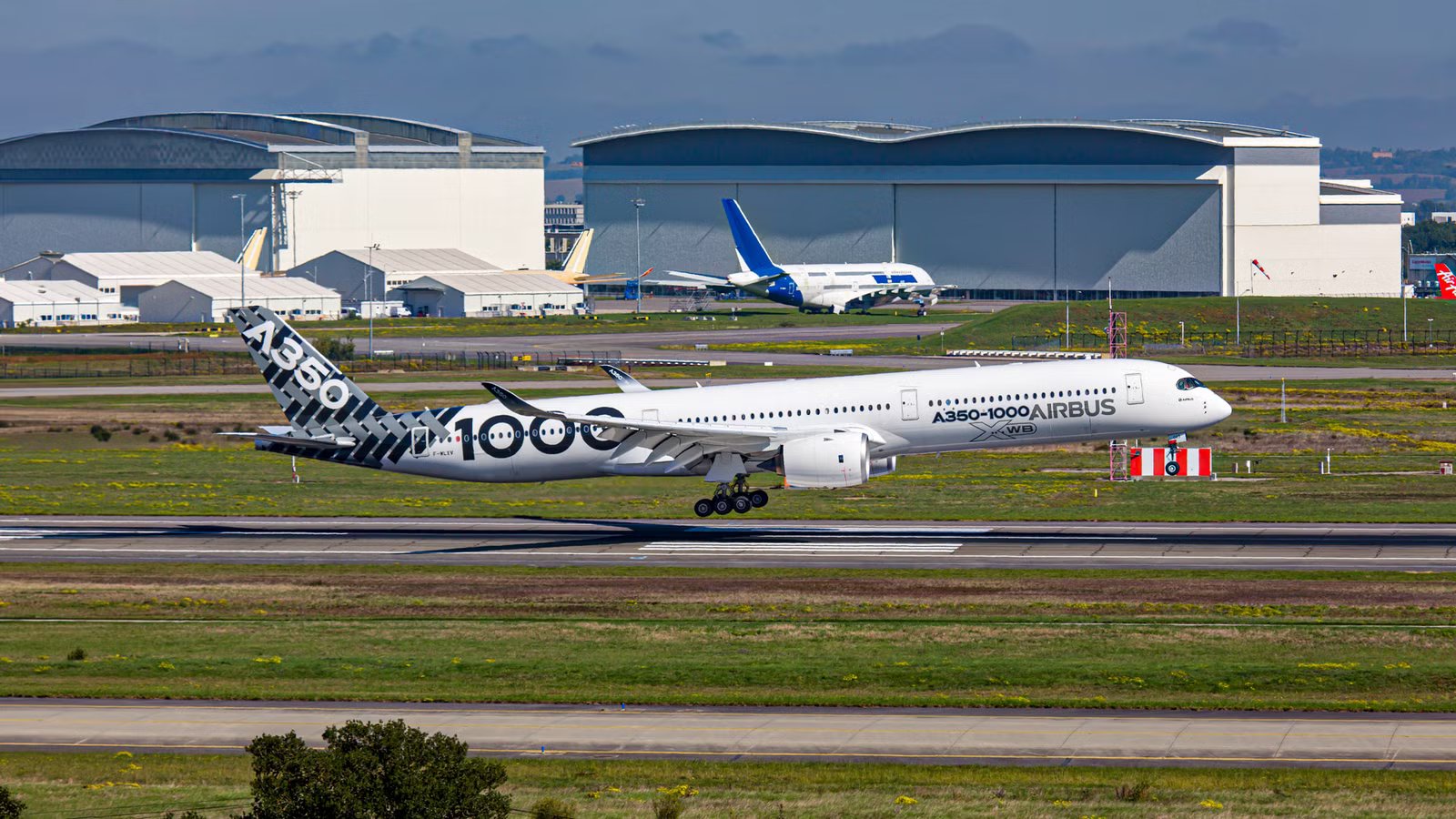
The moment an aircraft meets the runway, an extraordinary amount of engineering goes to work. The wings flex, spoilers rise, reverse thrust engages, and beneath it all, the landing gear absorbs forces that can reach hundreds of tonnes in a few seconds. It is one of the most structurally demanding systems on any commercial jet, designed to endure repeated high-energy impacts while protecting both the aircraft and its passengers. On the Airbus A350-1000, that engineering becomes immediately visible.
Unlike its smaller sibling, the A350-900, the -1000 variant rests on twelve main wheels, six on each landing gear leg. Our article breaks down the technical, structural, and operational factors that led Airbus to equip the A350-1000 with a 12-wheel main landing gear system, and why that decision represents a precise balance between physics, performance, and practicality.
From Four Wheels To Six: How The A350-1000 Differs From The A350-900

At a glance, the Airbus A350-900 and A350-1000 look almost identical. They share the same composite fuselage cross-section, the same 212-foot wingspan (64.75 meters), and the same Rolls-Royce Trent XWB engine family. But structurally, the -1000 sits in a different weight class, and that difference shows underneath the aircraft. The A350-900 has a maximum takeoff weight of around 617,000 pounds (280 metric tonnes), depending on variant, while the A350-1000 pushes beyond 698,000 pounds (316 metric tonnes) in its higher-weight versions. The 80,000 pounds (36 tonnes) gap translates directly into higher landing weights, higher braking energy, and greater structural loads during touchdown.
To manage that increase, Airbus moved from a four-wheel bogie per main gear leg on the -900 to a six-wheel bogie on the -1000. In simple terms, the -900 has eight main wheels, and the -1000 has twelve. That additional axle per side reduces the load carried by each individual tire. Even after burning fuel on a long-haul sector, an A350-1000 can still approach 551,000 pounds (250 tonnes) at landing. Touching down at roughly 170 mph (150 knots), the landing gear must absorb enormous vertical energy while also handling forward loads as the wheels spin up from zero to runway speed in seconds.
Distributing that mass across 12 wheels instead of eight lowers pavement loading, reduces stress per tire, and spreads structural forces more evenly into the wing box. Airbus reinforced the landing gear attachment structure within the wing and center fuselage to handle the revised geometry and higher loads. The six-wheel bogie allowed the A350-1000 to increase weight capacity while remaining within the pavement limits of major international airports — a crucial requirement for an aircraft designed to operate into constrained hubs such as London Heathrow or Tokyo Haneda.
Distributing Weight: The Physics Behind 12 Tires

When aviation enthusiasts on platforms like Reddit discuss the A350’s landing gear, one recurring theme appears: runway loading. The concept used in airport design is Pavement Classification Number (PCN). Aircraft must distribute their weight within limits that airport pavements can tolerate. Adding extra wheels reduces the load per tire. Imagine standing on snow in boots versus high heels.
The total weight hasn’t changed, but the pressure per square inch certainly has. The same principle applies to a 300-tonne jet: by increasing the wheel count from eight to twelve, Airbus reduces pavement loading per tire, keeping the aircraft compatible with major international airports without requiring runway upgrades. This was crucial. The A350-1000 needed to operate into the same global hubs as the -900, from London Heathrow to Singapore Changi.
The additional wheels also enhance braking performance. With more tires in contact with the runway, the aircraft benefits from greater frictional surface area, improving stopping power and redundancy. In the event of a single tire failure, the load is distributed across multiple others, maintaining safety margins.

Airbus A350-900 Vs. -1000: Which Aircraft Do Airlines Prefer More?
Delivery figures reveal a clear favorite in the A350 family. But what drives airlines to pick one over the other?
Engineering The Six-Wheel Bogie: Structure, Articulation, And Strength

The A350-1000’s six-wheel bogie is longer and is more sophisticated. Each main landing gear assembly must retract cleanly into the fuselage while maintaining optimal geometry for landing loads. Engineers had to redesign the gear bay and adjust structural components to accommodate the extended bogie beam.
Unlike older four-engine widebodies like the Boeing 747, which use body gear and wing gear combinations, the A350-1000 remains a twin-engine aircraft with two main gear legs. That means each leg carries a significant portion of the aircraft’s weight. Increasing each bogie to six wheels was the logical solution rather than adding additional gear legs.
A popular aviation thread highlighted how enthusiasts initially assumed Airbus would simply “beef up” the existing four-wheel gear. Instead, engineers opted for an additional axle, noting that structural reinforcement alone would have increased weight penalties and stress concentrations. The six-wheel configuration offered better distribution with manageable design complexity.
The bogie also features advanced shock absorption systems. Hydraulic struts compress on touchdown, converting kinetic energy into heat within the oleo-pneumatic system. The geometry ensures that the rear wheels typically touch down first, stabilizing the aircraft before the forward wheels settle. This sequencing reduces pitching forces and improves passenger comfort. The end result? A landing gear assembly that looks robust, but operates with remarkable smoothness.
Operational Benefits On Ultra-Long-Haul Routes

The landing gear configuration directly supports the A350-1000’s mission profile. Airlines such as Qatar Airways and British Airways deploy the aircraft on dense, premium-heavy long-haul routes. These flights often depart near maximum takeoff weight, carrying substantial fuel loads. Upon arrival, although much of that fuel has been burned, the aircraft may still be near maximum landing weight, especially on shorter long-haul sectors.
The six-wheel bogie ensures the aircraft remains within pavement loading limits even when arriving heavy due to operational constraints. A widely shared aviation post recently highlighted the A350-1000’s “robust six-wheel bogie design,” noting how the extra wheels contribute to stability during crosswind landings. With more rubber on the runway, the aircraft maintains directional control more effectively during rollout—particularly valuable at major hubs prone to gusty conditions.
Braking energy absorption is another factor. Carbon brakes generate extreme heat during heavy landings. By distributing braking loads across more wheels, the system manages temperature and wear more efficiently, potentially reducing maintenance intervals over time. In other words, those extra tires quietly enhance reliability, cost efficiency, and operational flexibility, basically all factors airlines care deeply about.

Why The Airbus A380’s Main Landing Gear Needs 20 Tires
From mass to mechanics: why the A380 needs more wheels than a semi-truck.
Structural Architecture: Lessons From The Boeing 777 Family

As aircraft weights increased, manufacturers had two main options: add more landing gear legs or reinforce the existing configuration. The Airbus A350-1000 chose the latter approach.  Boeing had already demonstrated the effectiveness of that strategy with the Boeing 777 family. When the original Boeing 777-200 entered service in 1995, it had a maximum takeoff weight of around 545,000 pounds (247 tonnes) and featured two main landing gear legs with six wheels each.
As the family grew — through the 777-200ER, 777-300, and especially the 777-300ER — maximum takeoff weight increased to approximately 775,000 pounds (352 tonnes). Despite stretching the fuselage by more than 33 feet (10 meters) and significantly increasing weight, Boeing did not add a third landing gear leg. Instead, it reinforced the existing gear structure and upgraded braking systems while keeping the same two-gear, six-wheel-per-side layout.
The upcoming Boeing 777X continues this philosophy. Even with a new 235-foot (71.8-meter) wingspan and structural changes to support higher efficiency and loads, it retains the same landing gear architecture. The consistency across the 777 family shows that for heavy twinjets in the 650,000–800,000-pound (295–360-tonne) range, two six-wheel main gear legs provide the right balance between load distribution, pavement compatibility, and structural simplicity.
For the A350-1000, this context is important. Its twelve main wheels place it in the same design category as the 777 series — reinforcing two primary landing gear legs rather than introducing a center gear assembly. Both aircraft families demonstrate that stretching a widebody does not necessarily require adding more landing gear legs, as long as the underlying structure is properly strengthened.
The Passenger Perspective: Stability You Rarely Notice

Most passengers will never think about how many tires are beneath them. But they will notice the outcome: a stable, predictable landing. The six-wheel bogie contributes to smoother load transfer during touchdown, particularly on longer fuselage aircraft where pitch sensitivity can be more pronounced.
When the rear wheels make initial contact, the aircraft’s descent energy begins dissipating before the forward wheels settle. This reduces abrupt vertical forces transmitted into the cabin. For a 350+ passenger aircraft, even small improvements in landing smoothness significantly enhance perceived comfort.
The configuration also adds a margin of resilience. In rare cases of tire damage, the distributed load reduces the immediate operational impact. Modern widebody tires are extraordinarily strong, but redundancy remains a fundamental design philosophy in commercial aviation. As aircraft weights evolve and airports balance infrastructure costs, optimized landing gear solutions like the A350-1000’s six-wheel bogie may remain the sweet spot between structural efficiency and operational compatibility.
Ultimately, the A350-1000 has 12 main tires because physics demands them, airports require them, and long-haul performance depends on them. Beneath that sleek composite fuselage lies a landing gear system purpose-built to carry one of the world’s most advanced twinjets safely back to Earth—every single time.