dailynewsnblog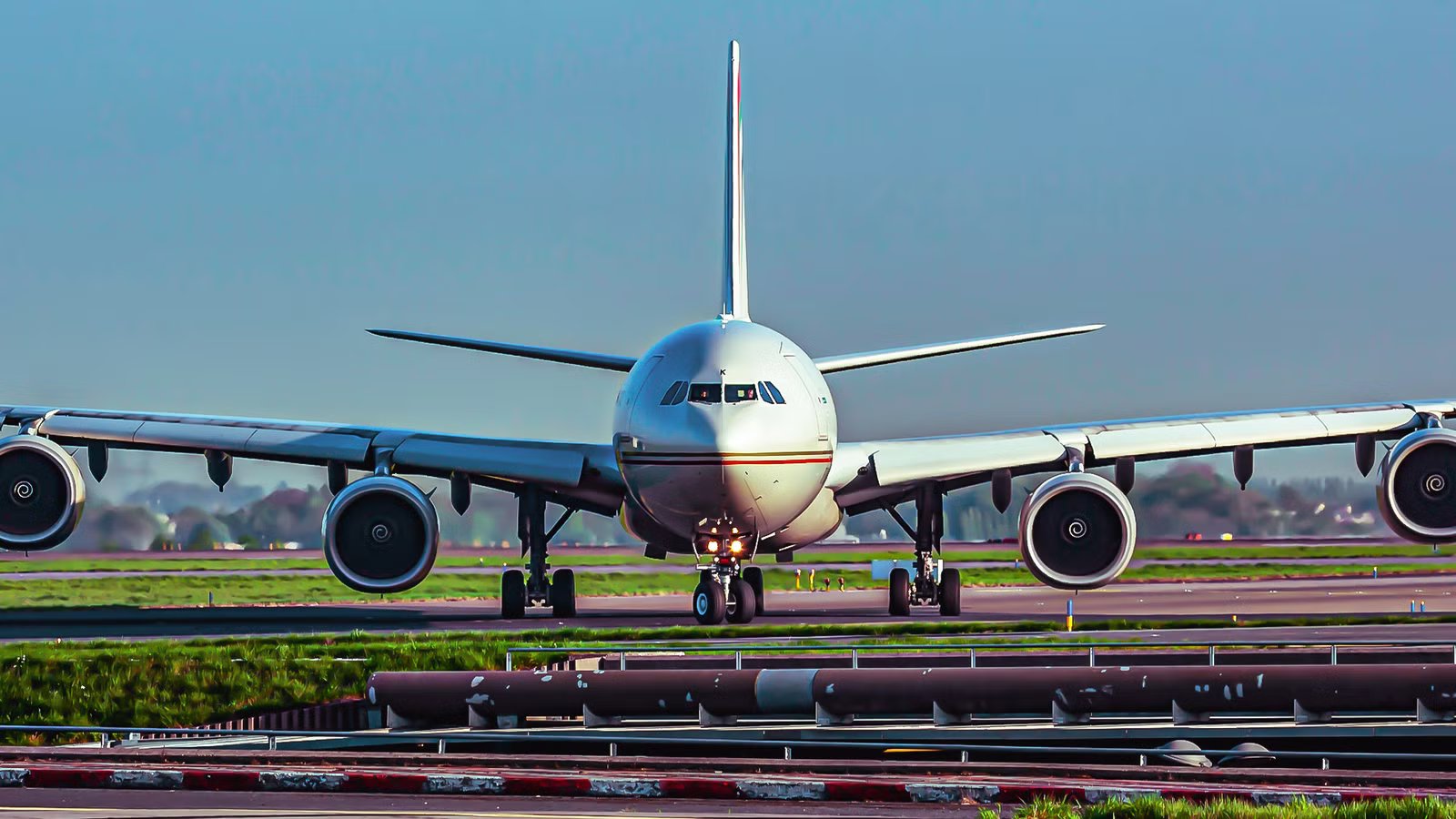
For many in the aviation community, the Airbus A340 already feels like a relic. Once a flagship of long-haul ambition, the four-engine widebody has mostly vanished from airline schedules, displaced by newer, more efficient twin-engine aircraft. Spotting one today often feels like an anomaly, something worth photographing. That visibility gap has led to a widespread assumption that the A340 is effectively retired, with its remaining airframes simply waiting out the clock.
While there is indeed truth to that assumption, in aviation, “retired” is a far more nuanced concept than it appears. While the A340’s days as a mainstream commercial workhorse are unquestionably over, the aircraft itself is not on the verge of disappearance. Instead, it is settling into a quieter second life outside the airline spotlight, flying fewer hours and serving narrower missions. When it is said that the Airbus A340 won’t be retired anytime soon, it does not mean a comeback to global airline fleets. Rather, it means a slow fade measured in decades, not headlines, as the type continues to prove useful well beyond the scope of its original market.
What Retirement Means In Aviation

In most industries, retirement is a clean break: someone stops working altogether, or a product stops being made or sold. The word does not carry the same meaning in aviation. An aircraft can be retired by one operator while remaining perfectly viable for another. Similarly, a certain airplane can be retired from commercial passenger service, but still often fly in other capacities. A great example of this is the McDonnell Douglas MD-11, which has not flown a fare-paying passenger since 2014, but has been essential to domestic air cargo operators since then. In practice, retirement is not a single event but a spectrum, shaped as much by economics and mission profiles as by age.
For airlines, retirement is usually driven by commercial pressures, rather than airworthiness. Rising fuel costs, changing route structures, new environmental targets, and the availability of more efficient replacements often make older aircraft uncompetitive long before they are unsafe or worn out. A jet like the A340 did not leave airline fleets because it stopped working; it left because its four engines no longer made sense in a market optimized around fuel burn per seat and high utilization. That kind of retirement says more about the business model than the airplane itself.
Outside the commercial airline sector, however, retirement follows very different rules. Governments, militaries, charter operators, and specialist users prioritize reliability, range, flexibility, and ownership cost over headline efficiency. Aircraft in these roles often fly fewer hours per year, age more slowly structurally, and face no pressure to match airline economics. As a result, an aircraft type can be commercially obsolete while remaining operationally valuable. This is a distinction that sits at the heart of why the A340, despite its reputation, is nowhere near the end of its flying life.
The A340 At A Glance

The Airbus A340 was conceived for a very different aviation market from the one that currently exists today. The program was launched in the late 1980s, and the aircraft entered service with  Lufthansa and
  Air Francein March 1993. It was designed to give airlines true long-haul capability at a time when extended-range twin-engine operations were still tightly constrained. With four engines and intercontinental range, the A340 promised operational freedom. It was able to fly long sectors over oceans and remote regions without the regulatory hurdles, such as ETOPS, that limited early twin-engine jets. At the time, that capability mattered, and for many carriers, the aircraft delivered exactly what it was built to do.
The A340 has four main variants: the Airbus A340-200, -300, -500, and -600. The original, shorter models emphasized utility and flexibility, while the stretched variants offered impressive passenger capacity and range. When introduced in 2002, the Airbus A340-500 was the world’s longest-range commercial airliner. This enabled its launch customer,  Emirates, to begin nonstop routes from Dubai to New York for the first time. All A340 models shared a common cockpit philosophy with the Airbus A330, reducing training costs and easing fleet integration, which was another key selling point in its prime.
Key A340-300 Dimensions and Performance Numbers | |
|---|---|
Length | 208 feet 11 inches |
Wingspan | 197 feet 10 inches |
Height | 55 feet 5 inches |
Max. takeoff weight (pounds) | 597,453 |
Max. payload weight (pounds) | 115,000 |
Range (nautical miles) | 6,700 |
Engine | 4 x CFM International CFM56-5C |
Source: Lufthansa
What ultimately defined the A340, however, was not a technical shortcoming but a shift in the surrounding market. Advances in engine reliability, evolving ETOPS regulations, and the rise of highly efficient twin-engine widebodies eroded the four-engine advantage the A340 was built around. Yet those same robust design choices and performance capabilities are precisely what allow the aircraft to remain useful today, even as its original airline role has faded from view.

Why Don’t Any US Airlines Fly The Airbus A340?
In the United States, the aircraft never aligned with the market’s priorities.
Who Is Flying The A340 Today?

Despite its diminished presence in today’s airline schedules, a surprising number of Airbus A340s remain active in 2026, and their operators represent a mix of legacy flag carriers, smaller carriers, and niche users. The total number of A340s still in active use is a small fraction of the 380 originally built, but it is far from zero. There are dozens of aircraft that continue to operate on scheduled services and in specialized roles around the world.
Top A340 Operators Today | |
|---|---|
Operator | Total Number |
Other (Government, charter, cargo, etc.) | 17 |
Lufthansa | 15 |
Mahan Air | 10 |
Swiss | 3 |
Edelweiss | 3 |
Source: ch-aviation
Government, charter, VIP, cargo, and other special-mission aircraft collectively account for the biggest single share of the remaining active global fleet. Even though economic pressures have been pushing the A340 out of commercial service, the aircraft continues to be operated by a wide array of personnel across the world. Just below the Other category at the top of the list is Lufthansa, which remains the single largest operator of the A340. The German flag carrier still flies a fleet of A340-300 and A340-600 aircraft on selected long-haul routes, particularly across the Atlantic and to parts of Asia. Lufthansa’s extended A340 operations have been influenced by delays and delivery gaps in newer replacements.
An Aging Global Fleet

By any conventional metric, the A340 is an old aircraft. Most still flying today were built in the late 1990s or early 2000s, placing the average airframe well into its third decade of service. In the airline world, that age alone often signals imminent retirement. Yet, in aviation, age is measured less by calendar years than by cycles, utilization, and how an aircraft has been used. On those terms, many A340s are aging more gracefully than their build dates suggest.
The oldest remaining A340 airframes are still largely in airline hands, and airlines continue to retire the type at a steady pace. Even a paid-off A340 struggles to compete with new-generation twins on operating cost, emissions targets, and passenger expectations. As replacement aircraft arrive and fleet simplification becomes a priority, airlines are naturally the first to let the A340 go.
What prevents this airline-driven retirement from becoming a full-scale extinction event is the continued demand from non-airline operators. Specialized users are still actively interested in the A340. Lower acquisition costs, long-range capability, four-engine redundancy, and reduced utilization expectations make the aircraft attractive in roles where efficiency is secondary to availability and capability. As a result, while airlines are steadily closing the book on the A340, other operators are deliberately keeping it open for now, ensuring that the global fleet continues to shrink slowly rather than disappear all at once.
Top 10 Oldest Active A340’s Today | |||
|---|---|---|---|
Operator | Variant | Registration | Age (years) |
Saudi Arabian Royal Flight | -200 | HZ-124 | 33.86 |
Alpha Star Aviation | -200 | HZ-SKY1 | 33.07 |
Qatar Executive | -200 | A7-HHK | 32.8 |
Conviasa | -200 | YV1004 | 32.55 |
Egyptian Air Force | -200 | SU-GGG | 31.83 |
Mahan Air | -300 | EP-MJC | 29.95 |
Mahan Air | -300 | EP-MMD | 28.88 |
Mahan Air | -300 | EP-MJD | 28.52 |
Saudi Arabian Royal Flight | -200 | HZ-HM52 | 28.14 |
Lufthansa | -300 | D-AIGN | 27.96 |
Source: ch-aviation

Lufthansa To Retire Airbus A340-600: Final Flight Set For October
The end of the line for the stretched quadjet.
Meaningful Service Life Outside The Airlines

Once freed from the economics of scheduled airline service, the Airbus A340 begins to make sense again. Outside the airline model, aircraft are not judged by seat-mile efficiency or daily utilization targets, but by whether they can reliably perform a specific mission at an acceptable cost. In that context, the A340’s perceived weaknesses fade, and its strengths come back into focus.
Government and VIP operators value the A340 for its ability to fly long, nonstop sectors without relying on diversion infrastructure or ETOPS constraints. For heads of state, military transport units, and special-mission operators, four engines provide operational margin rather than a liability, and cabin space allows for communications suites, medical facilities, or secure layouts that would be expensive to replicate in newer aircraft. These airframes typically fly far fewer hours per year than airline jets, stretching their remaining service life well beyond what calendar age alone would suggest. It is not unusual for presidential or VIP aircraft to remain in service for 30 to 40 years. Air Force One is a prime example of how long a mission-critical airframe can remain relevant.
The A340’s Likely Future: Slow Fade, Not Sudden End

The Airbus A340 will not disappear overnight. Airline retirements will continue steadily, gradually shrinking the visible commercial fleet, but the aircraft will remain useful in specialized roles. Its remaining airframes are increasingly concentrated with operators who value capability over cost, creating a self-sustaining ecosystem that slows the pace of total retirement.
Over the next decade or two, the A340 is likely to fade quietly rather than vanish abruptly. As older airframes are retired and parts become scarce, replacements will be gradual and mission-specific rather than fleet-wide. In practical terms, while the aircraft is no longer a mainstream airline staple, it is far from gone. The A340 serves as a reminder that retirement in aviation is rarely sudden; it is a long, measured decline shaped by economics, mission, and the enduring utility of the airframe itself.