dailynewsnblog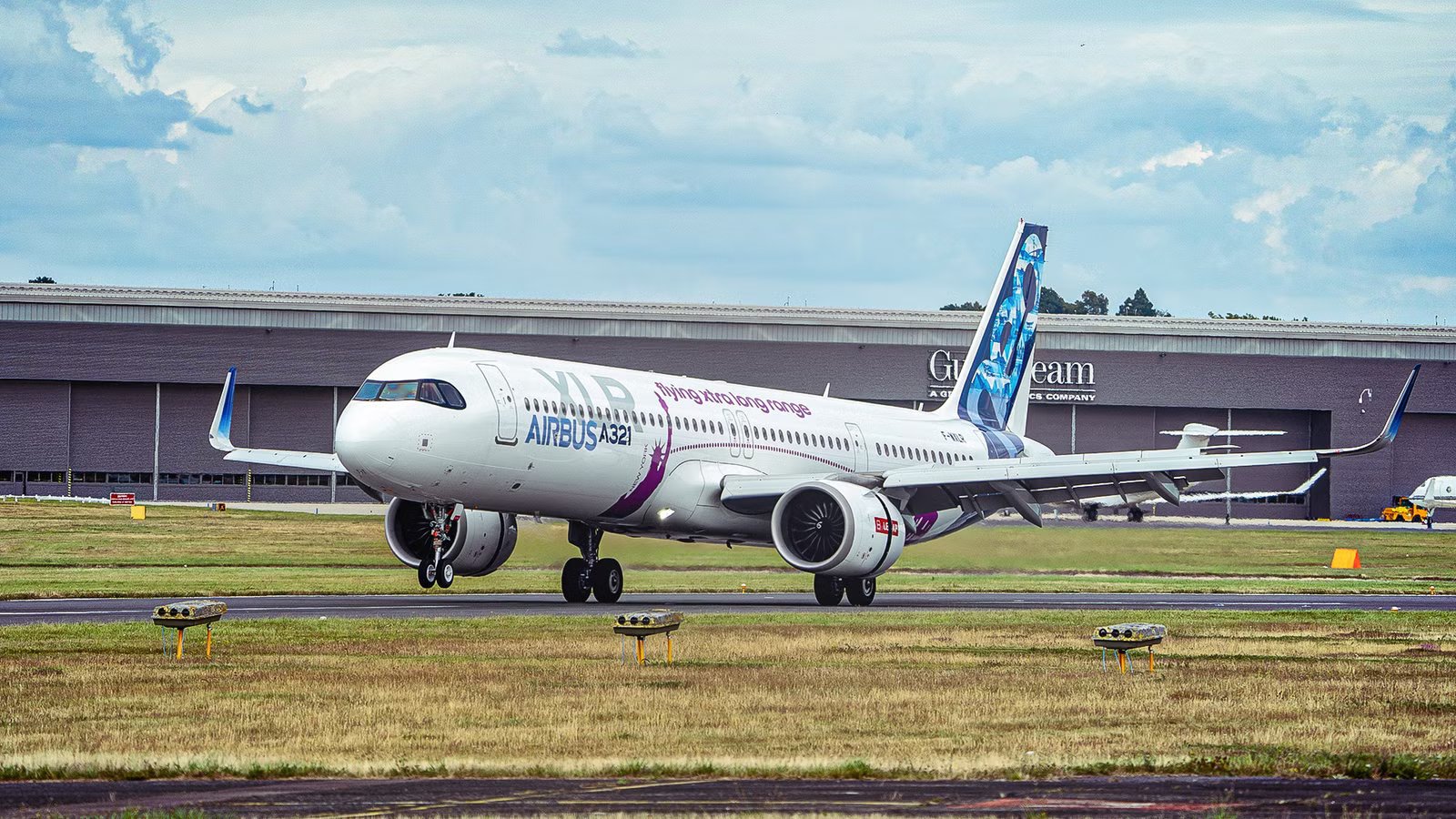
The Airbus A321XLR is doing something that, until recently, seemed almost impossible for a single-aisle aircraft. Airlines are now using it to launch nonstop flights lasting up to 11 hours between cities that previously required either a connection or a much larger, less economical widebody. While aircraft such as the Boeing 737 MAX and Airbus A321LR already pushed the boundaries of narrowbody flying, the A321XLR crosses an entirely new threshold by combining genuine long-haul range with the economics of a narrowbody.
That capability is not the result of bigger engines or an all-new wing. Instead, Airbus achieved it through a clever structural redesign centered around a permanent Rear Center Tank (RCT) integrated into the fuselage. As Airbus explains in its overview of the A321XLR, the innovation gives airlines access to thousands of new city pairs while maintaining the operating costs of an aircraft carrying around 180 to 220 passengers. It also explains why dozens of new long-haul routes are entering service during 2026, creating markets that previously had no suitable aircraft. Industry observers, including The Flying Engineer, describe the aircraft as the missing link between conventional narrowbodies and widebodies thanks to its unique combination of range and economics.
The Engineering Innovation That Changed Narrowbody Aviation

The A321XLR may look almost identical to every other Airbus A321 from the outside, but beneath the cabin floor lies the feature that completely transforms its capabilities. Instead of relying primarily on removable Additional Center Tanks (ACTs) installed inside the cargo hold, as used on the A321LR, the XLR incorporates a permanent Rear Center Tank directly into the aircraft’s primary fuselage structure. According to Airbus’ technical overview, the tank is fully integrated into the airframe rather than being installed as optional equipment, allowing engineers to maximize fuel capacity without sacrificing the aircraft’s external dimensions.
The integrated RCT stores approximately 3,408 gallons (12,900 liters) of fuel while occupying less cargo space than the multiple ACTs required on earlier variants. Because the tank forms part of the aircraft’s structure, Airbus also preserved valuable underfloor cargo capacity, allowing airlines to carry more baggage and freight on long-haul flights. Supporting the extra fuel required reinforcing both the nose and main landing gear, increasing maximum take-off weight from 97 tonnes to 101.5 tonnes, while local wing strengthening ensured the aircraft retained comparable take-off performance despite carrying significantly more fuel. Airbus notes that these modifications were specifically developed to achieve the aircraft’s impressive range without requiring an entirely new aircraft program.
Those engineering changes translate directly into operational capability. Airbus certifies the A321XLR for 4,700 nautical miles (8,700 km) and flights lasting approximately 11 hours, compared with roughly 4,000 nautical miles (7,408 km) for the A321LR. On paper, an extra 700 nautical miles (1,296 km) may not sound revolutionary. In airline network planning, however, that additional reach opens hundreds of routes that previously fell just beyond the limits of any narrowbody aircraft, allowing airlines to bypass traditional hub airports and operate nonstop between city pairs that previously required connections.
Why Another 700 Nautical Miles Changes Everything

Aircraft range figures can sometimes be misleading because the relationship between distance and airline economics is not linear. An additional 700 nautical miles (1,296 km) represents only about a 17% improvement over the A321LR on paper, but it pushes the aircraft beyond one of the industry’s most important operational thresholds. As Ready for Takeoff explains in its analysis of the aircraft, that extra range allows airlines to move beyond simply reaching the eastern edge of the Atlantic and instead connect secondary European cities directly with destinations across North America, the Middle East, and South Asia.
The additional endurance dramatically expands the number of commercially viable city pairs. Routes such as Dublin–Nashville, Madrid–Santo Domingo, and London-Medina become realistic nonstop services without requiring a widebody aircraft. According to Simple Flying’s review of the aircraft’s 2026 route network, around three dozen new long-haul routes are expected to launch during 2026, with many specifically targeting underserved secondary cities rather than traditional hub airports. The Flying Engineer similarly notes that the aircraft enables airlines to profitably serve markets that previously generated too little demand for an Airbus A330 or Boeing 787.
The impact extends well beyond individual routes. Rather than replacing existing long-haul services, the A321XLR is allowing airlines to redesign their international networks around point-to-point travel. Airbus has referred to the aircraft as a “network opener”, reflecting its ability to create routes that simply were not commercially viable before.
How The A321XLR Outclasses Every Other Narrowbody


The A321XLR’s technical achievement becomes even more impressive when compared with every other narrowbody currently in production. While Boeing’s 737 MAX family and Airbus’ own A321LR have steadily expanded the capabilities of single-aisle aircraft, neither was designed to perform genuine ultra-long-range missions lasting 10 to 11 hours. The A321XLR therefore occupies a unique position in the market, offering capabilities that no competing narrowbody can currently match. As Airbus explains in its A321XLR program overview, the aircraft was specifically developed to bridge the gap between conventional narrowbodies and larger twin-aisle jets while preserving the operating economics airlines expect from the A320 family.
The clearest comparison comes with Boeing’s largest single-aisle aircraft, the 737 MAX 10. According to Boeing’s official specifications, the MAX 10 offers a maximum range of approximately 3,100 nautical miles (5,740 km), making it well suited to dense domestic and medium-haul international routes. However, that leaves it roughly 1,600 nautical miles (2,963 km) short of the A321XLR’s certified 4,700-nautical-mile (8,704 km) range. As highlighted in our comparison of the two aircraft, the Airbus can fly more than 50% farther than the MAX 10 while carrying a broadly similar number of passengers, enabling city pairs that the Boeing simply cannot serve nonstop.
Even Airbus’ own A321LR cannot replicate every mission performed by the XLR. With a range of approximately 4,000 nautical miles (7,408km), the LR represented a major leap forward when it entered service, but the additional 700 nautical miles (1,296 km) delivered by the XLR unlock a completely different category of routes. According to analysis from Business Traveller, the XLR occupies a unique niche by combining genuine intercontinental range with narrowbody economics, leaving it without a direct competitor currently in production.
Catch what other flight trackers miss
Emergency squawks, holds, NOTAMs — live signals, no signup.
Open tracker
Catch what other flight trackers miss
Emergency squawks, holds, NOTAMs — live signals, no signup.
Open tracker
Why Airlines Wanted An Aircraft Between A Narrowbody And A Widebody

For airlines, range alone has never been the biggest challenge. The real issue has always been matching aircraft size to passenger demand on some routes. Many international city pairs generate enough travelers to support a nonstop flight but not enough to consistently fill a 250- to 300-seat Airbus A330, Boeing 787 or similar widebodies. For decades, airlines either accepted poor economics on lightly filled long-haul aircraft or routed passengers through major hubs instead. The only aircraft available that was used in similar situations was the Boeing 757, but Boeing closed the production line and never upgraded the remaining aircraft. The Airbus A321XLR became the only viable substitute for the once-popular 757. As Airbus explains, the A321XLR was specifically designed to open or continue underserved or thin markets by combining intercontinental range with a cabin typically seating 180 to 220 passengers.
The economics extend far beyond fuel consumption. A smaller aircraft requires fewer cabin crew, generally incurs lower airport and navigation charges, and reduces the financial risk of launching a new international route. Airlines can also offer more convenient schedules by operating two daily A321XLR flights instead of a single widebody departure, increasing flexibility for both leisure and business travelers. This combination of lower trip costs, long-haul capability, and right-sized capacity is one of the main reasons airlines have embraced the aircraft so rapidly.
Perhaps the A321XLR’s greatest contribution is that it dramatically lowers the risk of opening completely new routes. Deploying a Boeing 787 or Airbus A330 on an unproven market requires airlines to fill hundreds of seats every day to generate acceptable returns. The XLR changes that equation by allowing carriers to test emerging long-haul destinations with far lower operating costs while still offering passengers the convenience of nonstop service. Rather than replacing widebodies, it complements them by serving markets that previously occupied an economic “no-man’s-land” between traditional narrowbody and widebody operations. That flexibility explains why so many airlines now regard the A321XLR not simply as another A320-family aircraft, but as one of the most important network-planning tools introduced in decades.
Comparing Today’s Longest-Range Narrowbodies

The A321XLR occupies a category of its own because no other modern narrowbody combines its range, passenger capacity and operating economics. While several single-aisle aircraft can perform medium-haul international missions, only the XLR can consistently operate flights approaching 11 hours while carrying a commercially viable payload.
Comparing today’s longest-range narrowbodies
Aircraft | Maximum range | Typical two-class capacity | Primary long-haul capability | Best suited for |
Airbus A321XLR | 4,700 nm (5,408 miles / 8,700 km) | 180–220 passengers | Up to 11-hour missions and true transatlantic narrowbody operations | Secondary intercontinental routes, leisure markets, “long thin” city pairs |
Airbus A321LR | ~4,000 nm (4,603 miles / 7,400 km) | 180–220 passengers | North Atlantic and regional long-haul services | Established long-range narrowbody routes |
Boeing 737 MAX 10 | ~3,100 nm (3,567 miles / 5,740 km) | Up to 230 passengers | Medium-haul international and domestic operations | High-density short- and medium-haul markets |
The comparison illustrates why the A321XLR has become such a popular aircraft. The A321LR remains an excellent long-range narrowbody, while the 737 MAX 10 is planning to excel on high-capacity regional routes, but neither can consistently perform the ultra-long missions that the XLR was designed to fly. The result is an aircraft that occupies a unique niche in the market, combining the trip costs of a narrowbody with route capabilities once reserved for much larger twin-aisle aircraft. Many of the world’s longest single-aisle flights are now either operated by, or planned around, the A321LR and especially the A321XLR, underlining how dramatically the type has expanded the boundaries of narrowbody aviation.
The Aircraft Reshaping Airline Networks Rather Than Replacing Widebodies

The growing list of A321XLR operators demonstrates that airlines are using the aircraft for far more than replacing older narrowbodies. Instead, carriers are redesigning their long-haul strategies around markets that previously lacked sufficient demand for widebody aircraft. According to our review of the aircraft’s 2026 deployment, approximately three dozen new transatlantic routes are being launched using the type, illustrating how quickly airlines have embraced its unique combination of range, capacity and operating economics. Many of these routes connect secondary European cities directly with North America, bypassing traditional hubs and reducing total journey times for passengers.
Looking beyond the North Atlantic, the A321XLR’s influence is likely to extend across Asia, the Middle East, Africa and South America. Its 4,700-nautical-mile (8,704 km) range comfortably covers numerous underserved city pairs that previously relied on connecting traffic through major hubs. The aircraft is changing airline network planning by making point-to-point flying commercially viable on routes where neither conventional narrowbodies nor widebodies offered an attractive solution.
The Airbus A321XLR succeeds because of a remarkably simple engineering idea executed exceptionally well. By integrating a permanent Rear Center Tank into the fuselage, Airbus created an aircraft capable of flying farther than any other production narrowbody without fundamentally changing its size, cabin, or operating philosophy. As Airbus describes it, the A321XLR is a true “network opener” — an aircraft that has extended the limits of single-aisle flying, and entirely occupied a niche market segment in the process.