dailynewsnblog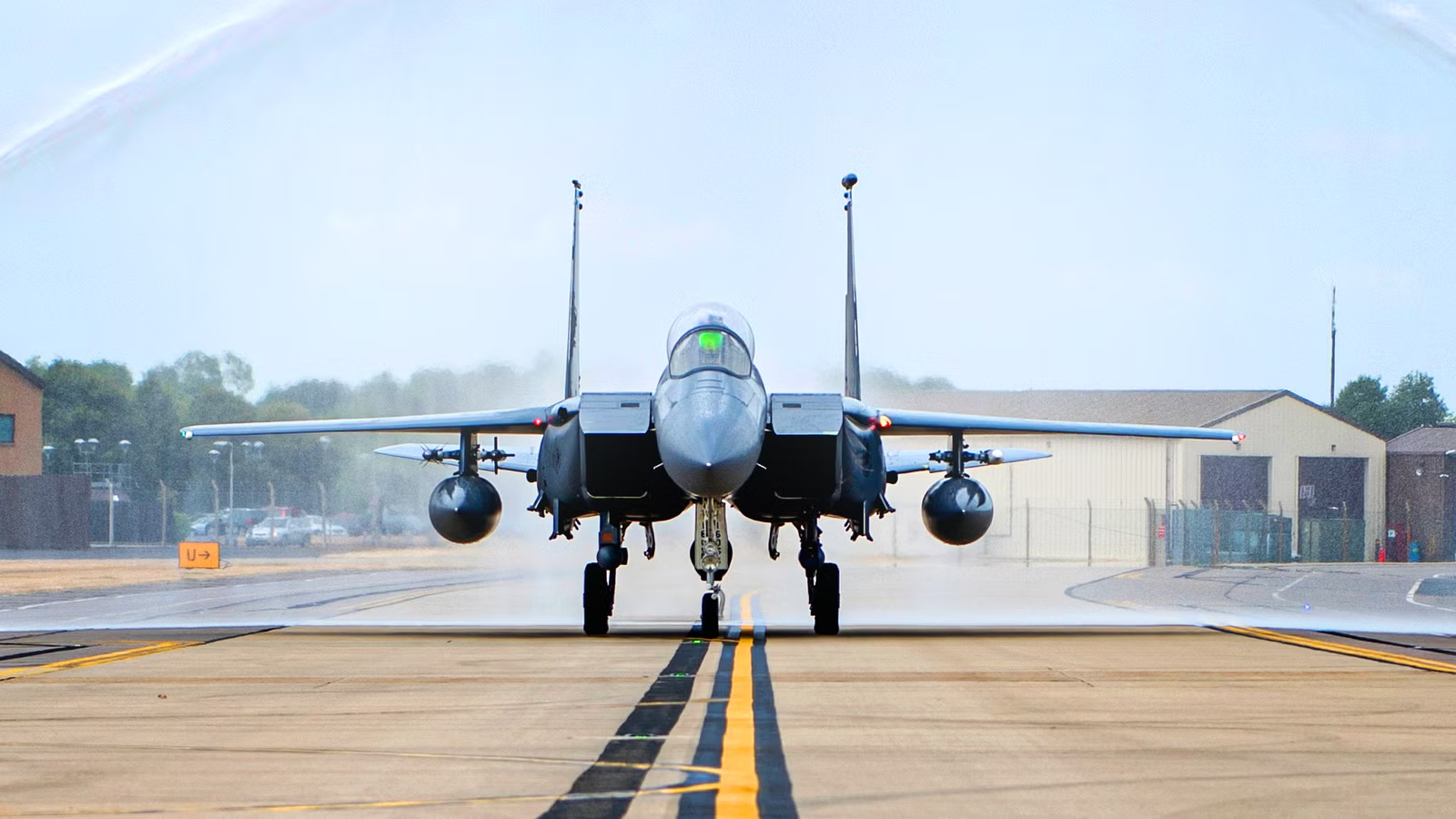
In an ironic twist of fate, the next-generation F-22 Raptor air-dominance fighter was intended to replace the Air Force’s F-15C/D air-superiority fleet, but its cancellation in 2009 after a much smaller-than-planned production run ultimately left the Air Force dependent on aging Eagles. The Air Force subsequently returned to the Eagle with the F-15EX, which is now planned to replace the remaining F-15C/Ds and eventually begin recapitalizing the F-15E fleet. The Air Force currently plans to purchase 267 F-15EXs—more than the 187 F-22s it purchased and substantially more than the planned 185-plus 6th-generation Boeing F-47s.
As part of its redesign of the fighter force, the Air Force is preparing to make Seymour Johnson a major F-15EX base while retaining F-15E operations there during the transition. It is also considering relocating F-15E aircraft from Seymour Johnson to Whiteman Air Force Base, the home of the B-2 Spirit, although that move remains subject to the Air Force’s basing process. The changes come as the B-21 Raider enters the bomber force, A-10s and some aging F-15s are retired, and the Air Force more than doubles its planned F-15EX fleet from 129 to 267 aircraft.
Seymour Johnson Is Major F-15E Base To Transition To F-15EX

Seymour Johnson Air Force Base is a major US Air Force base located in Goldsboro, North Carolina, and is a major installation of the Air Combat Command. The Air Combat Command includes the 4th Fighter Wing (the host wing), the Fourth Air Force, the 944th Fighter Wing, and the 567th RED HORSE Squadron.
Seymour Johnson has long been the Air Force’s principal F-15E Strike Eagle base. The 4th Fighter Wing’s 4th Operations Group includes four F-15E squadrons: the 333rd, 334th, 335th, and 336th Fighter Squadrons. The four squadrons make Seymour Johnson the Air Force’s largest active-duty concentration of F-15Es. Each squadron has an authorized strength of 24 F-15Es, meaning that it is authorized to maintain a total fleet of 96 F-15E Strike Eagle fighters.
Under the Air Force’s new force-structure plans, Seymour Johnson will become a major active-duty F-15EX Eagle II base and an F-15EX training center. The Air Force is also considering transferring some F-15E Strike Eagles from Seymour Johnson to Whiteman Air Force Base as the F-15EX enters service. The base is also home to the Air Force Reserve Command’s 916th Air Refueling Wing, which operates KC-46A Pegasus tankers.
Whiteman, Onto B-21s & F-15Es

Whiteman Air Force Base is currently the primary base for the Air Force’s fleet of 19 remaining Northrop B-2 Spirit stealth bombers and is set to be the primary base for the incoming Northrop Grumman B-21 Raider. That said, Ellsworth Air Force Base is scheduled to receive the first operational B-21s, beginning in 2027. The B-2s are currently receiving a series of upgrades that will see them flying into the 2030s or 2040s until they are eventually replaced by the B-21.
The B-2s are operated by the host 509th Bomb Wing (13th Bomb Squadron and 393rd Bomb Squadron) and the 131st Bomb Wing (110th Bomb Squadron, a B-2 associate squadron). Meanwhile, Whiteman has also long been a stronghold of the venerable Fairchild Republic A-10 Thunderbolt II ‘Warthog’ ground attack aircraft. Whiteman is home to around 18 A-10C ‘Warthogs’ operated by the 442nd Fighter Wing’s 303rd Fighter Squadron.
However, the Warthog is on its way out. The Fiscal 2026 budget allows the Air Force to reduce its fleet by 59 to 103 examples, and the Air Force is currently proposing divesting 49 more in 2027, leaving it with a fleet of 54 remaining in three squadrons. These would include two squadrons (36 jets) at Moody Air Force Base and one squadron at Whiteman. One Moody squadron would retire in 2029, and the remaining two would retire in 2030.
A Joint Seymour F-15E & F-15EX Schoolhouse

Under the new plan, the Air Force would transfer some of the younger F-15Es from Seymour to Whiteman. Some of the older Strike Eagles would be replaced by the new F-15EX Eagle II jets. The F-15E is seen as complementary to the B-2/B-21 as it carries a large conventional payload, functions as a standoff missile carrier, and can conduct escort missions and follow-on strikes.
The F-15Es would equip Whiteman’s 442nd Fighter Wing as it retires its A-10s. The Secretary of the Air Force, Troy Meink, has confirmed in a letter to Senator Ted Budd that Seymour Johnson will be a major recipient of the F-15EX. In the letter, Meink assures the Air Force will not reduce Seymour Johnson’s F-15 missions without replacement aircraft already in place, that the base will receive modernized F-15Es from elsewhere in the near-term, that F-15Es will only be reassigned after F-15EXs arrive, and that final decisions are not expected until 2028.
The plan is to consolidate F-15E and F-15EX training at the air base, instead of creating a separate F-15EX schoolhouse. Seymour Johnson has operated the Strike Eagle since 1988 and possesses the largest concentration of F-15 instructors, maintainers, and depot-level experience in the active Air Force.
How F-15Es Will Complement B-21s

The move would be a boost for Whiteman as the current plan is to replace 18 A-10s that are expected to retire around 2030, with 24 much larger F-15Es. According to reporting by Air & Space Force Magazine, the transfer is a while off. The publication writes, “The service expects Whiteman’s new F-15E mission will reach Initial Operational Capability in 2032 and Full Operational Capability in 2034.”
Meanwhile, Whiteman has traditionally been almost entirely a stealth bomber installation. However, as B-21s gradually replace the existing B-2s, the US Air Force plans for Whiteman to become a broader long-range strike complex, rather than a single-aircraft base with a few Warthogs. The Strike Eagle can launch JASSM and JASSM-ER stand-off missiles in large numbers, which is essentially part of the missile truck role that the Air Force is retaining its B-52s for.
Further than that, the Strike Eagle can perform conventional interdiction after stealth bombers open corridors, providing a flexible regional strike without having to commit valuable and scarce stealth bombers. Underlying the development is a transition to the B-21 being part of a family of systems for long-range strike. It represents another step in the blurring of lines between aircraft types and that future bombers and fighters are multirole.
Doubling Of F-15EX Purchase

The last three budget cycles have been transformative for the F-15EX. In Fiscal 2025, the F-15s were still essential at the end of a small program, with the Air Force only having a target to complete a modest purchase of 98 Eagle IIs. However, it also included a plan to ramp up production from one a month to two a month (from around 12 to 24 annually). It can be noted that Israel, having exercised its option for 25 more F-15EXs, also has 50 F-15EXs (specifically Israeli F-15IAs) on order that will come from Boeing’s production capacity.
Fiscal 2025 saw the Air Force purchase 18 more F-15EXs. In Fiscal 2026, the Air Force increased its target to 129 F-15EXs while maintaining the production target of two per month (24 per year). It requested funding for 21 F-15EXs, although Congress ultimately provided funding for 22. However, Fiscal 2027 has been significant.
Progression of F-15EX since 2025 (per US budget documents) | Fiscal 2025 (enacted) | Fiscal 2026 (enacted) | Fiscal 2027 (proposed) |
|---|---|---|---|
F-15EX procurement target | 98 | 129 | 367 |
F-15EX on order for foreign sales (Israel) | 25 | 25 | 50 (option exercised in 2026) |
Targeted production rate (annually) | 12 rising to 24 | 24 | 24 rising to 36 |
Number purchased in the year | 18 | 22 | 24 (rising to 36 by 2030) |
The Air Force has now boosted its planned total fleet to 267, effectively doubling last year’s target, and is seeking investment to boost production to as many as 36 F-15EXs per year. The Air Force has requested funds to purchase 24 aircraft, although negotiations are ongoing. Its Fiscal 2027 forecast anticipates it ordering 24 F-EXs in 2028, 28 in 2029, and 36 each in 2030 and 2031.
The Stealth Platform + Missile Truck Formula

The F-15EX fighter jets are expected to replace the remaining aging F-15C/D Eagles and many F-15E Strike Eagles. They will complement the Air Force’s fleet of F-35A stealth fighters. The F-35A will be the backbone of the future USAF manned tactical aviation. Under current plans, the USAF will purchase 1,763 F-35As (program of record), 267 F-15EXs, and 185+ F-47s.
The decision to purchase F-15EXs is not a vote of no confidence in the F-35A. It is somewhat analogous to the decision to pair the B-21 with the B-52. Stealth platforms are expensive and are constrained by the need to carry ordnance internally. However, F-15Es, F-15EXs, and B-52s can function as missile trucks, carrying large stores externally. The F-35A can go ‘beast mode’ carrying stores externally, but that sacrifices stealth.
It is a recognition that not every mission requires a stealth platform. Even in missions that do require stealth platforms, missile trucks can serve a very valuable complementary role, carrying long-range heavy stores. That said, it is also wrong to characterize the F-15E/F-15EX solely as a missile truck. The F-15EX, in particular, is a very modern and capable air superiority fighter able to carry out a range of missions.
Catch what other trackers miss
Emergency squawks, holds, NOTAMs — live signals, no signup.
Open tracker
Catch what other trackers miss
Emergency squawks, holds, NOTAMs — live signals, no signup.
Open tracker