dailynewsnblog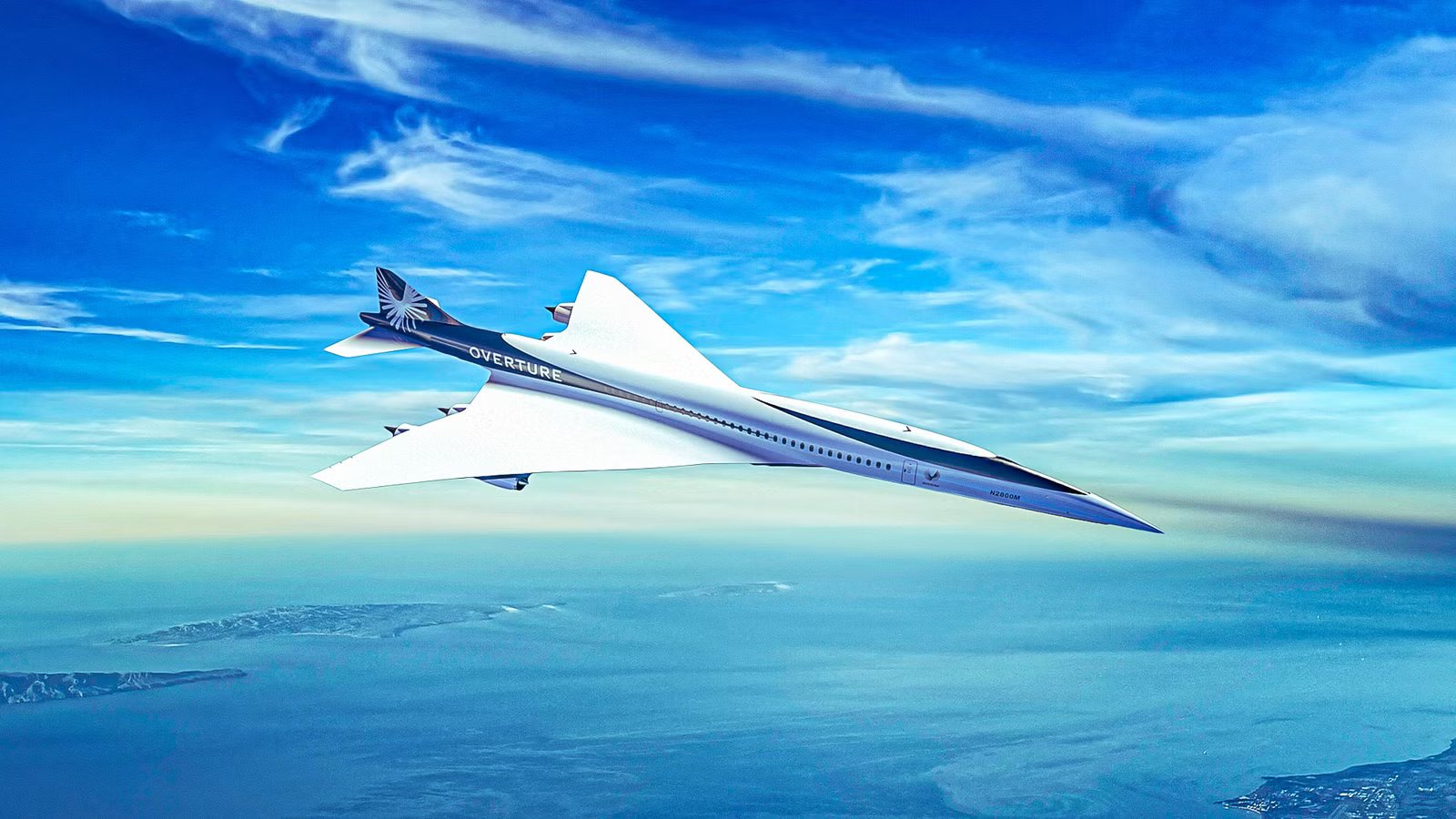
The Boom Overture promises to bring the option of supersonic travel back into the world of commercial aviation after Concorde’s retirement way back in the early 2000s. Developed to carry up to 80 passengers at double the speed of today’s airliners, the program has already picked up 130 orders from three carriers, including  United Airlines,
  American Airlines, and Japan Airlines.
So what is it that makes Overture appealing to airlines now, after the ultimate failure of the Concorde program, and how will the manufacturer attempt to guarantee a profitable successor? Well, some of the clues are actually visible and explain why, despite stemming from the same idea, Overture will look so different from Concorde.
Afterburners Axed For Quieter Successor

The glaringly obvious difference between the two will be in the makeup of the engines. Concorde was powered by four afterburning turbojets housed in two cases fitted directly under each wing without struts. Conversely, Overture will use medium-bypass turbofans, each mounted individually to the wings. Why Overture will not follow its predecessor here is largely down to noise.
Concorde’s Rolls-Royce Snecma Olympus 593 engines enabled an average cruising pace of over twice the speed of sound, or around 1,350 miles per hour (2,172 km/h). However, they relied on afterburners directly injecting fuel into exhaust gases to achieve such power, both for takeoff and also during cruise. This meant an incredibly noisy engine, and one that could be really inefficient when not pushing the sound barrier as intended.
An incredible feat of technology in its own right, Concorde’s engine was also a product of its own time and would appear incredibly dated against Boom’s Symphony engines. Four of these will power Overture, having been designed in-house to enable both sub-sonic and supersonic speeds of up to Mach 1.7 for flight over water and land, respectively. The lack of afterburners will keep the likes of noise and costs down, according to the company. “Each engine is fed by a highly-efficient, streamline-traced, axi-symmetric inlet,” Boom explains on its website. “These inlets provide exceptional pressure consistency that allows the engines to operate with subsonic airflow at supersonic speed.”
Fuselage Shaped Using Area Rule

Perhaps slightly more subtle, but an update that will make a big difference nonetheless, is Overture’s fresh fuselage design. Concorde’s main body was cylindrical with a constant cross-section. Boom has dropped this uniform, tube-like shape for Overture, instead drawing up a fuselage that will visibly pinch and swell in different sections.
Much like a Boeing 747 with its infamous forward hump to house an upper deck, Overture’s fuselage will visibly thin towards the middle of the aircraft. This is due to a technique known as “area ruling,” where, in its simplest terms, attempts are made through the shaping of aircraft to carefully manage airflow during flight at transonic and supersonic speeds.
Concorde Specifications
Capacity | 92-120 passengers (128 in high-density layout) |
Crew | 2 pilots and 1 flight engineer |
Range | 3,900.0 nautical miles (7,222.8 km) |
Service ceiling | 60,000 ft (18,288 meters) |
Maximum speed | Mach 2.04, temperature limited |
Runway requirement | 11,800 feet (3,596.6 meters) with maximum load |
Maximum takeoff weight | 408,010 lb (185,070.2 kg) |
Length | 202 feet, 4 inches (61.7 meters) |
Wingspan | 84 feet (25.6 meters) |
Height | 40 feet (12.2 meters) |
Powerplant | 4x Rolls-Royce/Snecma Olympus 593 Mk 610 turbojets |
Thrust | 31,000 lbf (140 kN) dry, 38,050 lbf (169.3 kN) with afterburner |
Boom itself previously noted this use of a wider diameter at the front of its fuselage would “minimize wave-drag (resistance caused by shock waves) and maximize fuel efficiency at supersonic speeds”. Realistically, the change comes after huge technological leaps in the time since Concorde was around. Where engineers previously relied solely on the likes of wind tunnels and pure physical testing, “modern computer simulations offer thousands more iterations of the designs” than those historic technologies, as Boom put it.

Concorde: Inside The Fastest Passenger Jet Ever Built
What was it like to ride the fastest commercial airliner? We take a look at the interior of Concorde.
Gull Wings & Horizontal Stabilizers At Tail

Another subtle change from Concorde to Overture, at least for the untrained eye, will be in the wings. Both share the same delta wing design at their core. Commonly used on military aircraft for improved maneuverability and due to structural advantages, such wings are shaped like triangles with a sharply swept-back leading edge and straight trailing edge.
Catch what other flight trackers miss
Emergency squawks, holds, NOTAMs — live signals, no signup.
Open tracker
Catch what other flight trackers miss
Emergency squawks, holds, NOTAMs — live signals, no signup.
Open tracker
Concorde’s wings had their own specialized spin on the delta shape, featuring a continuous curve on their leading edge. This allowed a more extreme sweep angle at the inner-most part to reduce drag during supersonic flight, while the outward curvature of the wing aided lift when flying more slowly. Twists and cambering across the span of the wings also worked to optimize airflow for both low-speed handling and high-speed cruising.
Overture Specifications
Passengers | 65–80 |
Crew | 2 pilots |
Cruise speed | Mach 1.7 supersonic or Mach 0.94 subsonic |
Range | 4,250 nautical miles (7,871 km) with full payload |
Service ceiling | 60,000 feet (18,288 meters) |
Length | 201 feet (61.3 meters) |
Wingspan | 106 feet (32.3 meters) |
Height | 36 feet (10.9 meters) |
Powerplant | 4x medium-bypass 100% SAF-compatible turbofan |
Thrust | 40,000 lbf (178 kN) |
Overture’s wing structure has similarly been based on the delta shape, but also with its own twist, having been developed using a “gull wing” philosophy. This will make for a hybrid design aimed at ensuring performance when either supersonic or subsonic. The wings themselves will feature straighter swept leading edges against Concorde, with harsher angles on the trailing edges. Most prominently, Overture will be equipped with a horizontal stabilizer at its tail, something Concorde did not have.
Droop Nose Replaced By AR System

Concorde’s wing configuration resulted in a steep angle of attack at low velocity, during takeoff or landing, for instance, and left pilots with next to no visibility of what was directly in front of their aircraft. Engineers had to do their best with what they had at the time to come up with a solution as a result. Ultimately, this gave rise to Concorde’s arguably most iconic feature: Its droop nose.
Thanks to the creative feature, pilots could literally re-position the nose of the aircraft downwards to see, or upwards to create the long, pointy snout needed for supersonic flight. The solutions of the design were two-fold, though, with the movable nose also allowing effectively interchangeable windscreens. This saw a heat-resistant visor used when traveling above the sound barrier, which was then replaced by an untinted alternative at the point of takeoff and landing.
Concorde’s iconic nose worked off an analog system, however, and was unfortunately never going to stand the test of time when it came to Boom’s Overture. Here, engineers have really taken advantage of today’s technology and incorporated an augmented reality vision system. That means “excellent runway visibility – without the weight and complexity of a moveable nose like Concorde’s,” in Boom’s own words. This has seen testing aboard Boom’s XB-1 demonstrator aircraft, which successfully broke the sound barrier for the first time in early 2025.
Aluminum Replaced By Carbon Composites

Another major difference between Concorde and Overture centers around what they were and will be made of. While not visible as such, Boom’s use of newer materials will have a string of benefits, from strength to weight to manufacturability.
Like the majority of aircraft from its time, Concorde was mostly made from aluminum. Specifically, a copper-based aluminum alloy called Hiduminium-RR58 was used. This did the job of withstanding fatigue and extreme temperatures that actually caused the airframe to expand by several inches mid-flight. Highly reflective white paint was also applied to the exterior of the aircraft to avoid excess heat being absorbed and to help protect against extreme conditions.
Concorde’s make-up was indeed groundbreaking, with conventional materials simply not up to the job. But, like with the droop nose, a superior solution has emerged with time. Overture is set to be made from carbon-fiber composites, like those used on both the Airbus A350 and Boeing 787. These are simply lighter and so better for fuel efficiency; easier to shape, so useful for Overture’s area-ruling-based design; and they remain stronger and expand less than previously-used materials at elevated temperatures.
Focus On Efficiency

Today’s aviation industry operates with efficiency at the front and center of its attention. Aircraft like the A350 and 787 are flaunted by their respective manufacturers for their superior fuel economy compared to predecessors.
A key reason as to why a successor to Concorde has yet to make it into service is this focus on efficiency, but also because it was just too expensive for most people to fly on. Concorde was notorious for its noisy and fuel-hungry engines, an issue that was less prominent upon its development when the Cold War made pushing the bounds of technology a key goal in both the Eastern and Western worlds.
Why will Overture not just fall victim to the same fate? Well, Boom has committed to powering its supersonic airliner purely with sustainable aviation fuel (SAF). Though actual credentials depend heavily on how such fuel is made, Boom has already put pen to paper on an agreement with AIR COMPANY for fuel produced from captured carbon and water. As such, the lack of controversy around environmental cost should see Boom and Overture avoid any political friction, however likely that may have been. Ticket prices are rumored to roughly mirror today’s business and first class fares, too, so the threat of the majority being priced out – as was the case with Concorde – should also be less prevalent.