dailynewsnblog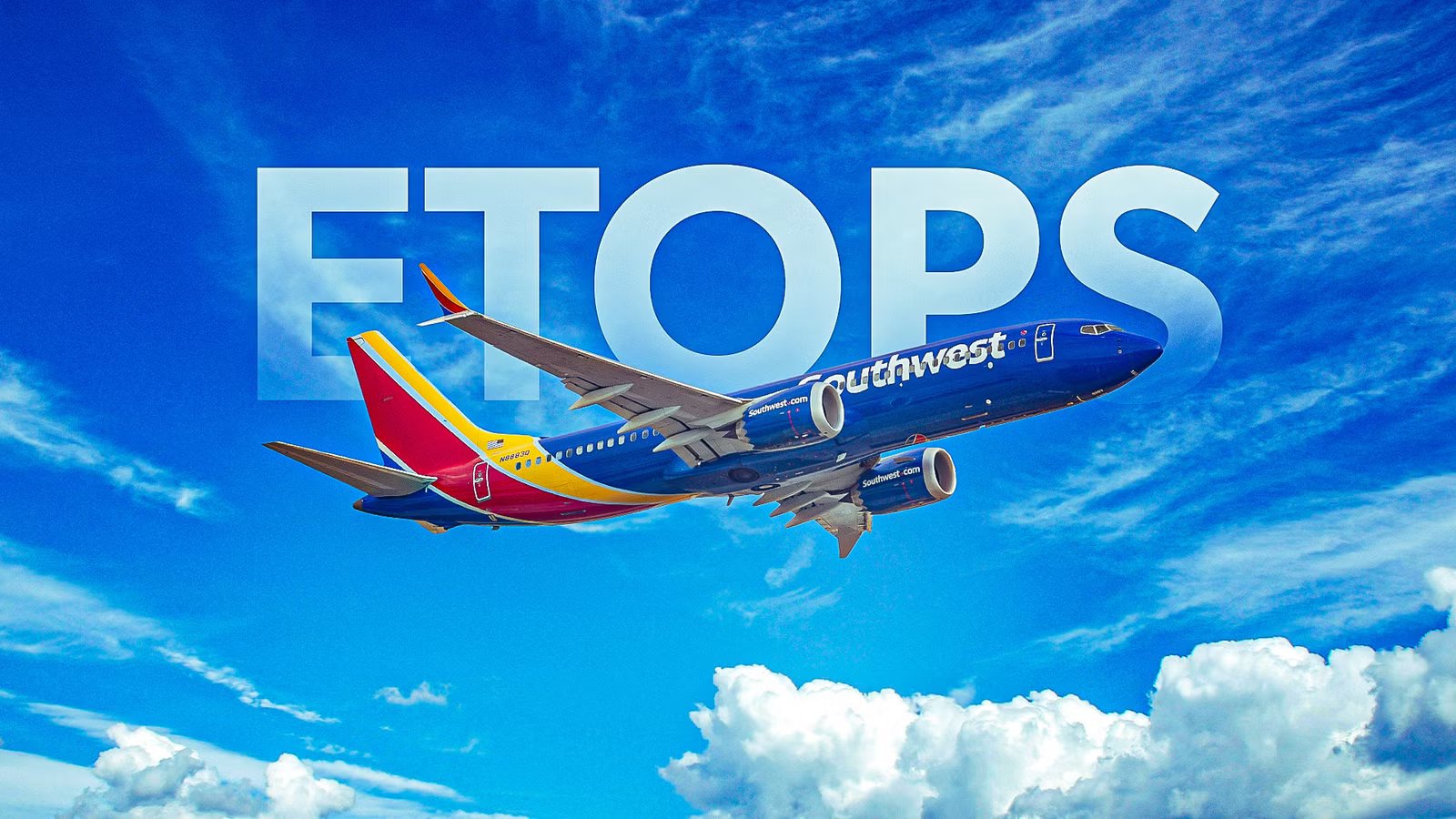
The  Southwest Airlines Boeing 737 MAX 8 is fully capable of long overwater flying in the right configuration, but that does not mean, on the fundamentals alone, that every MAX 8 in the fleet can simply be scheduled across the Pacific at will. The key issue is Extended-Range Twin-Engine Operational Performance Standards (ETOPS), the regulatory framework that governs twin-engine operations beyond a set diversion time from a suitable airport.
In practice, ETOPS is not just a model-wide label attached to the 737 MAX 8. It depends heavily on a combination of aircraft-specific approval, maintenance standards, dispatch procedures, crew training, route planning, and the airline’s broader operating program. This is a fundamental reason why Southwest’s Hawaii operation has always been more specialized than a casual observer might actually assume.
That ultimately makes Southwest an especially interesting case. The carrier built its Hawaii network only after receiving FAA ETOPS authorization in February 2019, then launched service the following month. Since then, its fleet has grown dramatically. Southwest ended 2025 with over 800 737s, including more than 300 MAX 8s, giving it one of the world’s largest MAX fleets.
However, fleet size alone does not guarantee universal overwater flight flexibility, particularly as the airline has also been reshaping its Hawaii schedule and trimming some island flying. The result is a fleet where the aircraft type may be common, but the operational permissions and mission profiles are not.
Southwest’s Fleet

The Southwest fleet remains one of the simplest in global aviation in pretty much all ways. This is very much true at the branding level, since passengers will only ever find one kind of jet. This strategy is incredibly important at the operational level as well. Southwest is still an all  Boeing 737 carrier, which helps it preserve the commonality that has long underpinned its low-cost model.
The airline uses this simple strategy to simplify pilot training, streamline maintenance, and maintain flexible crew and scheduling practices. Within that single fleet, the carrier operates three distinct sub-fleets with different roles in the network. At the end of 2025, the airline reported that it had 803 737s in service, including 300 737 MAX 8, alongside large numbers of older 737-700s and 737-800s. At a high level, the airline’s fleet is still fundamentally in transition.
The carrier is gradually retiring older 737NG jets while taking more MAX 8 deliveries, with 66 additional 737 MAX 8 jets expected to join the fleet in 2026 and roughly 60 retirements planned. That matters because the MAX 8 is not just newer but rather more fuel-efficient, better suited to longer sectors, and increasingly important to network planning. As such, while Southwest still looks uniform from the outside, its fleet is really a bridge between the legacy 737 era and a MAX-heavy future.
What Exactly Is ETOPS?

ETOPS is the set of rules that allows for a twinjet to fly routes that take it further than a prescribed diversion time from a suitable airport on one engine. At a high level, these regulations are about risk management for long overwater flights or remote operations. Instead of making the immediate assumption that a twin-engine aircraft should always remain close to land, regulators have now begun to allow longer routings.
This, however, only applies if the aircraft, air carrier, maintenance program, dispatch procedures, and crew training all meet stricter reliability and operational requirements. In other words, ETOPS is not just an aircraft capability, but rather an operational approval framework.
The FAA’s guidance describes ETOPS as approval for two-engine airplanes to operate on routes containing points more than one hour apart, at normal one-engine-inoperative cruise speed in still air, from an adequate airport. That matters to the Boeing 737 MAX family because the plane was designed with improved fuel efficiency and greater range, making it commercially useful on longer sectors, including long-haul overwater routes.
However, that range only becomes network-flexible when the airline has ETOPS approval in place and applies it to the relevant aircraft and operation. As for Southwest, ETOPS was the gateway to Hawaii service, and the airline says that the FAA formally approved its ETOPS authorization on February 27, 2019, before it moved to clear flights to Hawaii just a few weeks later. As such, while the 737 MAX 8 can be a strong ETOPS platform, not every MAX can automatically become Pacific-ready.
Why Are Only Some Southwest 737 MAX Jets Certified?

Only a small subset of Southwest 737s are ETOPS-certified because ETOPS is not a blanket label that automatically covers every aircraft of a given type. It is more so an operational approval tied to a specific aircraft, engine combination, maintenance program, dispatch system, and set of crew procedures.
In other words, only the aircraft that are enrolled in the approved ETOPS program, maintained to that standard, and documented accordingly can be used on long overwater routes such as flights to and from Hawaii. According to Southwest Airlines’ communications with Simple Flying, just 138 jets in Southwest’s fleet are ETOPS-certified.
This all matters for Southwest Airlines because ETOPS flying adds both cost and overall complexity. Aircraft used for these kinds of missions need tighter maintenance controls, additional planning, specific spare-parts and reliability tracking, and crews who are trained for extended-diversion operations. If an airline does not need every 737 for Hawaii or other remote overwater sectors, there is little reason to place the entire fleet under that more demanding regime.
Instead, it is more efficient to certify a subset of aircraft and rotate those jets into Pacific service. This is a key reason why Southwest’s fleet can be large and still not universally capable of crossing the Pacific. The MAX 8 is technically well-suited for ETOPS work, but operational approval is ultimately what matters most. A MAX 8 can be in the fleet without being one of the specific planes the airline has cleared and designated for those kinds of missions.
Is This A Common Practice Among Legacy Carriers?

Southwest is not unusual in this story. Many airlines certify only the portion of a fleet they actually need for extended overwater or remote operations. The reason is relatively straightforward. ETOPS approval is layered on top of normal operations, and it applies to specific airplane-engine combinations, maintenance programs, and operating authorizations rather than functioning as a simple fleetwide sticker.
FAA guidance explicitly ties ETOPS certification to specific planes and to a dedicated maintenance and reliability regime, all while Boeing notes that each airline must work with its regulator to obtain approval to implement and operate aircraft on these specific routes. In practice, that means that an airline often certifies the sub-fleet it expects to use on Hawaii, transatlantic, transpacific, or other diversion-sensitive flying, all while leaving other aircraft in ordinary domestic service.
That is rational in an economic sense. ETOPS brings tighter maintenance controls, added documentation, dispatch constraints, and crew procedures, so there is relatively little incentive to place every narrowbody under that regime if many will only spend their lives on short inland routes. The result is an industry pattern in which airlines frequently have aircraft of the same family, and sometimes even the same variant, with different overwater roles depending on how the operator has chosen to structure its ETOPS program.
How Much Does It Cost To ETOPS Certify An Aircraft?

There is no widely published or standard dollar figure for how much it costs to ETOPS-certify a 737 MAX. This is primarily because ETOPS certification is now typically bought in a per-aircraft fashion. Regulators mostly treat it as an operational move, as the airline must prove the aircraft-engine combination, maintenance program, dispatch procedures, crew training, parts support, and reliability tracking all meet the required standards.
The FAA and ICAO both frame ETOPS in this manner, emphasizing maintenance and flight-operations processes rather than a flat certification fee. As such, the real cost is programmatic and airline-specific. For a specific carrier, ETOPS expense usually sits in engineering work, manuals, compliance documentation, crew training, maintenance controls, spare-parts positioning, and ongoing reliability monitoring.
That means the cost can range from modest incremental spending to a much larger internal project if an airline is building out ETOPS capacity from scratch. Few public sources will provide a reliable single number for certifying a Southwest-style 737 MAX 8 ETOPS operation, and any hard figure would be extremely speculative.
The Bottom Line

At the end of the day, ETOPS certifications are a critical piece of how the modern aviation industry operates today. Without these much-needed certifications, it would be nearly impossible for the carrier to serve long overwater routes in an economical manner, limiting our ability to travel them as passengers.
Therefore, as airlines are businesses, they will naturally look to reduce costs as much as possible. Southwest’s decision to only pursue the entire ETOPS certification process for a small handful of its MAX jets is an excellent example of such cost-saving behavior. Certifying the entire fleet would be excessively expensive.
There are dozens of other airlines that have taken on this same operational philosophy. Overwater flight regulations are a bit different in foreign jurisdictions, but similar limitations are almost always placed on twin-engine aircraft flying far away from a diversion airport. This story highlights a true operational reality.