dailynewsnblog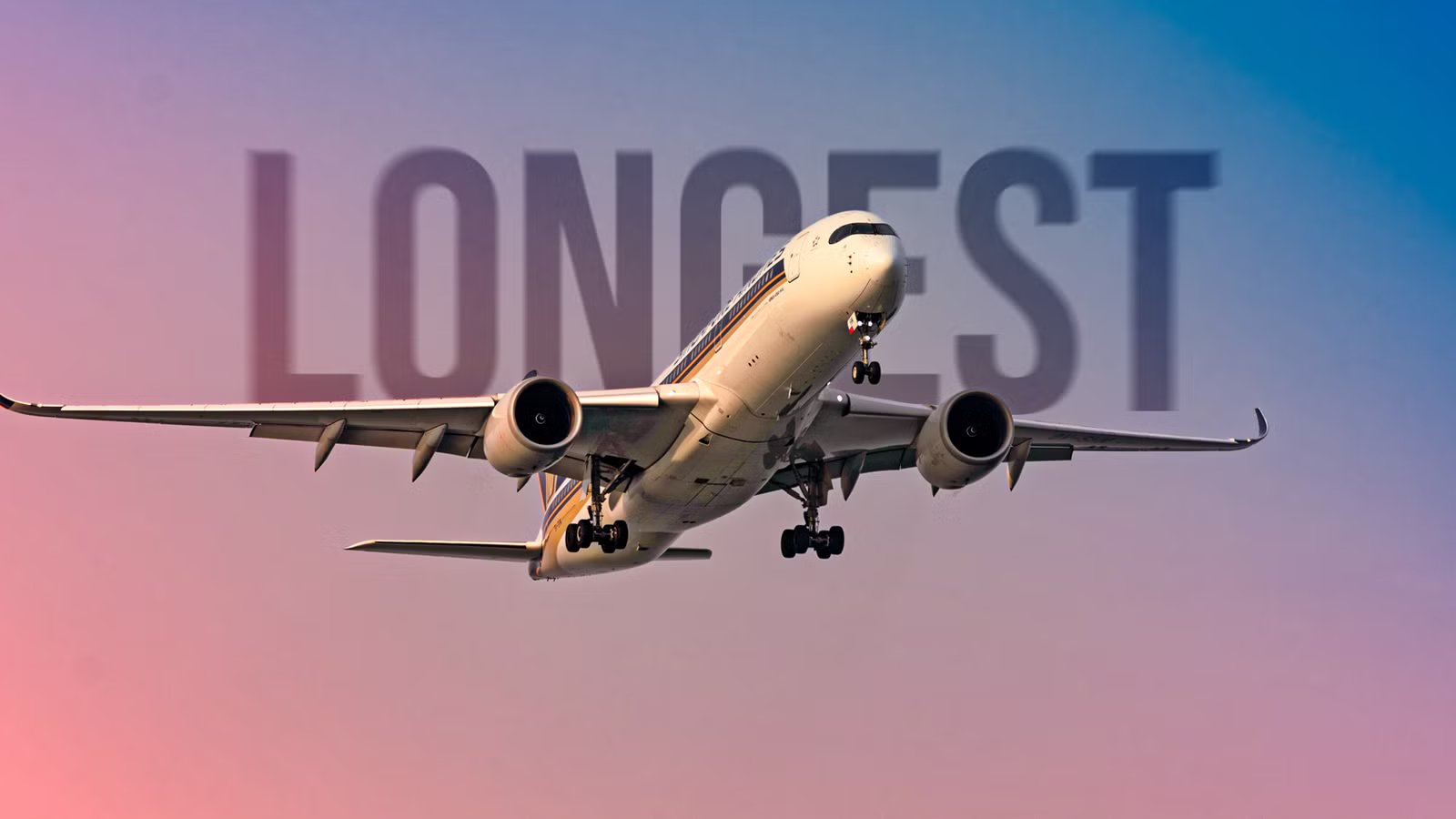
 Singapore Airlines has held onto one of commercial aviation’s most unusual records for years: its two services between Singapore Changi Airport (SIN) and New York spend close to 19 hours in the air, making them the longest nonstop commercial air routes. These routes survive because the
  Star Alliance carrier did not simply take an existing aircraft and ask it to fly further. Instead, it built its operation around the Airbus A350-900ULR, then paired its exceptional range with a deliberately small, premium-heavy cabin designed around the economics of an ultra-long-haul mission.
That formula remains difficult to copy, but the technology is moving on. Qantas’ Project Sunrise is preparing a specially modified Airbus A350-1000ULR for flights from  Sydney Kingsford Smith Airport (SYD) to both
  London Heathrow Airport (LHR) and New York John F. Kennedy International Airport (JFK), with additional fuel capacity and a cabin built around journeys of up to 22 hours. From 2027, the Australian carrier’s aircraft could therefore change the landscape of ultra-long-haul flying, although Singapore Airlines’ existing operation demonstrates why range alone is not enough to make such routes work.
The Aircraft That Made The Flight Possible

The key to Singapore Airlines’ success is the Airbus A350-900ULR itself. Singapore Airlines was the launch customer for the type, which can fly up to 11,160 miles (17,960 km), or more than 20 hours nonstop under suitable conditions. The aircraft was designed to handle missions that conventional long-haul aircraft could not serve efficiently, allowing Singapore Airlines to reconnect Singapore with both New York John F. Kennedy International Airport (JFK) and  Newark Liberty International Airport (EWR).
That capability was important because Singapore-New York pushes an aircraft close to the limits of what conventional widebodies could economically achieve. The route covers approximately 10,300 miles (16,700 km), while the scheduled journey can take up to 18 hours and 45 minutes depending on conditions. The Airbus A350-900ULR therefore provides enough capability to complete the sector while retaining the operational margins required for reserves, diversions and changing conditions.
The aircraft is also efficient enough to make such a demanding route more practical than it would have been with an older four-engine design. Its advanced aerodynamics, lightweight composite structure and efficient engines help reduce the fuel penalty associated with carrying enough fuel for an exceptionally long service. Singapore Airlines’ decision was therefore not simply to find an aircraft with the greatest possible range, but to operate a version of the Airbus A350 specifically suited to the commercial demands of ultra-long-haul flying.
Singapore Airlines Already Tried It Once

The current service is not Singapore Airlines’ first attempt at connecting Singapore and the New York area nonstop. The airline previously operated the route using the Airbus A340-500, beginning in 2004, but eventually suspended the service in 2013 as the economics of operating the very long sector with that aircraft became difficult. The return in 2018 was therefore based on a substantially different proposition, combining a more efficient aircraft with a cabin specifically configured for the mission.
When the Airbus A350-900ULR entered service in October 2018, Singapore Airlines launched the world’s longest commercial flight between Singapore Changi Airport and Newark Liberty International Airport. The aircraft was configured with 161 seats, comprising 67 business class seats and 94 premium economy seats, and Singapore Airlines initially planned to use it on other ultra-long-haul services as well.
The lesson from the earlier Airbus A340-500 operation was that range alone does not make an ultra-long-haul route commercially viable. Fuel represents a major part of the equation, but so do payload, ticket yields, crew costs, airport fees and the number of seats that can be filled at sufficiently attractive fares. The A350-900ULR gave Singapore Airlines a much more efficient platform, while the airline’s network provided the demand needed to support it over the long term.
The Unusual Cabin Makes The Numbers Work

Singapore Airlines originally configured its Airbus A350-900ULRs with just 161 seats, consisting of 67 business class seats and 94 premium economy seats. There was deliberately no economy class cabin. That decision sacrificed the large volume of lower-fare passengers normally used to fill a long-haul widebody, but it also reduced weight and gave Singapore Airlines much more space to sell higher-yield seats on a flight where every kilogram matters.
That configuration also says something about the market behind the route. Singapore and New York are major international business centers, and the nonstop service removes the need for a connection while linking two destinations with substantial corporate and premium leisure demand. Singapore Changi Airport also functions as a major connecting hub for the Star Alliance carrier, meaning passengers can originate elsewhere in Southeast Asia and beyond while using one of the nonstop New York flights as the long central segment of their journey.
The commercial logic has remained flexible as Singapore Airlines has adjusted its Airbus A350-900ULR fleet and cabins, continuing to emphasize premium accommodation and the passenger experience. That approach reflects the unusual economics of a flight that spends most of a day in the air, where carrying fewer passengers who generate stronger revenue can be more important than filling every available seat.
Why Other Airlines Have Not Simply Copied It

The difficulty for competitors is that an ultra-long-haul aircraft can be highly specialized. An airline buying an aircraft capable of flying nearly 11,000 miles (17,700 km) cannot necessarily use that capability profitably every day. If the aircraft spends much of its time flying shorter routes, the additional fuel capacity and reduced seating density become expensive features that provide little benefit. The ideal operator therefore needs both the aircraft and a route where passengers value nonstop travel enough to support the premium.
There is also the problem of operational margins. A flight of nearly 19 hours leaves little room for inefficiencies, and strong headwinds can materially affect fuel consumption and payload. Airlines must also account for diversion airports, reserve fuel, crew duty limitations, and cargo. Every additional passenger, bag, or piece of freight has to be considered alongside the fuel required to carry it, making weight management unusually important on these missions.
The route itself also needs sustained demand in both directions. A spectacularly long flight can attract attention, but publicity does not guarantee profitability. Singapore Airlines has spent years developing its premium brand and its award-winning hub at Singapore Changi Airport, while the Singapore-New York market combines business, leisure and connecting traffic. That established network is one reason the airline can continue operating a service that would be difficult for a carrier without the same hub structure to replicate.
Qantas Is Building The Next Ultra-Long-Haul Aircraft

The most significant development in this part of aviation is already taking shape in Toulouse. Qantas has ordered 12 specially configured Airbus A350-1000ULR aircraft for Project Sunrise, an aircraft program designed specifically to connect Australia with destinations such as London Heathrow Airport and New York John F. Kennedy International Airport nonstop. Each aircraft has an additional 20,000-liter fuel tank and is designed to fly more than 10,000 miles (16,000 km) for up to 22 hours nonstop.
The aircraft is larger than Singapore Airlines’ Airbus A350-900ULR and is being designed around a substantially different cabin philosophy. Qantas has specified just 238 seats across four cabins, making it one of the lowest-density Airbus A350-1000 configurations in the world. More than 40% of the seats are in premium cabins, while the aircraft will also feature a dedicated Wellbeing Zone between premium economy and economy class.
Project Sunrise is therefore not simply an attempt to fly farther with more fuel. Qantas has worked with the University of Sydney’s Charles Perkins Centre on lighting, meal timing, cabin design and passenger wellbeing, while the aircraft also includes additional crew-rest provisions and specialized systems. The result is another integrated ultra-long-haul platform, although Qantas has chosen to retain an economy class cabin rather than follow Singapore Airlines’ all-premium approach.
The Potential Replacement Is Already Flying

The first Project Sunrise Airbus A350-1000ULR completed its maiden test flight in June 2026, beginning the testing and certification campaign for the specialized systems required for ultra-long-haul operations. The first test flight lasted three hours and 43 minutes, while the aircraft’s specialized fuel system, including the additional 20,000-liter rear-center tank, is designed to support commercial flights lasting as long as 22 hours.
Qantas now expects the first Project Sunrise aircraft to be delivered in April 2027, with daily nonstop Sydney-London services scheduled to begin in October 2027. Tickets are due to go on sale in February 2027, while Sydney-New York has been confirmed as the next service after London, although its launch timing has not yet been announced.
That means Singapore Airlines’ position in ultra-long-haul aviation is not being challenged because its Airbus A350-900ULR has suddenly become inadequate. Instead, Qantas is taking the same fundamental concept into a new generation: put enormous fuel capability into an efficient twin-engine widebody, reduce conventional seating density, and build the passenger experience around a journey that can last almost an entire day. When Project Sunrise enters commercial service, the longest-flight record may therefore move to a new route, but the underlying formula pioneered by Singapore Airlines will remain at its core.