dailynewsnblog
The  Boeing E-3 Sentry has been the eye in the sky of the US Air Force for nearly as long as the service has flown jet-powered aircraft. Once a fleet of 31 jets, the number of these sophisticated Airborne Warning and Control System (AWACS) airframes has dwindled to half that number. The E-3 Sentry has continued to serve despite its obsolescence and very low rate of readiness for some time now because the only proposed replacement programs are nearly as prohibitively expensive as the cost to upgrade the Sentries.
Now, the 16 survivors are on the chopping block due to ever-increasing maintenance costs, declining readiness levels, and obsolete capabilities. Boeing and Northrop Grumman have essentially divested themselves from overhauling or upgrading the E-3 fleet. Since the E-3 airframe is so old, any major work on the dome mounts involves invasive structural repairs. The liability risk of the airframe cracking or failing while under the stress of a dome removal is so high that contractors demand astronomical insurance and labor premiums.
In 2025, the Department of Defense opted to shelve the E-7 procurement program in favor of acquiring Northrop Grumman E-2D Hawkeye airborne early warning aircraft that have been proven in service with the US Navy. The cost of the E-7 rose to over $700 million last year, up by 23% from the last round of negotiations, while an E-2D is no more than $300 million.
The turboprop E-2D is significantly cheaper per unit, but critics view this as a capability downgrade because the carrier-borne turboprop lacks the range, altitude, and crew capacity of the jet-powered E-3 or E-7. Despite the lack of a clear successor, the E-3 is quickly becoming nearly impossible to keep in the air.
The Struggle To Sustain The Eye In The Sky

Northrop Grumman is the supplier of the E-3’s enormous radar array fitted inside the rotating dome that towers above the fuselage. While the Boeing 707, on which it is based, is already nearly impossible to sustain, the rotodome is even more insurmountable. NG has essentially said that replacing one in the case of catastrophic damage is impossible ‘at any price on any timeline’ because all the manufacturing equipment and specialized skills to work on them have been retired for decades.
The Block 30/35 program ran from 1987 to 2001 and included upgrades to the aircraft’s computer processing power, datalinks, and GPS navigation. The Block 40/45 program started in 2003 and included upgrades to the aircraft’s electronic support measures, datalink/spectrum management, and battle management computer systems. Still, the E-3 has reached the end of its operational life, struggling with technological gaps that make it ineffective in 21st-century combat.
According to Task And Purpose, General Mark Kelly, then the head of Air Combat Command, described the fleet in these words to reporters in 2022:
“We basically have 31 airplanes in hospice care, the most expensive care there is. And we need to get into the maternity business and out of hospices.”
Being built on the 707 airframe, parts must often be scavenged from boneyards. In the rapidly evolving domain of air warfare in 2026, the antiquated E-3 fleet requires billions of dollars in modernization to overcome technological limitations and a vanishing supply chain. The previous round of upgrades, costing $2.7 billion, has made the jets an even more complex hybrid of digital-analog systems patched together.
The Trouble With Boeing And Replacing The Sentry

While Australia successfully fielded the E-7 years ago, subsequent customers have faced a much more difficult experience with Boeing. The United Kingdom expected a proven, Australian-standard aircraft. Instead, they faced very significant delays due to producer timing and the need to re-certify components that became obsolete while waiting for Boeing to deliver.
What was once considered the only off-the-shelf solution for airborne early warning has become a program now described by UK Ministry of Defense officials as being led by a ‘troubled partner.’ Even Australia, the original developer, confirmed in 2026 that it is already seeking a replacement for its E-7 fleet. According to Air Force technology, it will start in 2029 under Project AIR7002, clearly showing a desire to move away from the platform after a very short tenure.
The North Atlantic Treaty Organization, which flies E-3s, and individual members like France are turning to the Saab GlobalEye instead of the E-7. The GlobalEye is seen as a more modern, modular alternative that avoids ‘gold-plated’ American costs. South Korea also recently rejected the E-7 in favor of an L3Harris proposal using Bombardier aircraft.
Despite Pentagon attempts to shift funding, Congress has intervened, authorizing funds to keep the E-7 program alive and prohibiting further E-3 retirements until a replacement is active. The USAF attempted to cancel its own E-7 buy in mid-2025, citing costs that hit $724 million per jet. The service has grown increasingly skeptical of Boeing’s ability to deliver on schedule, given its widespread internal industrial struggles.
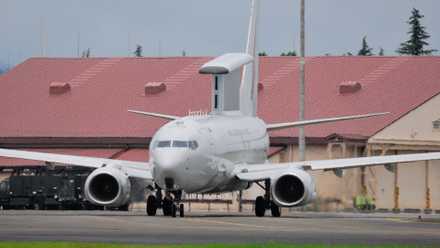
US Lawmakers Block Cancellation Of Boeing E-7 Wedgetail Program
US lawmakers block Pentagon plans to cancel the Boeing E-7 Wedgetail, preserving funding for the Air Force’s next-generation surveillance aircraft.
4th-Gen Tactics For A 6th-Gen Battle?

The basic design principles of the Sentry have also called into question its viability on the 21st-century battlefield. For most AEW and AWACS aircraft, the defining feature is a large, rotating radar dome capable of long-range, all-altitude surveillance and target tracking. The E-3’s advanced radar is integrated with identification friend or foe capabilities to allow detection, identification, and tracking of both friendly and hostile aircraft. Both the Sentry and Wedgetails are like ‘giant lightbulbs’ in the electromagnetic spectrum. Their powerful active radars make them easy to detect from hundreds of miles away, even if they stay in friendly airspace.
The E-7 differs because of its fixed array; it remains a highly vulnerable target in the modern battlefield. Modern air defenses, which would normally be present in any conflict where an AWACS platform is deployed, are generally considered to be extremely lethal to any non-stealthy airframes. A March 2026 missile and drone attack on Prince Sultan Air Base damaged an E-3G, highlighting that these assets are high-priority targets even when on the ground, as Air and Space Forces magazine reported.
While the E-7 provides a massive leap in sensor capability via its AESA radar, many strategists question whether any large, airliner-based platform can survive modern ‘AWACS-killer’ weapons. Near-peer adversaries have developed missiles specifically designed to target AWACS from extreme distances, like the Chinese PL-15 with a 124+ mile (200+ km) range. Then there’s Russia’s S-500 system, which claims to hit targets as far as 370 miles (600 km).
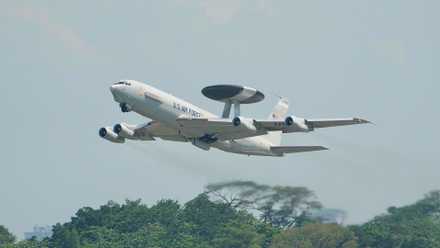
Rare US “Eye In The Sky” Command Plane Destroyed In Iran Strike On Saudi Air Base
The US has just a handful of E-3 Sentry’s in mission-capable condition.
Is AWACS Going To Space?

The Pentagon has attempted to cancel the E-7 program in favor of space-based surveillance like the Golden Dome. Space sensors are seen as more resilient and decentralized, though experts argue they currently lack the resolution and real-time battle management of an aircraft. When it comes to air warfare, just one second can be the difference between life and death. Radar effectiveness decreases significantly with distance. Placing a radar in space adds at least 100km of range compared to an aircraft, requiring massive amounts of power to maintain the same detection sensitivity.
Moving the flying command post to outer space introduces extra steps that delay the time from detection to when an air controller can actually communicate with troops on the ground or crewed aircraft in the battle space. Then there’s the question of cost, and in this case, Space Systems once again do not show much promise. Estimates for a comprehensive space shield like the Golden Dome range from $185 billion to as high as $3.6 trillion, according to the Joint Air Power Competence Center.
However, there are a number of upsides to this possibility, which is why it has been considered at all. Naturally, by virtue of being in orbit, satellites are beyond the reach of AWACS-killer missiles. Satellites provide continuous, 360-degree coverage of the entire globe, and they are not subject to terrain masking because the radar points down from above at all times. New space-based sensors, such as the Hypersonic and Ballistic Tracking Space Sensor, are also specifically designed to track low-flying, highly maneuverable hypersonic missiles, which air and ground-based radar sensors may not be able to detect.

The Royal Saudi Air Force’s E-3 Sentry AWACS Upgrade: What To Know
What is next for one of America’s closest allies in the Middle East as they get ready to modernize their fleet of rare and powerful Boeing E-3 AWACS?
The Air Force’s Compromise: A Hybrid Future

One of the most likely outcomes anticipated for the modernization of the US Air Force fleet of AWACS as they inevitably reach the end of their service lives is a new force composed of a hybrid structure. This would incorporate different airborne platforms like the E-7 and E-2D in a ‘high-low’ fleet composition complemented by space-based sensors.
If adopted, the lower-cost Hawkeye will serve as a bridge to a more capable airborne platform, whether that is eventually the Wedgetail or not. This would buy time for the USAF by providing essential radar coverage while the E-3 fleet is retired and more advanced systems mature. A small fleet of E-7s could serve as niche support platforms for the most demanding missions.
The long-term goal would be to shift the airborne moving target indication mission to space. While the US Space Force is aggressively funding this, the technology is still years from being a full replacement for manned battle management. Meanwhile, the Pentagon is exploring the use of stealth drones and crewed stealth aircraft, which are equipped with powerful radar and have the ability to fly inside integrated air defense networks.
Leveraging the advanced AESA radars on the Lockheed Martin F-35 Lightning II and Northrop Grumman B-21 Raider, as well as other advanced aircraft, to network sensor data together. Combining their high-quality sensors with data networking reduces the need for a single large picture of the battlespace for all US and partner forces.