dailynewsnblog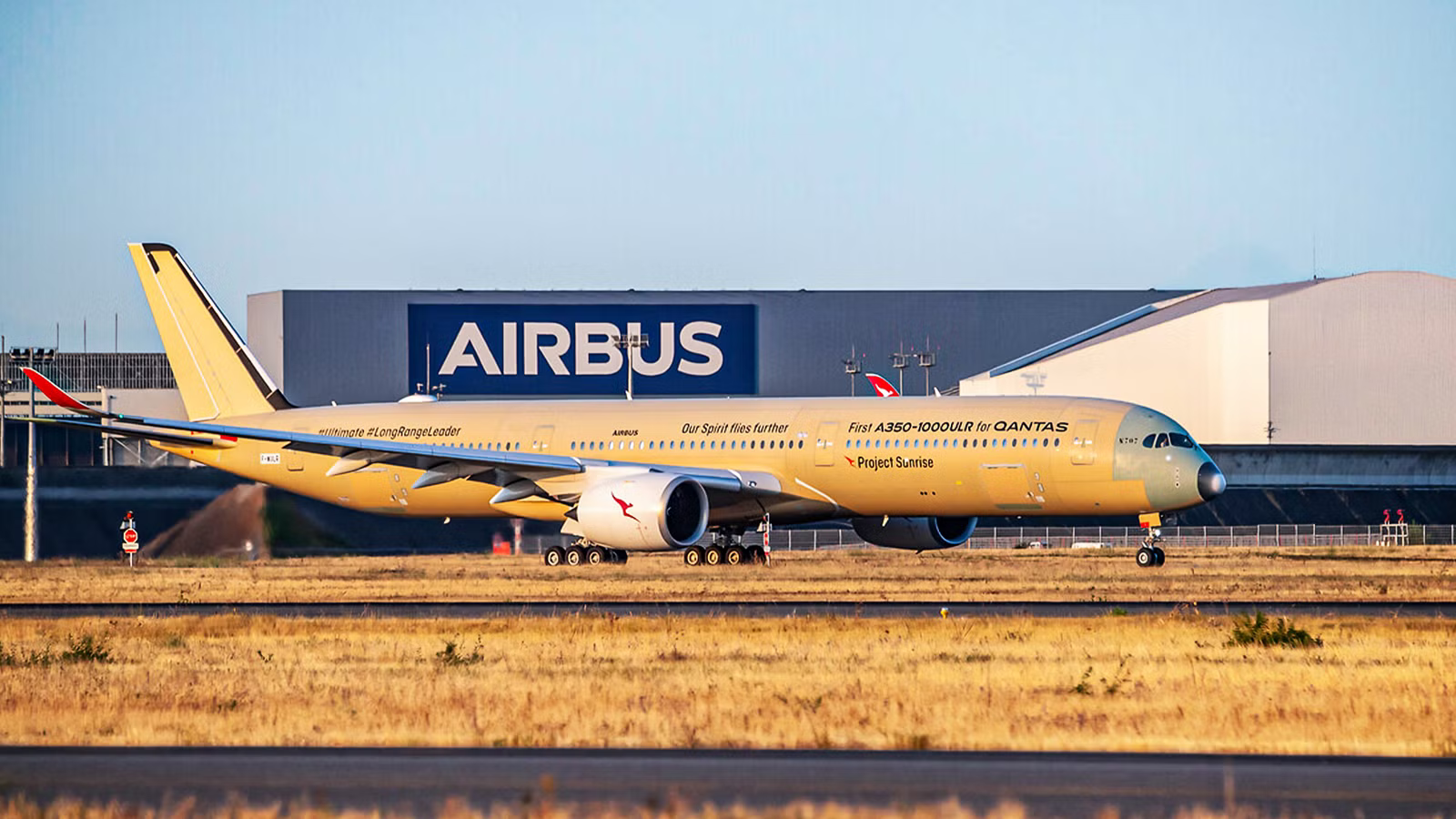
Qantas Project Sunrise is among the most ambitious commercial flight programs ever launched, with the goal of connecting London and New York to Sydney by the end of 2028. To achieve this, Qantas and Airbus teamed up to design the Airbus A350-1000ULR, the longest-range commercial twin-engine aircraft ever built. Created as an ultra-long-range variant of the A350-1000, the -1000ULR adds an extra 20,000-liter rear center fuel tank to allow for routes nearly 10,000 nautical miles long (18,500 km).
However, the additional fuel capacity comes with significant engineering and operational compromises. Unlike other long-range offshoots, the A350-1000ULR’s rear center tank is integrated directly into the aircraft’s structure. With Qantas’ first type expected to arrive in early 2027, with commercial operations targeted for October of that year, Airbus and Qantas have nearly completed the required ground and flight testing focused on the fuel tank that no other airline has ever ordered.
The Airbus A350-1000ULR: Redefining Ultra-Long-Haul Travel

The Airbus A350-1000ULR is not an entirely new aircraft design. Instead, it is a highly specialized version of the A350-1000, developed specifically to meet the requirements set out by Qantas’ Project Sunrise to operate the world’s longest flights from Australia. The standard Airbus A350-1000 already offers an impressive range of approximately 9,000 nautical miles (16,700 km), making it capable of operating flights stretching 15, 16 or even 17 hours long. However, flying from Australia’s east coast to the United Kingdom or the US east coast nonstop requires considerably more endurance than even the A350-1000 can provide, hence the A350-1000ULR.
According to Airbus’s own data, the ULR variant of the A350-1000 can fly nearly 10,000 nautical miles (18,500 km), made possible largely by the auxiliary fuel tanks installed on the aircraft. Additionally, in contrast to the A350-1000, which was designed to combine range and passenger capacity, the A350-1000ULR takes inspiration from the Airbus A350-900ULR, used by  Singapore Airlines to connect Singapore and New York nonstop, offering a seating capacity of only around 240 seats. This greatly reduced seating capacity, about 24% lower than even Delta Air Lines’ upcoming ultra-premium A350-1000 layout, helps lower the weight of the aircraft and improve fuel endurance.
24-Hour Flights Are Now Possible Thanks To The 20,000 Liter Rear Center Tank

For years, the central challenge behind Project Sunrise was that the aircraft must carry enough fuel to remain airborne for nearly an entire day. The major limiting factor is the weight of jet fuel, which weighs about seven pounds per gallon. A standard A350-1000 already carries a substantial fuel load with a capacity of roughly 156,000 liters. The A350-1000ULR takes this a step further with a capacity for almost 180,000 liters of fuel, giving Project Sunrise aircraft the endurance required for its demanding missions.
The auxiliary fuel tank design that enables this extra capacity and range is unique. Airbus has integrated the extra fuel tank, also known as the “Rear Center Tank,” into the aircraft’s rear center section, allowing the A350-1000ULR to carry additional fuel without a major fuselage redesign. This special tank can hold up to 20,000 liters (about 5,283 gallons) and dramatically increases the aircraft’s range for ultra-long-haul flights.
Because the rear center tank and extra fuel add weight, Airbus had to make a series of major changes for the A350-1000ULR. Most significantly, the A350-1000ULR will have a much higher maximum takeoff weight (or MTOW) due to the additional fuel, something that requires numerous additional ground and inflight tests before certification. While the specifics of the ULR’s new MTOW have not been released, the A350-1000 already has a MTOW of 710,000 pounds (322 tonnes). As a point of reference, the difference in takeoff weight between the A350-900 and A350-900ULR is approximately 30,000 pounds (12 tonnes), meaning the A350-1000ULR could have a MTOW of nearly 750,000 pounds (340 tonnes), about the same as the Boeing 747-100.
The Engineering & Modifications Behind The Rear Center Tank

While it may sound simple, adding a fuel tank to an aircraft is considerably more complicated than just placing another container in the back of a plane. With the A350-1000ULR, the decision to integrate the rear center tank directly into the fuselage of the airplane, several other significant engineering modifications had to be made. Hidden to passengers but critical to the ULR’s stability are the aircraft’s reinforced landing gear, designed to handle the additional weight on takeoff and landing. Airbus also added taller blended winglets and optimized the A350-1000ULR’s wing aerodynamics to ensure effective climb rates at a heavier gross weight.
Catch what other flight trackers miss
Emergency squawks, holds, NOTAMs — live signals, no signup.
Open tracker
Catch what other flight trackers miss
Emergency squawks, holds, NOTAMs — live signals, no signup.
Open tracker
Several computer systems also required modifications, including the flight management and fuel balancing systems. These received software upgrades to handle the complex fuel distribution inherent in an additional fuel tank, which is crucial to keeping the aircraft’s center of gravity within limits throughout the flight.
The engines powering the ULR also require major upgrades. Currently, the A350-1000 utilizes two Rolls-Royce Trent XWB-94 engines, some of the highest-thrust engines available on the market. The A350-1000ULR, however, takes this to the next level, with dual Rolls-Royce Trent XWB-97 engines, the most powerful ever fitted onto an Airbus aircraft. These engines, rated for 97,000 pounds (430 kN) of thrust during takeoff, offer a 25% reduction in CO2 emissions and fuel burn compared to previous-generation aircraft. They are also rated for 3,000 pounds more thrust than the XWB-94 and 13,000 pounds more than the XWB-84, the engine powering the A350-900.
Therefore, introducing the rear center tank required extensive design and certification work. Airbus and Qantas have worked with aviation regulators to ensure that the modifications meet the necessary safety requirements. The unusual nature of the rear center tank means that its structural integrity and performance must be thoroughly demonstrated before the aircraft can enter service. With that in mind, Airbus’ first production A350-1000ULR has already broken records during its extensive in-flight testing program.
24 Hours & 24 Minutes: Qantas’ A350-1000ULR Has Already Flown The Longest Flight Ever

In April 2026, Qantas’ first Airbus A350-1000ULR was rolled out from Airbus’ Toulouse final assembly line in France. Carrying the French test registration of F-WZNK and unpainted except for the winglets and engine, the first A350-1000ULR was ready to complete test flights to prepare for Project Sunrise. The aircraft is expected to be officially certified by early 2027 before being ferried to Sydney, where Qantas will conduct crew familiarization training ahead of the launch of Sydney to London service in late 2027.
While still ongoing, one of the most impressive feats of the -1000ULR’s test program so far came in July 2026. After flying nonstop from Toulouse to Melbourne, F-WZNK completed the longest-ever commercial flight, flying east from Melbourne across the Pacific Ocean, North America, and the Atlantic before touching down 12,460 nautical miles later in Toulouse. In total, the flight lasted a whopping 24 hours and 24 minutes.
Both the outbound flight to Melbourne and the return to Toulouse gave Airbus valuable insight into how the aircraft’s fuel system and performance will hold up over an exceptionally long period. The test aimed to demonstrate the aircraft’s ultra-long-haul capabilities by flying much longer than the planned 21- to 22-hour Project Sunrise flights. Additionally, the flight evaluated the cabin environment and other systems required for ULR operations, ensuring the plane could provide a reliable and comfortable environment during the longest scheduled passenger flights in the world.
Carrying More Fuel Means Less Passengers And More Premium Seats

The additional fuel required for Project Sunrise has a direct impact on the aircraft’s cabin. Similar to Singapore Airlines’ Airbus A350-900ULR, which has a capacity for just 161 passengers across a two-cabin configuration, down from 253 on its standard international A350-900s, Qantas’ A350-1000ULR will accommodate just 238 passengers. The cabin will feature six first class suites, 52 business class suites, 40 premium economy seats, and 140 economy class seats, making it the lowest-density A350-1000 configuration in the world.
Perhaps the most exciting part of Qantas’ A350-1000ULR layout is its six brand-new first-class suites at the front of the aircraft. All six suites feature a separate 22-inch (56 cm) wide armchair and 80-inch (203 cm) by 28-inch (71 cm) lie-flat bed. Naturally, each suite will be surrounded by a 57-inch (140 cm) tall wall, complete with a sliding privacy door. While not as tall as what travelers can find in Singapore’s Suites or Etihad’s Residence, the suite still promises an exceptional level of privacy and comfort for 20+ hour flights to Australia.
Onboard, passengers can also enjoy a personal wardrobe, a massive 32-inch in-flight entertainment screen, and a separate tablet that controls the suite’s lighting, temperature, and other elements. Additionally, first class guests will find a full duvet set, multiple pillows, slippers, pajamas, and complimentary noise-canceling headphones for in-flight use. Restaurant-quality dining will also be available throughout the flight, served alongside a wide range of alcoholic and non-alcoholic beverages.
Behind the first class cabin, Qantas will introduce a new business-class suite with a sliding privacy door. Each suite features many of the same features as first class, with a smaller footprint and a combined seat-and-bed setup. Next, Qantas will add a premium economy cabin in a 2-4-2 configuration. Each seat is fairly standard for premium economy, with privacy winglets, generous recline, and an extendable footrest. For those making the long journey in economy, Qantas has elected to go with a generous 33-inch seat pitch, among the highest of any airline. Wellness zones will also be available for all passengers to provide a space to stretch and relax during the flight.
London & New York: Inside The 2027 Project Sunrise Plan

After years of development, Project Sunrise is approaching its commercial debut. Qantas’ first Project Sunrise A350-1000ULR flights are scheduled for October 2027, beginning with nonstop flights between Sydney (SYD) and London Heathrow (LHR). The airline also recently confirmed that Sydney to New York-JFK flights will launch in 2028, complementing a once-daily one-stop option via Auckland (AKL). Flights for Qantas’ London service will go on sale in February 2027, with tickets for New York available starting August 2027.
When launched, London to Sydney will become the longest commercial flight in the world, topping Singapore Airlines Singapore (SIN) to New York (JFK) A350-900ULR service. At 10,573 nautical miles (19,581 km), this route will take almost 21 hours from start to finish. New York to Sydney will become the second-longest flight in the world, just slightly longer than SIN – JFK at 9,950 nautical miles (18,427 km).
Both routes still depend on Airbus certifying the A350-1000ULR as soon as possible, giving Qantas enough time to complete the induction process and crew familiarization training, likely on medium-haul regional flights within Australia or to nearby Asian destinations. Qantas will also need multiple A350-1000ULRs before it can launch either route, with at least four aircraft likely required to launch London service due to the time in air and the need for a spare aircraft in case of maintenance issues. Nevertheless, Project Sunrise is close on the horizon and will be made possible by the A350-1000ULR’s impressive capabilities.