dailynewsnblog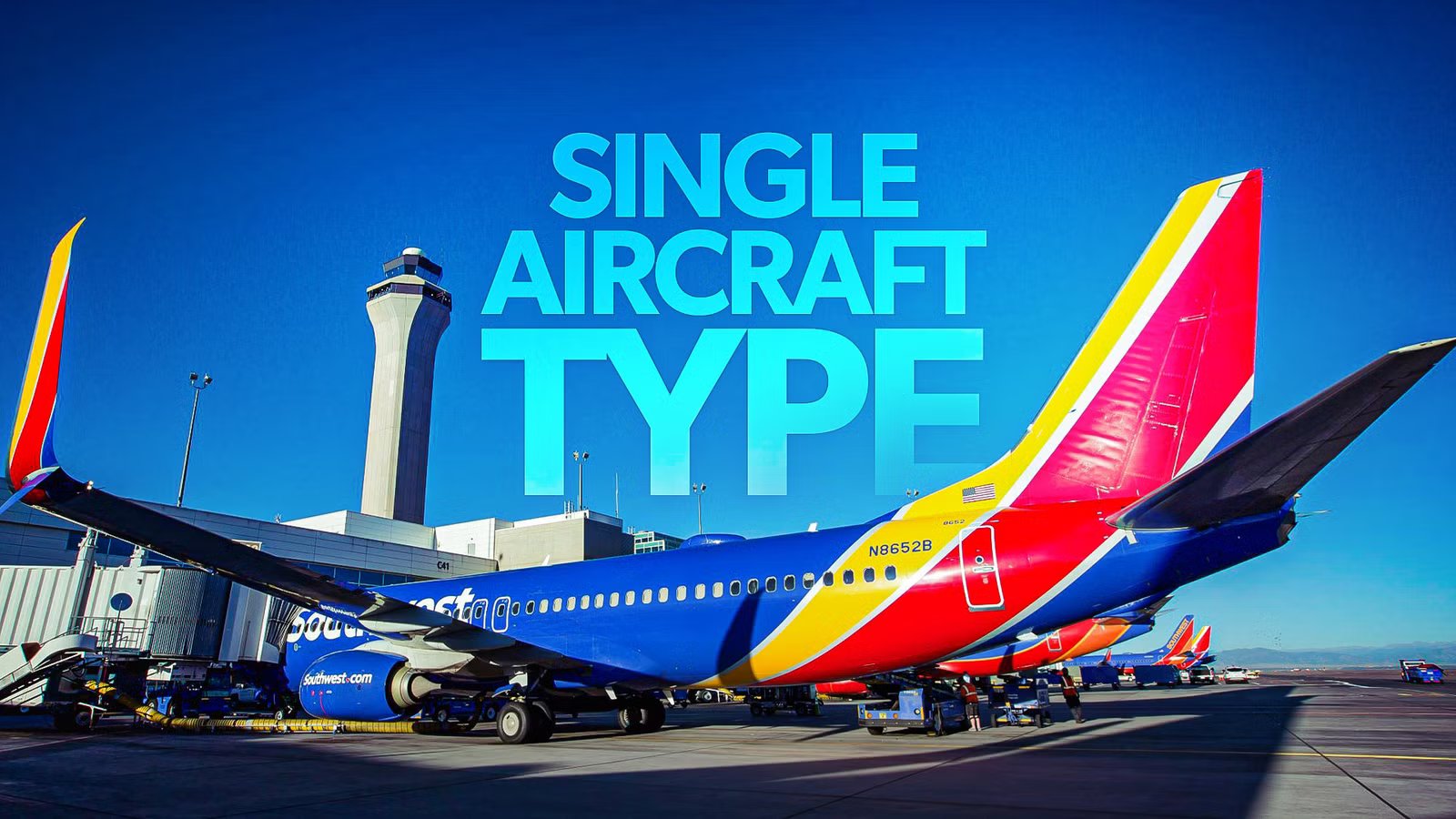
Southwest Airlines’ decision to commit its entire operation to a single aircraft type stands as one of the most distinctive strategic bets in modern aviation. While most global carriers have diversified fleets designed to serve everything from short regional hops to ultra-long-haul international routes,  Southwest Airlines chose a radically different path, one built on uniformity, repetition, and operational simplicity.
At the center of that decision is the Boeing 737, an aircraft that has become inseparable from the airline’s identity. The logic behind this strategy dates back to the airline’s earliest days and reflects a broader philosophy about efficiency and cost discipline. At face value, the idea of relying entirely on one aircraft type might appear limiting.
However, Southwest Airlines has transformed it into a powerful competitive advantage, enabling rapid growth, high utilization, and industry-leading turnaround times. Yet this same decision has also introduced risks that have become increasingly visible in recent years, particularly as the development challenges experienced by  Boeing have directly affected the airline’s future plans.
A Philosophy Built On Simplicity

The foundation of Southwest Airlines’ single-aircraft strategy can be traced to co-founder Herb Kelleher, whose approach to running an airline emphasized simplicity over complexity at every level. From the beginning, the company avoided the layered operational structures that characterized legacy carriers, instead focusing on a model that minimized variables and maximized efficiency.
Choosing one aircraft type was a natural extension of that mindset, unlike the major US legacy carriers such as  American Airlines,
  United Airlines, and
  Delta Air Lines. Operating a single-type fleet allowed Southwest Airlines to eliminate an entire category of logistical complications.
There was no need to maintain different pools of spare parts for different aircraft, no requirement for multiple pilot certifications across various types, and no necessity to tailor maintenance programs to a wide range of aircraft. Every operational decision could be standardized, which in turn reduced costs and improved reliability.
This simplicity extended beyond maintenance and training into broader operational planning. By removing fleet diversity, Southwest Airlines created a system where aircraft could be swapped, reassigned, or rotated across routes without friction. The result was an airline that could react quickly to disruptions and maintain a level of flexibility that more complex carriers struggled to achieve.

What Airlines Operate An All-Boeing Fleet?
Some of the world’s largest and most iconic airlines exclusively operate Boeing fleets.
The Economics Of Fleet Commonality

At the heart of Southwest Airlines’ strategy lies the economic principle of fleet commonality, which delivers compounding cost advantages over time. By operating only the Boeing 737, the airline has been able to streamline maintenance processes in ways that few competitors can match. Mechanics develop deep specialization in a single aircraft family, improving efficiency and reducing the likelihood of errors.
Training costs are similarly reduced, as pilots certified on one variant of the Boeing 737 can transition more easily to others within the same family, and cabin crew procedures remain consistent across the fleet. This uniformity simplifies scheduling, allowing Southwest Airlines to assign crews dynamically without worrying about aircraft-specific qualifications.
The benefits extend into procurement and inventory management as well, and spare parts can be standardized across the fleet, reducing the need for large inventories of specialized components. Over time, these savings accumulate, contributing to the airline’s ability to maintain low fares while remaining profitable.
This approach also supports higher aircraft utilization, which is a key driver of airline economics. Aircraft generate revenue only when they are in the air, and Southwest Airlines’ model is designed to minimize the time aircraft spend on the ground. By removing operational complexity, the airline ensures that its fleet can be turned around quickly and kept flying for as many hours per day as possible.
Fast Turnarounds & Operational Discipline

One of the most visible outcomes of Southwest Airlines’ single-fleet strategy is its ability to achieve rapid turnaround times. The airline has long been known for turning aircraft in as little as 20 minutes, a benchmark that has influenced other low-cost carriers and ultra-low-cost carriers such as Frontier Airlines and Spirit Airlines. This capability is closely tied to the consistency provided by operating a single aircraft type.
Ground crews become highly efficient when they perform the same tasks repeatedly on identical aircraft. There is no need to adjust procedures for different cabin layouts or cargo configurations, and equipment can be standardized across all operations. This repetition leads to speed, and speed translates directly into increased aircraft utilization. Southwest Airlines reinforced this advantage through other operational choices, such as its former open seating policy.
By eliminating assigned seating, the boarding process became faster and more predictable, further reducing time on the ground. These decisions are interconnected, forming a cohesive system in which each element supports the others. However, Southwest recently removed this quirk in favor of assigned seating, drawing a furious reaction from many of its frequent flyers.
In any case, its uniform fleet means that it can operate more flights per day with the same number of aircraft compared to competitors with more complex fleets. This efficiency has been a cornerstone of Southwest Airlines’ business model, enabling it to offer frequent service on point-to-point routes while maintaining competitive pricing.

This Is How Short Southwest Airlines’ Turnarounds Used To Be
Southwest Airlines once pulled off the impossible, using an ambitious strategy to save the company.
Scale & Commitment To The Boeing 737

Over time, Southwest Airlines’ commitment to the Boeing 737 has only deepened. Today, the airline operates 810 aircraft, all of them belonging to the 737 family, making it the largest operator of the type in the world. This scale amplifies the benefits of fleet commonality, as efficiencies become more pronounced across a larger operation. Per the latest data from ch-aviation, Southwest Airlines’ fleet is outlined in the table below.
The airline’s future plans reinforce this commitment. With hundreds of additional Boeing 737 MAX aircraft on order, Southwest Airlines aims to transition toward an all-MAX fleet by the early 2030s. This move is expected to deliver further cost savings through improved fuel efficiency and reduced maintenance requirements compared to older variants.
|
Aircraft |
Number In Fleet |
Number On Order |
|---|---|---|
|
Boeing 737-700 |
304 |
– |
|
Boeing 737-800 |
196 |
– |
|
Boeing 737 MAX 7 |
– |
257 |
|
Boeing 737 MAX 8 |
310 |
186 |
However, this level of dependence also ties the airline’s fortunes closely to those of Boeing. Unlike carriers with diversified fleets, Southwest Airlines does not have the option to shift capacity to alternative aircraft types, such as those by rival manufacturer Airbus, if issues arise. This interdependence has become a defining feature of the airline’s strategy, shaping both its opportunities and its vulnerabilities.
Despite these risks, Southwest Airlines has shown little interest in diversifying its fleet. The consistency of the Boeing 737 remains central to its identity, and the airline continues to view fleet commonality as a core competitive advantage rather than a limitation.
When Strategy Meets Reality

The risks of relying on a single aircraft type became particularly evident during the challenges surrounding the Boeing 737 MAX program. Development delays, regulatory scrutiny, and certification issues disrupted Southwest Airlines’ fleet plans, leaving the airline without the aircraft it needed to replace aging models. The situation was especially acute for the Boeing 737 MAX 7, a variant that Southwest had heavily invested in as a successor to its older Boeing 737-700 fleet.
This period highlighted a fundamental trade-off in Southwest Airlines’ strategy. While fleet commonality simplifies operations under normal conditions, it can create significant constraints when external factors disrupt the supply of aircraft. Without alternative types to fall back on, the airline’s flexibility is limited.
The challenges also underscored how deeply the carrier’s strategy is intertwined with Boeing’s product decisions. Changes in aircraft design, certification timelines, and production schedules have direct and immediate consequences for the airline, reinforcing the high-stakes nature of its single-fleet approach.

5 Reasons Why Southwest Airlines’ Operating Model Is Different From Other Carriers
The carrier operates an extremely unique network.
Identity, Loyalty, & Long-Term Risk

Southwest Airlines’ relationship with the Boeing 737 goes beyond operational efficiency: it has become a defining element of the airline’s brand and identity. Passengers associate the airline with a consistent onboard experience, while employees benefit from the predictability and familiarity that come with a standardized fleet. This consistency extends into the airline’s culture, where simplicity and efficiency are core values.
The decision to stick with one aircraft type reflects a broader commitment to these principles, even in the face of industry trends that favor diversification. At the same time, this loyalty introduces long-term risks. As the aviation industry evolves, airlines must adapt to changing market conditions, technological advancements, and regulatory requirements. A single-fleet strategy can limit the ability to respond to these changes, particularly if new aircraft types offer capabilities that the Boeing 737 cannot match.
Nevertheless, Southwest Airlines has remained steadfast in its approach. The airline continues to view the benefits of simplicity and standardization as outweighing the potential drawbacks, even as challenges emerge. In this sense, the Boeing 737 is not just a tool for Southwest Airlines but a central pillar of its business model, shaping every aspect of its operations and defining its place in the global aviation landscape.