dailynewsnblog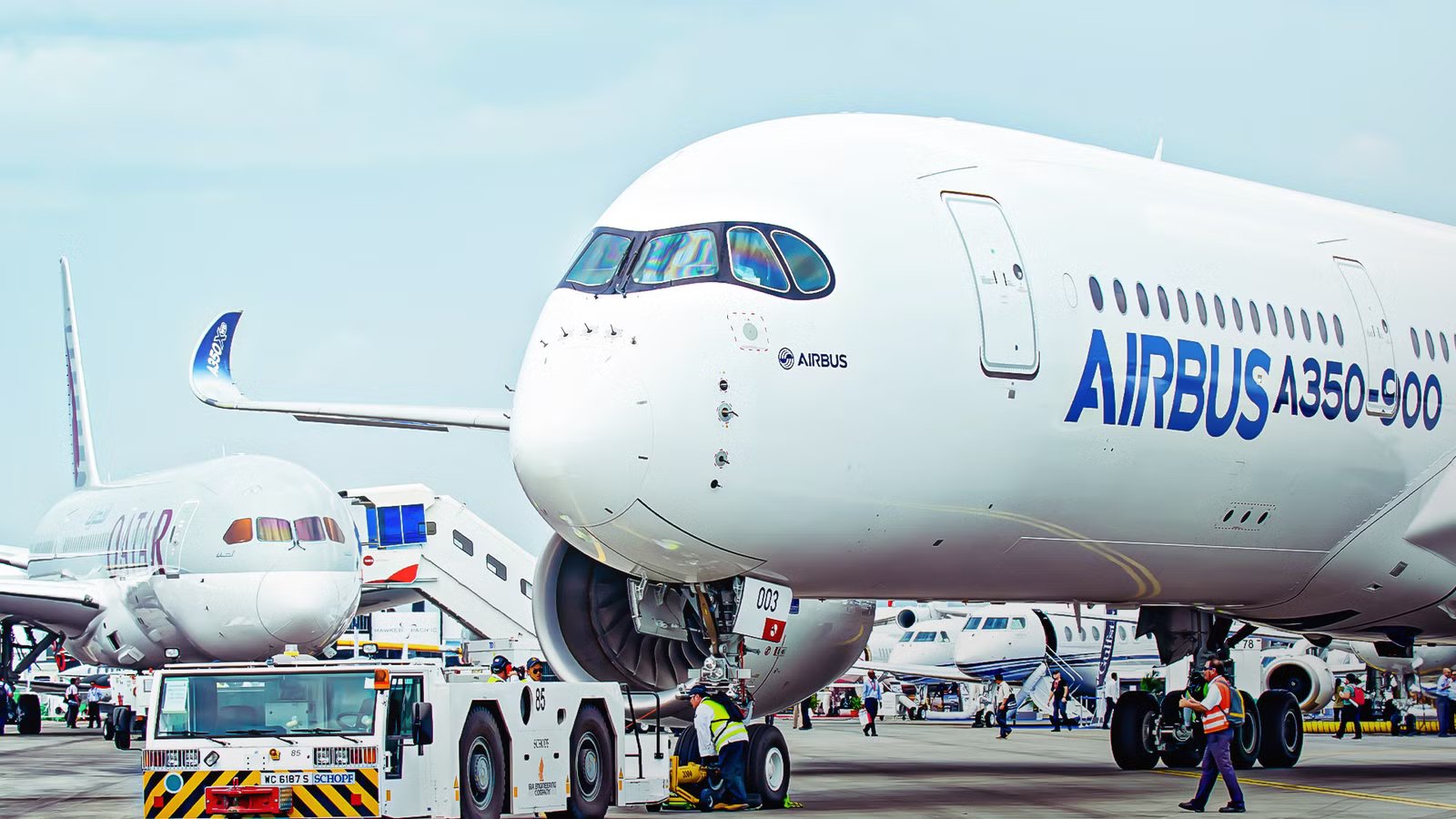
The Airbus A350 has firmly established itself as the world’s most efficient twin-aisle jet, and its dominance is a primary catalyst for why  Boeing is fundamentally rethinking the path to its next new airplane. It has set the gold standard in fuel efficiency, burning roughly 2.39 liters (0.63 gallons) per 100 km per passenger, and proving its maturity through years of high-dispatch reliability. The A350 has raised the bar for what a next-generation aircraft must deliver. Over in the United States, Boeing is confronting a difficult reality: the era of simply iterating on successful previous designs may be hitting a performance ceiling that only radical new architectures can break, yet the financial and operational reality of the current Boeing ecosystem necessitates extreme caution.
This article explores how the A350 has made Boeing’s job of creating its own next-generation widebody significantly more challenging, creating a level of scrutiny for Boeing’s upcoming programs that did not exist a decade ago and may well not have existed if the A350 had not come along. We will examine why Boeing’s leadership, under CEO Kelly Ortberg, is choosing to prioritize operational stability and balance-sheet repair over rushing into a clean-sheet race it is not yet prepared to win.
A Game Of Catch Up

The A350 proved that good enough is no longer enough for the long-haul market. Successfully taking advantage of carbon fiber composites to shave up to 20 tons (18,144 kg) off its airframe and pairing that with the efficiency of the Rolls-Royce Trent XWB, Airbus delivered a platform that did not just meet efficiency targets; it redefined them. The success of the A350 essentially turned the performance of the Boeing 777X into a moving target that Boeing has struggled to hit for some time now.
For Boeing, the A350 has created an execution trap. Airbus’s aircraft is already a mature, ultra-reliable product, and as a result, Boeing’s 777X is being judged not just against its own potential performance, but against the proven reality of the A350’s daily operations. Boeing cannot simply promise efficiency; they have to guarantee it on a timeline that airlines can build a business around. Delays have pushed the program significantly out of expected timelines, but the A350’s success in the meantime has only been more detrimental to the 777X program.
Any further delay to the 777X only widens the gap in operational maturity, making it increasingly difficult for the aircraft to capture the next-gen narrative that the A350 currently owns. Airlines, as a result, are buying the reliability of the one that can be delivered in a reasonable timeline, as opposed to one that still has no definitive entry date.
Already Plenty To Be Concerned With

The primary influence on Boeing’s rethink is the cost of developmental instability. When the 777X program launched in 2013, the competitive landscape was fundamentally different. Today, that competitive landscape is defined by the aging tarmac problem. The 777X has faced multi-year delays, and early test frames have spent years parked on the ramp, becoming technically obsolete before they even reached their first customer.
The Federal Aviation Administration (FAA) has tightened oversight significantly following previous industry crises, extending certification timelines for every new aircraft program. Simultaneously, the supply chain has struggled to keep up with the demands of building high-tech composite airframes, leading to parts shortages. A major issue is that frames built early in the program often lack the latest modifications, leading to costly and time-consuming rework requirements.
These considerations mean that Boeing’s next move cannot be a speculative leap. They will need to evaluate trade studies, balancing the need for a truly competitive clean-sheet jet against the immediate, crushing requirement to stabilize production and regain customer trust. Taking this reality with the stark contrast of Airbus’ far more stable position, one where its competitor is already highly favored by airlines, Boeing is quite clearly being left far behind for the time being.
A Breakdown In Customer Faith

The sentiment from airline customers, particularly heavy hitters like  Emirates, has shifted from enthusiastic anticipation to hard pragmatism. When the largest launch customer publicly remarks that the earliest-built test frames have aged out of relevance, the reality for Boeing quickly becomes dealing with a breakdown in confidence.
Emirates President Sir Tim Clark has been vocal about his refusal to accept early-build 777X frames that require heavy modification, famously quipping that they might be better suited for conversion into cans of cooked beans. The statement may have a lighthearted overtone, but it is a clear signal that the industry’s patience for prototype-style aircraft is waning. Airlines are voting with their checkbooks, opting to take A350 aircraft to plug capacity gaps while they wait for the 777X to become a viable, modern product.
This feedback is a directive that forces Boeing to prioritize the boring work of fixing existing manufacturing over chasing a clean-sheet design that the market is already weary of waiting for. The next Boeing aircraft will be judged on build quality and delivery consistency above all else, so while CEO Kelly Ortberg has already mentioned turning attention to its next clean sheet development, it seems on the surface that vision is being distracted by the future while the present is far from perfect.
A Clear And Direct Threat

The 777X is often positioned as a necessary bridge from the network strategies of the past to today, an aircraft that offers unparalleled payload and capacity for slot-constrained airports. In this niche, it remains a strong contender, as seen by the over 600 orders placed for the type. However, when compared to the A350’s operational maturity, the 777X starts to look like a high-risk derivative rather than a revolutionary leap.
The A350’s success is built on a clean-sheet architecture that has had 11 years to refine its manufacturing processes. Boeing’s next jet, by contrast, faces a second-mover disadvantage. If Boeing launches a new program too quickly, it risks repeating the certification struggles of the 777X. If it waits, it risks the A350 and its successors locking in airline fleets for the next 20 years.
Looking specifically at the impact of the 777X delays on the A350 order book, roughly 40 to 50 specific A350 orders could be seen as directly and publicly tied to the 777X delays. The most substantial of these orders is Air Canada’s decision to order up to 16 A350-1000 aircraft, demonstrating a major change in fleet strategy for the airline. Air Canada already operates a mature fleet of 28 777 aircraft and is expected to continue the trend of operating the next stage of the 777 evolution. This order is particularly noteworthy because it shows that even for an airline that can inherit many of the benefits of already operating 777 aircraft, the delays mean that completely shaking up a fleet strategy is far more worth the gamble.
The Saving Grace For Boeing

Boeing is at a major crossroads at the moment. Prioritizing stability and incrementally improving existing platforms to avoid the developmental nightmares of the past means Boeing risks entering a state of technological stagnation. If the company waits too long for the “perfect” clean sheet design, it cedes the innovation narrative entirely to Airbus. Should the A350 family introduce a significant performance update or a new variant that further widens the efficiency gap, Boeing’s approach could transform from a prudent risk-mitigation strategy into a fatal loss of market share.
However, the A350’s dominance is not absolute, and there are specific market exceptions where Boeing’s current widebody strategy remains superior. The 777X offers a unique payload-to-range capability that remains unrivaled in certain high-density, slot-constrained markets. While the A350-1000 is undeniably more fuel-efficient per seat, the 777X’s cabin volume and cargo capacity offer a total lift advantage that continues to attract major carriers. For airlines looking to maximize revenue per square meter in premium-heavy cabins, the 777X remains a specialized tool that the A350 cannot perfectly replicate, even if airlines are still waiting for it to come.
The real disruption will occur when the next generation of engine cores, or potentially open-fan architectures, becomes viable. If Boeing’s rethink focuses purely on body and wing refinements while Airbus manages to integrate game-changing engine efficiency, the safety-first strategy will provide only a temporary reprieve before the company faces yet another existential technology gap.
Time To Rebuild

The A350 has succeeded in becoming the reliable and ultra-efficient backbone of the world’s best airlines. It has made the 777X look disorganized, not because the 777X is a bad airplane, but because the A350 made predictability the most important feature of a modern jet. As long as Boeing keeps on top of development, the 777X will eventually move into service and, after some time, will start to regain the trust of those who once doubted it.
Boeing’s path forward is not to mimic the Airbus timeline, but to rebuild its own capability to deliver. The next new Boeing jet will likely arrive in the late 2030s, and it will be successful only if Boeing stops trying to win on marketing slides and starts winning on factory-floor execution. It is hard to ignore the impact that Airbus has had on the 777X program, but often, it is far better to ignore that outside pressure and focus on the immediate problems that need fixing.
After all, Boeing is a manufacturer that has been widely successful over many decades, outlasting many other manufacturers that are no longer at the top of the industry. The industry is entering an era where being reliable is the true competitive advantage, and Boeing has a lot to prove over the next few decades. The promise is there, but can the manufacturer actually deliver on it?
Catch what other trackers miss
Emergency squawks, holds, NOTAMs — live signals, no signup.
Open tracker
Catch what other trackers miss
Emergency squawks, holds, NOTAMs — live signals, no signup.
Open tracker

![Only 222 Seats: United Airlines’ 8 New Ultra-Premium Boeing 787 Routes Revealed [Map]](https://dailynewsnblog.com/wp-content/uploads/2026/08/771-united-airlines-boeing-787-9-markus-mainka-_-shutterstock.jpg)