dailynewsnblog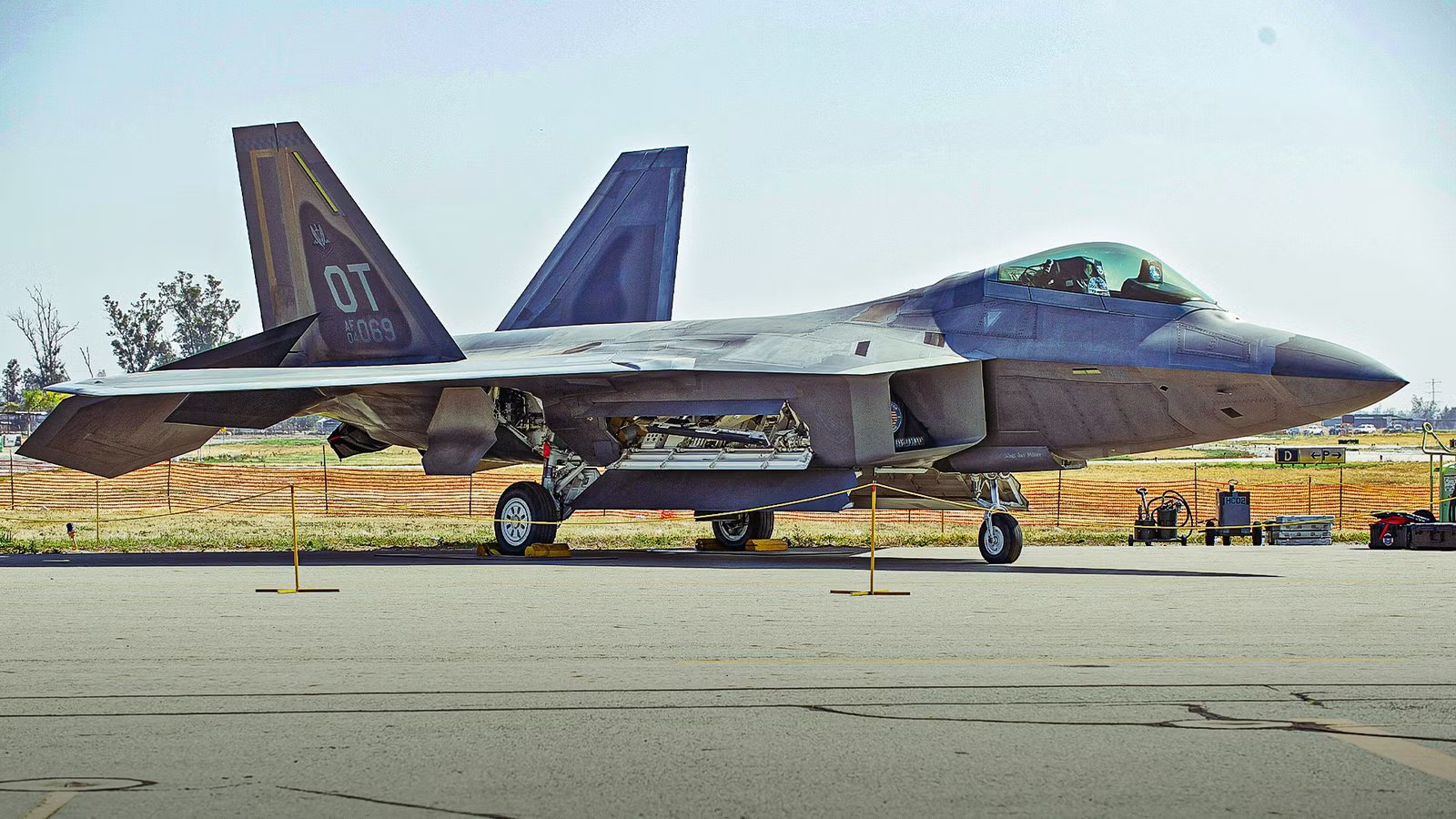
As the US Air Force will need to wait half a decade before the arrival of a true successor to the Lockheed Martin F-22 Raptor, it is preparing for one final modernization program to keep its first fifth-generation fighter combat-ready. Referred to as the Raptor 2.0 upgrade, the list of improvements includes technology like a refreshed data link and electronics, but much of the investment is going into extending the range of the Raptor. This is specifically intended to make the F-22 more effective in the Pacific Theater.
A major overarching theme of the fleet-wide modernization programs that the US Air Force is conducting is optimization for agile combat employment as the service pivots to the Pacific. The USAF is retrofitting its existing fleet and optimizing its incoming airframes for operations across disparate, remote airfields in the first and second island chains to counter Chinese aggression. The rapidly expanding Air Force and Navy of the People’s Republic of China have prompted a massive surge in investment since 2025.
The new Low Drag Tank and Pylon in development will be stealthy and jettisonable to increase the combat radius of the F-22 from 530 nautical miles (981 km) to 850 nautical miles (1,574 km), as the National Security Journal reports. It will also be complemented with an upgraded infrared search and tracking pod that is stealth optimized to greatly improve the intelligence, surveillance, and reconnaissance capability of the Raptor against both air and surface threats. According to 19 Forty Five, the $11 billion program includes a 10-year FASTeR III sustainment contract that will keep the Raptors flying until at least 2037.
No Rest For The Raptor

The Lockheed Martin F-35 Lightning II stealth fighter has notoriously fallen short of expectations and left a critical capability gap for the US and its allies that rely on the Joint Strike Fighter. Simultaneously, the first sixth-generation fighter jet is years away from flying, and the advanced loyal wingman drones are also not yet in production to support the F-35 fleet. That leaves the F-22 Raptor as a vital secondary stealth platform for the US military to ensure mission readiness levels.
The F-35 fleet is currently languishing at a 50% or lower combat-capable readiness level. Lockheed Martin is struggling to remedy its technology refresh three, block four package to get the F-35 fleet up to expectations and improve force readiness levels. The Department of Defense expects that the latest round of modernization will take years to achieve full capability, with much of the electronic warfare, computing, and sensor capabilities expected to take one to two more years. Meanwhile, the engine upgrades that are designed to support these advanced systems are not expected to be truly up to par until 2031.
Even the less advanced Boeing F-15EX Eagle II fighter jet platform, designed to give the USAF fleet an affordable, high-performance ‘missile truck’ for its new high-low fleet strategy, is behind schedule due to labor disputes with the workers at the production line. The two most important fighter jets currently in production to replace the F-22 are both behind schedule, and its true successor, the Boeing F-47, which will be the first sixth-generation fighter, is still on the drawing board.
Deterrence Through Superior Firepower

The J-20 was purpose-built to seek out and destroy high-value platforms operated by the US Air Force, Navy, and coalition allies like Japan and Australia in the Pacific region. Those support aircraft are essentially defined as air-to-air tankers and Airborne Warning and Control Systems (AWACS) that make it possible for tactical platforms like fighter jets and bombers to perform their offensive missions. The Mighty Dragon has a very large internal fuel capacity and extensive beyond visual range engagement capabilities to this end.
Even with China’s growing capability, giving the F-22 longer legs and a ‘bigger brain’ will force the PLAAF to acknowledge that it does not have immunity to operate in the East China Sea. The new first sensor pods are crucial to countering both Chinese aircraft and naval vessels once the F-22 gets its new LDTPs. The IRST will not only expand the ISR capability of the F-22 but also allow it to target adversaries without activating its radar and giving away its position.
The J-20 does not have a stealth profile that is as low as the RCS of the F-22, and jet engines made in China are notoriously far less efficient than Western equivalents. Specifically, military-grade fighter jet engines with afterburners produce a far greater thermal signature and, with powerful thermal imaging, can easily give away the position of a J-20. This gives the F-22 the upper hand in stealth on stealth hunting. Further expanding these new capabilities are modernized data links that will allow the Raptor fleet to communicate with the wider Joint Force discreetly for the first time.
5 Fighter Jets That Will Define Air Combat In The 2030s
The next era of air power is on the horizon.
Skunk Works Gets The F-22 Online For The First Time

The upgraded Raptor integrates the Multifunction Advanced Data Link as well as Link 16. Built to be a Cold War interceptor, not only was the F-22 never exported under the Obey Amendment, but it was also built with a tactical networking system that could not communicate with other platforms. While the F-22s could talk to each other as they hunted Soviet bombers in their counter-nuclear mission, they could not integrate with conventional ‘kill web’ networks during any conflict in the post-Cold War era.
To give the F-22 the closest parity possible in the cockpit with its younger cousin, the F-35, it will also receive next-generation helmet display systems for the first time. The HMD will put up all of the information from data links right in front of the eyes of the Raptor pilot to exponentially empower their tactical decision-making. If that wasn’t already a massive increase in lethality to the world’s best fighter jet, the F-22 is also being prepared to integrate with collaborative combat aircraft, or loyal wingman drones.
The Raptor 2.0 will be able to command multiple advanced drones at the same time to give them tasking throughout the battle space. This will allow the F-22 to greatly expand its search radius on long-range patrols, give it deeper magazine depth on strike and air defense missions, and protect it from enemy threats by using its drones to deceive and defend against adversaries. This will also pave the way for the tactics and strategy being prepared for the introduction of the F-47.

From 76 F-22 Raptors To 200 Next-Gen Fighters: How Much Larger America’s Air Superiority Fleet Could Get
A closer look at the future of air power in the US Armed Forces.
The Call For Air Power Over Contested Seas

The People’s Liberation Army Air Force famously flew two sixth-generation fighter jet prototypes in 2024, which forced the Pentagon to respond by awarding Boeing the contract for the Next Generation Air Dominance (NGAD) fighter in 2025. At the same time, the PLA Navy is improving its aircraft carrier fleet and has introduced its first stealth fighter jets. Additionally, the Chengdu J-20 Mighty Dragon stealth fighter production line is ramping up to deliver hundreds per year, with the total fleet expected to be over 1,000 in the near future.
This slow but steady technological progress in the Chinese military would not be as alarming if it were not for the aggressive activity that both the PLAAF and PLAN have exhibited in recent years. From violating national airspace and territorial waters to actively harassing merchant and Coast Guard vessels of neighboring nations, the Chinese military has made it clear that it is not backing down from geopolitical pressure. A particularly noteworthy incident was the Chinese carrier strike group that conducted exercises in extreme proximity to Taiwan as well as Japanese territory in 2025.
The Chinese military has continued the development of small islands in the South China Sea and even set up its first expeditionary military base on another continent with a naval station in Africa. On June 23, a Chinese aircraft carrier sailed through the Strait of Taiwan in a symbolic gesture to reinforce rhetoric from Beijing that the PRC still considers the island its rightful territory and has not disavowed the use of military force to reclaim it, as Asahi reported.
Under these conditions, one of the few military assets that provides both an incredible threat and an effective deterrent is advanced stealth fighter jets, like the F-22 Raptor. Although the J-20 is a stealth platform, its performance and lethality pale in comparison to the Raptor despite being decades newer. Arming the F-22 with superior electronics and a longer range will give it more than enough combat capability to surpass its Chinese rivals and level the playing field.

Lockheed Martin Pushing For Upgrades To US Air Force’s Oldest F-22 Raptors Instead Of Retirements
The maker of the world’s first fifth-gen fighter says it can keep the fleet alive.
By The Numbers: Building A Super Raptor

The F-22 Raptor is perfectly capable of using standard drop tanks that give it an additional 600 gallons (2,271 liters) of fuel to ferry across vast distances like the Pacific Ocean. It can also perform aerial refueling, which gives it a virtually unlimited range. Yet each of these has the distinct disadvantage of surrendering the F-22’s best quality: low radar cross section. By creating external fuel tanks that can be jettisoned for combat and do not compromise the RCS of the F-22 Raptor, the venerable fighter jet will be able to conduct extremely long-range patrols with invisibility.
The new LDTP tanks feature highly angular, faceted surfaces designed to scatter radar energy rather than reflect it to enemy arrays. Unlike previous drop tank designs, the Air Force explicitly intends for pilots to retain these tanks during direct combat. They will also be aerodynamically shaped to allow the F-22 to continue to exploit its unique capability of super cruising without afterburner. However, they are equipped with tech that allows for instant jettisoning if the pilot needs to regain the absolute maximum flight performance and minimal RCS.
The F-22 Raptor is not only more stealthy than the J-20 but is also more maneuverable and has higher performance, which makes it far more lethal in aerial combat. The problem is that if the F-22 can’t be in the right place at the right time to intercept, then it is incapable of performing its core mission. The Raptor remains the apex predator of all fighter jets in the world, thanks to its unmatched combination of performance and stealth, but making the F-22 independent of support platforms will unlock even greater potential than ever before.