dailynewsnblog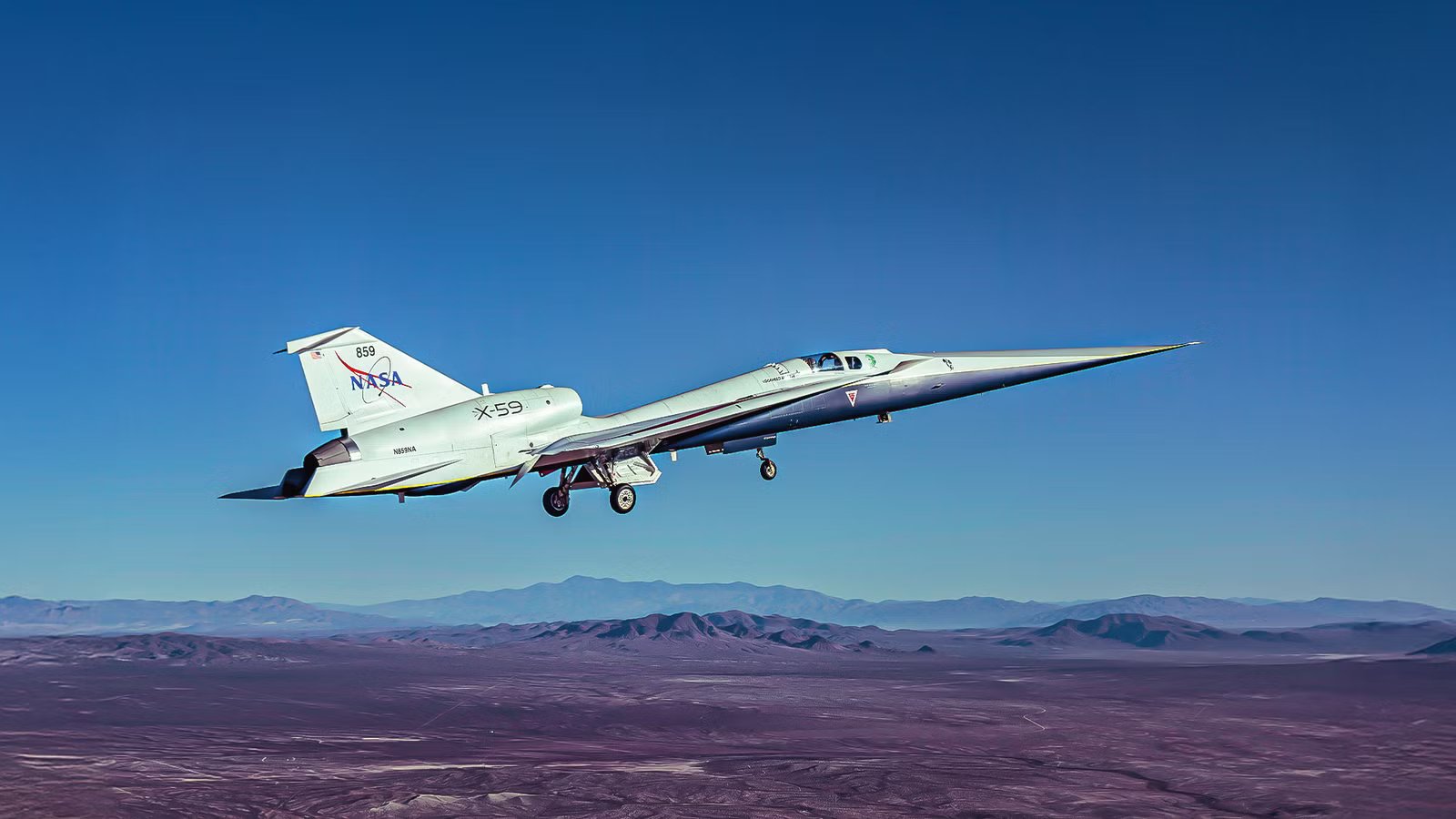
The NASA X-59 Quesst aircraft, built by Lockheed Martin Skunk Works, took roughly seven months from its first flight on October 28, 2025, to safely cross the sound barrier for the first time on June 5, 2026. Rather than immediately flying at full speed, experimental aircraft must undergo a careful process called envelope expansion. Even though the X-59 is intended to pioneer quiet supersonic flight for commercial airliners, engineers must slowly push the aircraft’s limits to ensure it remains safe and controllable.
The methodical timeline was necessary due to strict aerospace safety protocols and the complexity of experimental aviation. The X-59 is not built like a traditional jet, meaning its baseline handling was entirely unpredictable without real-world test data. NASA conducted 16 subsonic flights prior to the supersonic attempt. These flights verified basic airworthiness, engine performance, handling qualities, and structural integrity.
The entire airframe of the X-59 Quiet Supersonic Technology Demonstrator is uniquely contoured to keep pressure waves from merging into a traditional sonic boom. As a highly complex, one-of-a-kind experimental aircraft, the X-59 inevitably experienced minor technical hurdles that set the pace of operations. Now that the sound barrier has been broken, NASA is scaling the aircraft up to its design cruise speed of Mach 1.4 to begin gathering feedback from select communities of the American public to refine the jet’s quiet “sonic thump.”
Zero Margin For Error On Step One

An experimental aircraft’s first flight campaign, such as the NASA X-59, is viewed as a highly planned, high-risk scientific experiment rather than a speed demonstration. Due to the inherent high danger of taking off in a completely new type of aircraft that has never flown before, the maiden flight in particular is an especially time-consuming evolution. In order to demonstrate that the aircraft can safely take off, climb, turn, and land, the first twelve flights are solely focused on low speeds.
The first few flights are largely geared toward flight envelope identification and verification. This is the first step in translating the theoretical flight envelope from paper to actual operating doctrine. Test flights are used to rigorously verify the calculated safe limits of altitude, speed, and structural stress before further advanced research is conducted. The plane’s speed is also gradually increased to prepare for the aerodynamic chaos of the transonic area just before and after breaching the sound barrier.
Before the X-59 ever left the ground, pilots flew hundreds of hours in a ground-based simulator. However, simulators are just math models. Each step up in speed requires a dedicated flight to analyze data before the pilot is cleared to go faster. Engineers compare the real flight data against the simulator. If the real plane rolls 5% faster than the simulator predicted, testing stops until they understand why the computer model was wrong.
Changing The Flying World Step By Step

An experimental jet goes through hours of examination upon each landing, in contrast to a commercial aircraft that lands and takes off again an hour later. Prototypes with unique components that have never flown are known as experimental aircraft. Aerodynamic forces can cause an aircraft’s wings or tail to vibrate uncontrollably at certain speeds. This is known as flutter, and it has the power to completely destroy an airplane in a matter of seconds. Ground technicians inspect for fluid leaks, weak wiring, and structural flaws following each flight.
Experimental planes are wired with thousands of specialized sensors. These include strain gauges to measure metal bending, accelerometers to detect vibrations, thermocouples to monitor heat, and pitot-static tubes to measure air pressure. All of that data must be downloaded, cleaned, and reviewed by teams of aerodynamicists, propulsion experts, and structural engineers before the plane is cleared to fly again.
The X-59 has an additional layer of complexity because of its unique aerodynamic shape. The pilot cannot actually see forward through a traditional cockpit window. Instead, the flight deck is equipped with an external vision system that has a 4K monitor connected to an external camera array. Testing a plane when the pilot is essentially flying blind via a television screen requires layered safety backups. If a camera sensor glitches or a cockpit warning light flashes, the entire flight is cut short to investigate the hardware.
Skunk Works’ X-59: Trust The Telemetry

In a cutting-edge aircraft like the X-59, crossing the sound barrier is not just a matter of pushing the throttle forward. It requires transforming live data into safety clearances at every single step of the way. The telemetry process acts as the ultimate ‘gatekeeper’ of a flight test campaign. It is the primary reason why progress toward breaking the sound barrier is a slow, methodical grind. In flight testing, the air campaign is a highly scripted sequence of flights designed to hit specific milestones. Telemetry dictates this entire schedule.
Every flight has a rigid “test card” with a minute-by-minute script of maneuvers. A pilot cannot move from step A to step B without explicit clearance from the ground control room. The pilot will fly at Mach 0.85 and perform a “wind-up turn” to put G-forces on the structure. The pilot then holds steady while the telemetry engineers on the ground look at their display. If the data matches predictions, the flight test conductor radios the pilot to confirm that they are approved to move on to the next maneuver.
Every fraction of a Mach number closer to the sound barrier introduces entirely new physics. Ultimately, the biggest time sink isn’t what happens in the air. It is what happens on the ground between flights. After a flight, gigabytes of uncompressed, high-fidelity data are downloaded from the aircraft’s onboard hard drives. Deep dive analysis can take days or even weeks for a single flight hour. The aircraft is grounded until the data is fully reconciled and signed off by chief engineers.
NASA’s One Of A Kind Quesst

In a revolutionary aircraft like the NASA X-59, engineers are not just managing two separate tracks, safety and research, at different times. They are doing both simultaneously during the build-up process. The ground telemetry room verifies that the aircraft is structurally sound to verify the safety envelope. Meanwhile, aerodynamicists simultaneously analyze the data to see if the plane’s unique shape is actually reducing the sonic boom to achieve the final research goals.
The testing campaign’s parallel track adds massive layers of analytical complexity, making the timeline to break the sound barrier exceptionally slow for several key reasons. Every single flight’s telemetry data is split between two entirely different engineering teams. The airworthiness team will analyze things like structural loads, skin temperatures, and wing vibrations. Simultaneously, the research team checks the aerodynamic performance through pressure sensors along the nose, fuselage, engine inlets, and other key surfaces on the plane to see how well shockwaves are being dispersed.
If telemetry shows the nose is flexing more than expected at Mach 0.92, the research team must calculate how that twist will affect the sonic boom at Mach 1.4. Even a tiny fraction of a degree of structural twisting changes the way a shockwave is shaped. In order for the air campaign to continue on to the next stage, the aircraft must make progress on safety as well as performance goals. Engineers cannot approve a test pilot to break the sound barrier until they are certain the plane will actually achieve its quiet research goals.
Eye On The Ball: Reinventing Supersonic Air Transportation

The NASA X-59 Quesst exists to solve a single legal and economic hurdle: the global ban on commercial supersonic flight over land. By designing a jet that replaces the booming explosion with a gentle ‘thump,’ NASA aims to provide data that will convince global regulators to change the law and open a new multi-billion dollar market for supersonic passenger travel. Because it is a $247 million flying science laboratory, NASA must mathematically guarantee that crossing the barrier will yield the high-quality acoustic data needed to achieve its ambitious aims.
When older supersonic transports like the Concorde were built in the 1960s, aerospace engineers had to test aerodynamics via physical trial-and-error in wind tunnels. Lockheed Martin Skunk Works division crafted the X-59 by leveraging decades of advancements in computational fluid dynamics. Skunk Works has spent decades building radical shapes like the F-117 Nighthawk and SR-71 Blackbird. The X-59’s hyper-elongated airframe acts like a wedge. It breaks the air pressure into a sequence of dozens of tiny, progressive shockwaves that stay separated as they roll away from the aircraft.
In order to fly supersonic, the X-59 is powered by a General Electric F414 afterburning turbofan engine, which is the exact same engine used in the Boeing F/A-18E/F Super Hornet fighter. Yet, the power plant of the X-59 is mounted in an unusual position in order to optimize the deflection of shockwaves away from the ground. In the case of engine exhaust, Skunk Works placed it on top of the fuselage to direct the ‘sound wake’ upward and away from the populated areas that the plane will fly over.
Making The SST Dream A Reality

The ultimate goal of the NASA Quesst mission is to completely overturn the global ban on overland commercial supersonic flight. Later this year, the plane is expected to begin trials over populated areas. After each mission, NASA will survey the local residents to gather data about how its unique ‘sonic thump’ impacts the people living in its flight path. Residents will not know exactly what time the X-59 is passing overhead, preventing them from looking out the window or magnifying tiny sounds out of anticipation.
Once the community overflights are complete, NASA will package this massive dataset into a public archive. In 2030, NASA intends to deliver this report directly to the International Civil Aviation Organization and the Federal Aviation Administration. This data will provide the regulatory foundation for aerospace companies like Boom Supersonic or Horizon to legally build and operate supersonic passenger jets that can cross from New York to Los Angeles in just over two hours.