dailynewsnblog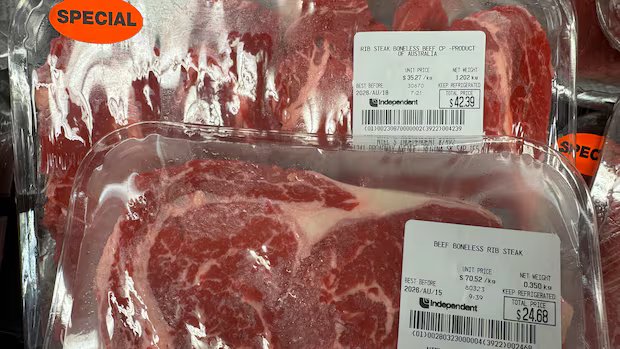

Listen to this article
Estimated 4 minutes
The audio version of this article is generated by AI-based technology. Mispronunciations can occur. We are working with our partners to continually review and improve the results.
Australian beef is on Canadian supermarket shelves at much lower prices than for Canadian beef.
Some producers are concerned about their products being undercut, and some consumers are just happy to have an affordable option.
Tyler Fulton, president of the Canadian Cattle Association, said the Australian option has been around for years.
“Recently there’s been an increased visibility to consumers as to that choice, in particular with some of those steak-type cuts,” he said.
Many factors contribute to the price difference, Fulton told CBC Saskatchewan.

“The Australian production model is a grass-based system that commonly has a short grain feeding at the end of it. So the result is really a product that is leaner, doesn’t tend to have quite the same marbling and therefore isn’t as preferred in Canada as compared to the Canadian-produced beef.
“The other likely big factor here is that retailers will use a ‘loss leader’ tactic.”
Australia has had more access to the Canadian beef market since 2018, when the Comprehensive and Progressive Agreement for Trans-Pacific Partnership (CPTPP) came into effect.
Fulton said the same agreement benefits Canada in a very similar way, allowing preferred access in countries like Japan and Vietnam.
“While we wish it was Canadian, there’s an acute purpose for really bringing in some imported beef,” he said.
“It fills a short-term need or void in supply. I don’t think that there’s a big concern from a Canadian beef producer standpoint about seeing a product like Australian beef that — we have confidence in their standards, but quite simply isn’t of the same quality.”
CBC News talked to shoppers coming and going from the Loblaws-owned Real Canadian Superstore and Independent Grocer in Regina, to hear the consumer perspective.
“I just can’t spend that kind of money on one steak,” said Karen Novak.
She completely adjusted her diet because of the prices, she said.
“The last time I tasted beef other than ground beef was probably two Christmases ago, when I made beef Wellington instead of turkey … Beef is definitely a luxury. So if any of our friends want to invite us over for a steak, I’ll bring a salad.”

Jordan Fieseler said he buys beef in bulk from local producers instead.
“I think it makes sense if the price is so high that people are going to look to something cheaper. Certainly it’s not the sustainable option … I’d prefer things to not come from a long distance away. It’s not as important to me as it was in the past, but that’s only just because sometimes life gets crazy, and you have to just make things work,” he said.
“Options are always good. Everyone’s going to make their own choices,” said Larry Evans. “If the quality is not there, they probably won’t, but it comes down to cost. In the future, if beef keeps rising, I’ll try some Australian.”
Loblaws responded to a CBC request for comment with a statement.
“In recent years, North American cattle supply has tightened while Australian beef production has increased, contributing to differences in market pricing. We remain committed to supporting Canadian beef producers while providing customers with choice and value,” the statement said.
As for the Canadian Cattle Association, Fulton said producers are better positioned for further domestic growth.
“I’m really very optimistic about what the opportunities are abroad, but keeping in mind our bread and butter is the domestic Canadian consumer,” he said.
“We went darn near two decades with kind of low or negative profitability in the beef sector. Last year, the beef cow herd grew in Canada 2.5 per cent, and my expectation is that we’ll continue to see that growth because the incentives are there.”