dailynewsnblog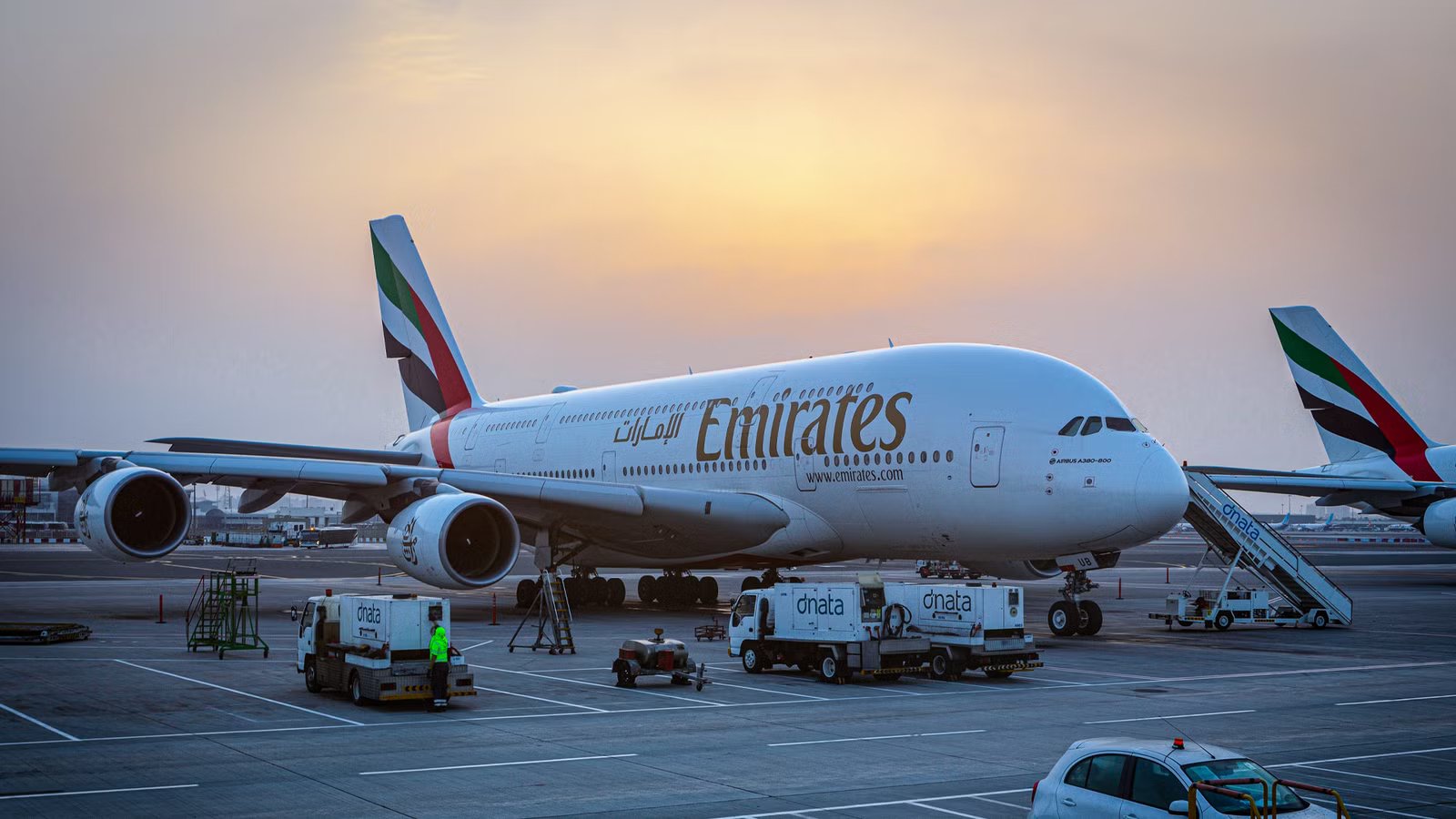
Dubai World Central (DWC) will soon become one of the most critical megahubs ever built, and now that expansion plans have been approved, we may see the torch passed over even faster. This isn’t Dubai building the world’s largest airport for prestige; it’s Dubai building the only airport on Earth engineered end-to-end around a single carrier’s superjumbo and next-gen widebody ambitions. Spanning a massive desert footprint, this multi-billion-dollar project promises to reshape global transit networks completely.
The move away from the constrained boundaries of  Dubai International Airport (DXB) has been well sought after for local authorities and carriers alike. The current airport serves as the busiest international hub on Earth, but its tight geographical footprint prevents it from growing past its modern capacity limit. Now starting fresh in the desert, planners have a blank canvas to resolve the complex ground-handling bottlenecks that plague double-decker aircraft at traditional airfields. Dubai World Central can truly be built for the next generation of air travel with very little worry about restrictions.
Inside The 128 Billion AED Mega-Expansion

Transforming a patch of desert into the ultimate aviation gateway requires capital on an unprecedented scale, but fortunately, in the UAE, there is plenty to spend. The government authorized an investment of $34.85 billion (128 billion AED) to fund the monumental passenger terminal expansion at  Al Maktoum International Airport. The massive cash injection will develop a layout that dwarfs any existing commercial airfield on the planet.
The sheer size of the project makes its historic scale abundantly clear, stretching across 36,000 acres (145.7 square kilometers) of dedicated space. Once the engineering work concludes, the facility will boast five parallel runways designed to accommodate simultaneous, high-frequency heavy jet departures. The final master plan outlines an ultimate annual capacity of 260 million passengers, alongside a cargo network capable of moving 12 million tons of freight every year, truly incredible numbers that will solidify the airport’s place as a global giant. Managing this staggering volume of travelers across such an expansive footprint led to opting for a sprawling network of four distinct concourses.
To ensure that travelers can navigate the colossal facility without exhausting delays, a high-speed automated people mover system will tie the processing zones together. This transit line will utilize 14 strategic stations to shuttle passengers seamlessly between the central terminal facilities and the boarding zones. The initial phase of construction targets a completion date of 2032, providing an immediate capacity of 150 million passengers annually. Once everything is in place and ready for the onslaught of passenger traffic, the airport will allow the city to shift its entire commercial network away from its historic base, setting a new benchmark for late-century infrastructure.

To safely handle the largest commercial airliners, international airports need to keep up with rigorous design criteria that are required by aviation governing bodies. The highest regulatory category for the largest commercial airliners, known as Code F, dictates precise spacing guidelines for runways, taxiways, and terminal gates to prevent costly spatial incidents. Generally, standard global airfields designate only a small handful of these premium slots for heavy aircraft; Dubai’s master plan takes an entirely different approach. Designing a massive facility where every single parking position meets these extreme dimensional requirements eliminates the typical operational constraints that plague mixed-fleet hubs all over the world.
Catch what other flight trackers miss
Emergency squawks, holds, NOTAMs — live signals, no signup.
Open tracker
Catch what other flight trackers miss
Emergency squawks, holds, NOTAMs — live signals, no signup.
Open tracker
The Airbus A380 needs a tremendous amount of physical clearance due to its substantial wingspan of 262 feet (80 meters) and an overall length of 241 feet (73 meters). At traditional international gateways, accommodating even a single superjumbo forces ground controllers to shut down adjacent taxiways or leave neighboring gates vacant to guarantee safe separation. The solution for DWC lies in constructing 400 contact positions that natively meet Code F specifications. The upcoming terminal removes these spatial liabilities completely and means that the largest passenger jets can navigate the entire apron without disrupting nearby ground traffic.
Making the building standardized gives flight dispatchers total freedom when assigning parking positions to arriving flights. An incoming aircraft can pull into any vacant gate across the network without triggering logistical delays on the active taxiways. Crucially, it helps to mitigate the scheduling headaches that occur when a giant aircraft is forced to wait on the tarmac because its single designated parking position remains occupied by a delayed flight.

18 Years After Emirates Took Delivery Of Its First A380, The Quadjet Is Still The Backbone Of Its Long-Haul Network
Emirates’ bold move to acquire the A380 transformed air travel, but 18 years later, challenges loom.
Emirates’ Superjumbo Symphony

The biggest task for this airport likely doesn’t stem from anything on the airport grounds, but rather at its predecessor airport, on the other side of Dubai. Emirates has already initiated its plan to move its entire fleet to DWC by breaking ground on a brand-new engineering facility at Dubai South, costing 18.7 billion AED ($5.1 billion). Establishing this industrial footprint early signals that the new hub is a bespoke home tailored entirely to the carrier’s specific operational needs, helping the in-house maintenance to grow with the fleet in conjunction.
The upcoming maintenance base is a massive investment in the longevity of large-capacity airframes. Instead of adjusting daily operations to fit a generic terminal layout, planners are tailoring the infrastructure directly to the unique requirements of the Emirates’ long-haul fleet. It guarantees that heavy jets receive rapid mechanical turnarounds, maximizing the hours they spend transporting passengers through the sky and provides a highly stable foundation for future network growth.
The massive scale of this mechanical hub also shows the long-term commitment to operating ultra-large aircraft deep into the current century. Plenty of other global carriers have decided to phase out their double-decker passenger planes, but Emirates thrives with these types in service, building its entire business model around the strengths they offer. This new base ensures the carrier possesses the specialized hangars, heavy machinery, and parts storage necessary to support giant jets for decades to come.
Four Concourses, 400 Stands

Processing hundreds of passengers simultaneously onto a multi-level aircraft is no easy feat, and engineers working on DWC had to once again use scale to their advantage. To fully exploit the capabilities of the 400 universal gates, the airport design incorporates four massive concourses that each house 100 dedicated boarding positions. Every single one of these locations will utilize advanced multi-deck jetbridges to manage the immense flow of travelers efficiently, aiding in preventing the severe crowding issues that typically slow down departures at older international terminals.
Standard boarding setups often rely on a single jet bridge, creating frustrating bottlenecks as hundreds of travelers queue down a narrow hallway to board a massive aircraft. The new concourses solve this issue by deploying dual and triple-deck jetbridges at every contact stand, allowing premium and economy passengers to board separate levels of the cabin simultaneously. Having these jetbridges significantly shortens the time required to load a full flight, keeping tight flight schedules perfectly on time. Investment is, of course, massive, but it seems that the focus is more on investing in operational and cost efficiency without compromise rather than grandeur.
Integrating these complex boarding bridges across all 400 positions introduces major structural engineering hurdles for the terminal buildings. Architects need to design multi-level holding lounges that align precisely with the heights of the different aircraft decks. This is where the sprawling automated people mover system with 14 integrated stations comes in, to continuously distribute arriving and departing travelers smoothly across the wide layout. At DWC, moving between distant concourses will be consistently fast and predictable for connecting passengers.
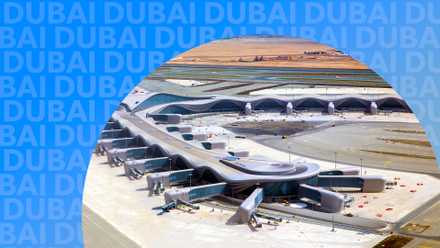
The Game-Changing New $35 Billion Mega Airport Project Coming To Dubai
Dubai’s new mega airport is scheduled to take over from the current airport in 2034 and eventually become the world’s largest airport.
Eradicating The Apron Bus

The last thing that an airport of such size taking in aircraft as big as an A380 would want is an abundance of remote stands and a lack of gates big enough to accommodate such a large aircraft. Air travelers absolutely dread the experience of descending a long set of mobile airstairs on a hot tarmac, only to crowd into an apron shuttle bus. For airlines like Emirates, this potential scenario would be a total logistical failure that severely compromises tight flight schedules and damages the passenger experience.
Deplaning more than 500 passengers via temporary ground stairs requires an immense amount of airport equipment and stretches turnaround times past profitable limits. DWC guarantees that every single one of the 400 positions is a contact stand with direct terminal access. As a result, Al Maktoum International Airport completely removes this operational bottleneck that is present at many of the world’s largest and busiest airports. Ground crews can immediately attach the permanent jetbridges to an arriving jet, keeping the flow of travelers moving steadily into the main building.
Eliminating remote stands protects the airline’s daily timetable while simultaneously increasing the safety of the entire ramp environment. Ground personnel can focus entirely on technical tasks like refueling, catering, and baggage loading without needing to navigate large crowds of walking passengers across an active airfield. This design philosophy ensures that high-capacity widebody operations remain highly predictable, even during peak travel waves when dozens of large jets land simultaneously.
Setting A Century-Long Precedent

The long-term success of this monumental mega-airport project puts Dubai back on the global map and into the spotlight again. Established gateways across Europe and North America frequently face strict night flight bans, intense local legal challenges, and severe spatial limitations when trying to add a single new runway. Dubai’s new aviation facility can expand outward without running into urban boundaries or legal blockades, because it is surrounded by unconstrained desert land.
This blank slate allows the city to construct an interconnected aerotropolis that functions continuously without geographic restrictions. Carriers utilizing this advanced hub can comfortably schedule heavy widebody departures at any hour of the day or night, optimizing fleet utilization across various global time zones. The ability to coordinate hundreds of international flight connections without noise curfews gives the hub a significant economic edge over landlocked airfields.
As international passenger volumes steadily climb through the final decades of the century, global travel will rely heavily on massive hubs like this one, capable of consolidating immense traffic streams. DWC engineers decided to think big, opting for a 400-gate airport entirely around universal Code F capabilities. Such a massive, monumental investment establishes an entirely new standard for global connectivity, securing the region’s role as an indispensable crossroads for commercial aviation and keeping Dubai at the heart of global connectivity.