dailynewsnblog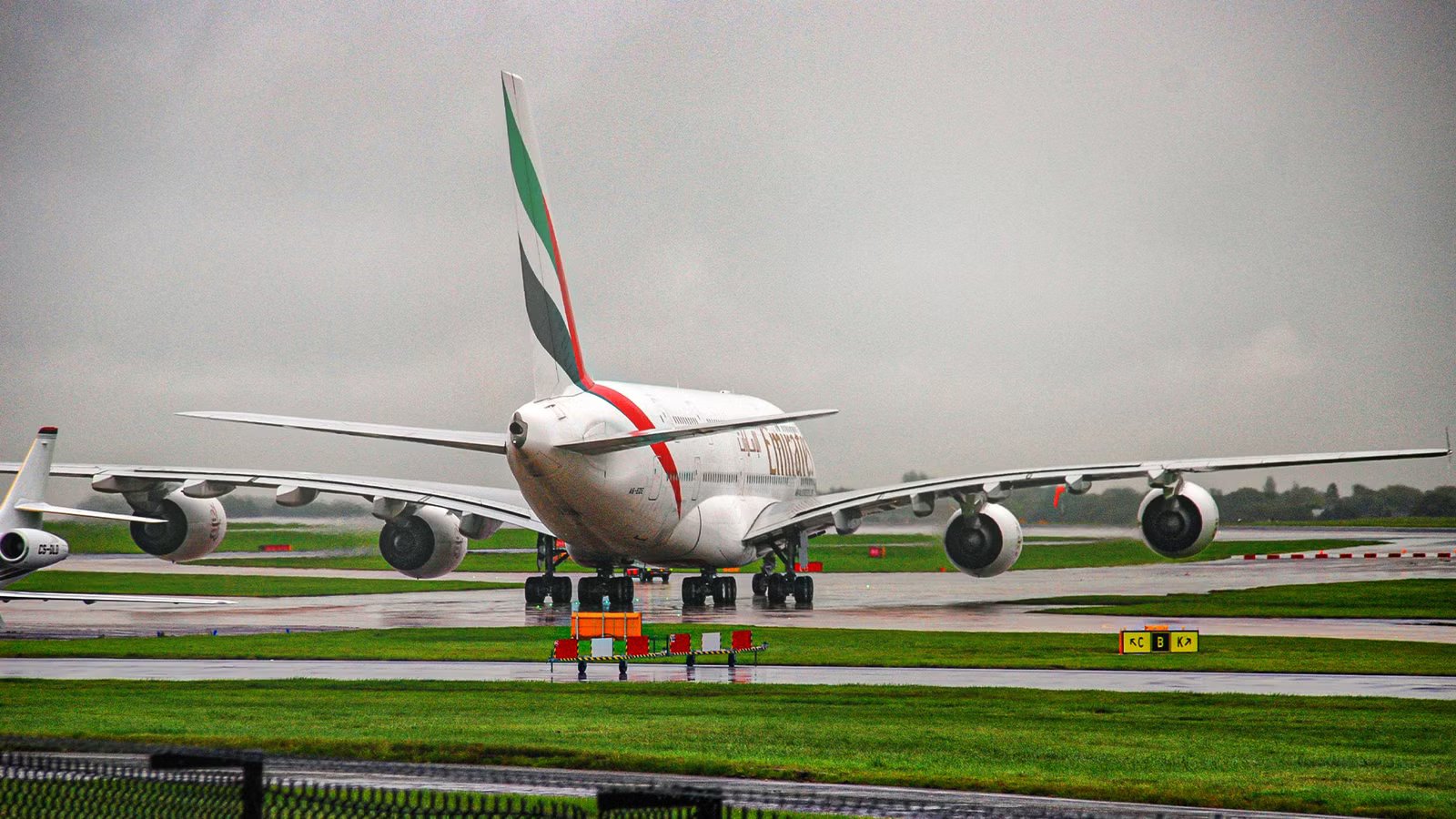
The Airbus A380 is undoubtedly one of the most iconic aircraft ever built, and it remains the only full-length double-decker aircraft in commercial operations. However, despite its popularity among passengers, the type has also become one of the most complex airplanes for airlines to keep flying. After all, Airbus delivered the final A380 to  Emirates in December 2021, ending the program after less than two decades of production. Among other things, this has made it increasingly difficult for airlines to retain the aircraft in their fleets. However, for Emirates, the A380 remains a crucial part of its long-haul fleet and network strategy.
The Dubai-based airline has already made clear that it wants to keep flying the jet well into the next decade, and potentially until 2041. However, doing so will not be simple, and as the A380 fleet gets older, Emirates is increasingly dependent on spare parts, engine maintenance, and airframes that can be used to keep the rest of the fleet in service. Interestingly enough, one of the most important factors in the A380’s future is no longer the airplane itself, but the engines hanging under its wings. The type was originally offered with two engine options: the Engine Alliance GP7200 and the Rolls-Royce Trent 900. At the time of the A380’s development, this was simply a normal engine choice. Today, it increasingly determines which aircraft are economical to keep flying and which are more valuable as parts donors.
The A380 Is Still Too Important For Emirates To Retire

For many airlines, the A380 was simply too large to operate profitably. The aircraft was designed for a world in which airlines would move large numbers of passengers between major hub airports. However, by the time the type entered service, the market had already shifted toward smaller, more efficient twinjets such as the Airbus A350 and Boeing 787. These aircraft allowed airlines to operate more direct long-haul routes with thinner demand. Instead of forcing passengers through large hubs on very large planes, airlines could operate more point-to-point services using aircraft that were easier to fill and cheaper to operate.
This was one of the main reasons why the A380 struggled commercially, and while passengers liked the aircraft, airlines often found it difficult to make the economics work outside a limited number of high-density trunk routes. Airbus ultimately delivered just 251 A380s, far below what would have been needed to make the program a wider commercial success. Emirates, however, is the exception, and the airline’s business model is built around  Dubai International Airport (DXB) as a large connecting hub between Europe, Asia, Africa, Australia, and the Americas. On some of these routes, the A380 still makes sense because it allows Emirates to carry a large number of passengers using limited airport slots.
This is especially important at congested airports such as  London Heathrow Airport (LHR), where adding more flights is difficult. In these markets, using a very large aircraft can be more attractive than simply adding another frequency and even be the only option for growth. The A380 also gives Emirates a large premium cabin, an onboard bar, and a product that still stands out in the market. Therefore, Emirates does not view the A380 the same way as most other airlines. For many operators, the aircraft is a niche or legacy type. For Emirates, it remains a core part of its brand and network, which explains why the airline is still investing in the type, even though the production line has closed.
The Engine Choice Now Matters More Than Ever

When the A380 was still in production, airlines could choose between two engine options. The Rolls-Royce Trent 900 was selected by airlines including Singapore Airlines, Lufthansa, Qantas, and British Airways. The Engine Alliance GP7200, developed by General Electric and Pratt & Whitney, was selected by airlines including Emirates, Etihad, Qatar Airways, Air France, and Korean Air. At first, the Trent 900 was the more popular option. This was partly because  Singapore Airlines, the A380’s launch customer, selected the Rolls-Royce engine. However, the long-term balance shifted because Emirates became by far the largest A380 operator, and most of its A380s are powered by the GP7200.
This has made the GP7200 the dominant engine on actively flying A380s, even though the Trent 900 was selected by several major airlines. The difference is that most Trent 900 operators have much smaller A380 fleets, and some have already retired or reduced their superjumbo operations. On paper, the GP7200 also appears to have had several advantages, and Engine Alliance has historically claimed that the engine offered a 1.3% to 1.4% fuel burn advantage over the Trent 900. It has also claimed that the GP7200 achieved time-on-wing at Emirates that was two to four times longer than the Trent 900.
This is important because engine maintenance is one of the highest costs for any long-haul aircraft, and if an engine can stay on the wing longer before needing a hangar visit, it can save an airline a significant amount of money. This is especially relevant for a four-engine airplane such as the A380, which has twice as many engines as a modern twinjet. However, this does not automatically mean that GP7200-powered A380s are easier to keep flying. Since Emirates flies its A380 fleet much more than most other airlines ever did, the opposite may actually be happening.
The GP7200 Is Doing Most Of The Hard Work

The interesting part of the A380 engine story is that the GP7200 can be both the better engine on paper and the engine facing the bigger long-term retirement issue. This sounds contradictory, but the GP7200 powers the largest and most active part of the global A380 fleet, and as a result, GP7200 engines are accumulating far more hours than the Trent 900 engines used by smaller A380 operators. According to Aviation Week’s MRO forecast, GP7000-family engines are expected to log significantly more average engine hours than their Trent 900 counterparts. The same data also showed a much higher expected number of GP7200 engine retirements over the next decade than of Trent 900 engine retirements.
This does not necessarily mean that the GP7200 is less reliable. It simply means that the engines are being used much more intensively. Emirates operates the A380 at a scale no other airline comes close to matching, which completely changes the maintenance picture. For example, an engine that performs well over a long period can still require many hangar visits if the fleet using it is large and highly utilized. This is exactly the situation Emirates faces, and its GP7200-powered A380s are not just surviving because the engine is strong, but they are also aging faster because they are doing most of the flying.
Catch what other flight trackers miss
Emergency squawks, holds, NOTAMs — live signals, no signup.
Open tracker
Catch what other flight trackers miss
Emergency squawks, holds, NOTAMs — live signals, no signup.
Open tracker
This makes the A380’s future more complicated than simply asking which engine is better. The better question should therefore be which engine can still be supported economically as the aircraft enters its final years. For Emirates, this is not a small issue, and central to whether the airline can keep enough A380s in service until the late 2030s and early 2040s.
Some A380s Are Becoming More Valuable As Parts Donors

As the A380 gets older, Emirates will also have to make difficult decisions about individual airframes. Some aircraft will be worth retrofitting and maintaining for many more years. Others may become too expensive to return to service, especially if they are older, need heavy maintenance, or require costly engine work. This is where cannibalization becomes part of the strategy. In simple terms, cannibalization means using parts from one aircraft to support another. For a large active fleet, this can be a very useful way to keep aircraft flying when spare parts are expensive, delayed, or no longer produced in large numbers.
For the A380, this is particularly relevant because the aircraft is no longer being built. There is no production line creating a steady flow of new aircraft and components. Airlines therefore have to depend on existing spare parts, supplier support, and aircraft that have already been retired. Emirates is in a stronger position than most airlines because it has such a large A380 fleet. This gives the airline more flexibility. It can retire older aircraft and use parts from those airframes to support aircraft that still have years of useful life left. In that sense, Emirates’ scale is both a problem and an advantage.
It is a problem because Emirates has the largest A380 maintenance burden in the world. However, it is also an advantage because the airline has enough aircraft to create its own support pool. Smaller A380 operators do not have this luxury to the same extent. If an airline operates only a dozen A380s, every retirement reduces the usefulness of the fleet. Emirates, on the other hand, can sacrifice some aircraft to keep a larger number flying. This is why the A380’s future at Emirates will likely not be equal for every airframe. Some will be refurbished and continue flying passengers. Others will gradually become a source of engines, landing gear, cabin parts, and other components.