dailynewsnblog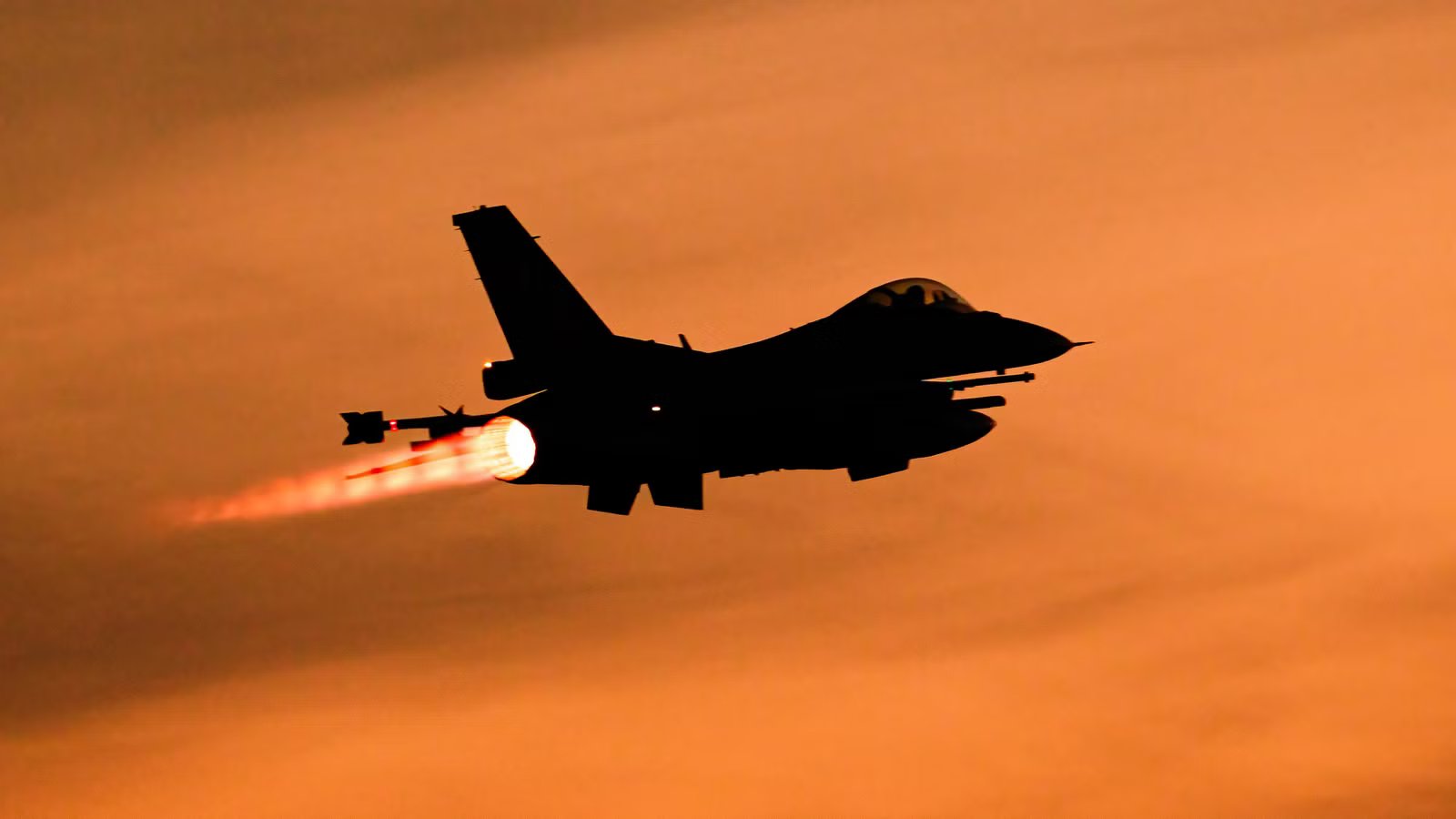
Originally conceived and brought into production by General Dynamics, the F-16 Fighting Falcon continues to be produced by Lockheed Martin today. Although the airframe’s design is more than 50 years old at this point, its status as the most produced fighter jet continues to be reinforced by ongoing deliveries. Even in the United States Air Force, which has a vast armada of more advanced, fifth-generation fighter jets, the Falcon remains the most numerous type of them all.
In the time that has passed since it was first introduced, the F-16 has received many upgrades; however, a notable exception for a jet that leverages maneuverability as its primary performance feature is the absence of thrust vectoring. After making more than 4,600 Vipers, as the F-16 is also known, according to The War Zone, the fleet accounts for almost 20% of all the world’s fighter jets in service. Upgrading the Vipers’ engines with thrust vectoring still isn’t even on the table.
It is worth noting that after the F-16 was successfully selected as the winner of the lightweight fighter program in the early 1970s, it did go on to be tested by the USAF and NASA to potentially receive thrust vectoring. This was declined as it was not perceived to be valuable enough for the cost, complexity, and weight that it added to the already very high-performance Viper. Today, the F-16 is going up against supermaneuverable adversaries and stealth fighters; even now, future upgrades are focused on technology and stealth instead of agility.
Viper: The World’s Most Produced Fighter Jet

In the early 1970s, John Boyd and Thomas Christie led a group of fighter pilots, engineers, and scientists to help the Air Force create an aircraft that could go toe to toe with adversaries like the MiG-21 Fishbed in dogfights and emerge victorious. The reason that this group pushed their design ahead in the lightweight fighter program was because of the losses that the McDonnell Douglas F-4 Phantom II pilots suffered in Vietnam in the 60s. Those lessons learned in blood created the outline for the aircraft that became the F-16 Fighting Falcon.
Unlike today’s 4.5 and 5th-gen fighter jets that heavily rely on automation and digital pilot aids to empower the aircraft to perform seemingly impossible feats of aerial agility, the F-16 was designed to give the pilot the maximum amount of control possible. The F-16 was not even meant to carry significant radar or air-to-air missile munitions, and pilots report that the first experience using the gun in the Viper is an eye-opening shock because it rattles the light airframe so hard from recoil.
Although the F-16 does not feature a cutting-edge maneuverability system like thrust vectoring, when it was developed, it was one of the very first aircraft to ever implement a fly-by-wire system. The advanced computer flight controls eliminated direct mechanical linkages between surfaces and the side stick, which itself was very innovative at the time. Its improvements in the cockpit were complemented by the bubble canopy, aggressive aerodynamics, extremely strong airframe, and, more importantly, the very low weight of the F-16.
Pure Viper: Don’t Fix It If It Ain’t Broke

The F-16 achieved its renowned agility without the need for thrust vectoring in an era when that technology was unavailable through different means that simply relied on aerodynamics. The Viper pioneered what is known as relaxed static stability and laid the blueprint for later generations of fighter jets today. This design puts the center of gravity very near or directly behind the center of lift to make the aircraft naturally pitch up instead of being biased towards straight and level flight.
The Falcon was the first fighter capable of sustained 9G maneuvers with a full combat load, outturning almost everything in the US arsenal until the F-22 arrived in 2005. Based on energy-maneuverability (E-M) theory, this design allows the F-16 to change direction with significantly less speed loss than its contemporaries, keeping its energy high during a “knife fight.”
The Viper has a natural tendency to turn through the aerodynamic effects of its baseline shape and design. The fly-by-wire system keeps the aircraft in check during level flying, but when the pilot commands the aircraft to maneuver, it essentially ‘permits’ the jet to do what it naturally wants to do. Also, in traditional stable jets, the tail must push down to keep the nose up, but in the F-16, the tail provides upward lift to balance the airframe, which reduces drag and increases turn rates.
Furthermore, critics of post-stall maneuvering argued that fighters should never get slow in the first place, according to Code One Magazine. The shift toward beyond-visual-range combat doctrine reduced the premium placed on extreme close-in maneuverability. This is another reason why the F-16 has never been updated with thrust vectoring. It has instead evolved to carry a larger payload and a wider range of weapons while improving range, technology in the cockpit, and low observability improvements to defend against modern air defenses instead.
Try Before You Buy: US Air Force Edition

The US Air Force did not ignore the question of thrust vectoring for the F-16. A dedicated research program thoroughly explored it. The F-16 Multi-Axis Thrust Vectoring (MATV) program began as a joint General Electric and General Dynamics privately funded effort, according to F-16.net. The Air Force did not show interest at first, but in the early 90s, the concept was relaunched to modernize and enhance the Viper.
This research used a heavily modified F-16D known as the VISTA, for Variable Stability In-flight Simulator Test Aircraft, later designated the NF-16D and more recently the X-62A, which incorporated artificial intelligence into the flight controls. The MATV-equipped F-16 demonstrated a steady angle of attack of as much as 86 degrees and a transient AOA of 180 degrees, which effectively allowed it to briefly fly backwards. VISTA proved itself extremely capable in 1-vs-1 and 1-vs-2 within-visual-range engagements against standard F-16s.
The downside was a loss of energy when maneuvering so aggressively. The F-16 would essentially become a ‘sitting duck’ after bleeding all of its speed off so rapidly. In the era of beyond-visual-range engagements, where missiles have become far more advanced than they were when the Falcon was originally conceived, this is an unacceptable compromise. The data and control laws refined during these trials were critical for the development of the F-22 Raptor, which uses single-axis thrust vectoring to maintain stealth and maneuverability simultaneously.
The F-16’s Fly By Wire Watershed Moment

When the F-16 debuted in the 1970s, it introduced the first all-electronic fly-by-wire system in a production fighter. The system incorporated several technologies that laid direct foundations for the succeeding generations of American fighter jets. The flight computer’s ability to help a pilot safely dogfight under 9G conditions has informed the designs of the current air superiority generation. The side-stick also proved so successful that it became the standard for modern Lockheed Martin 5th-gen fighters like the F-22 Raptor and F-35 Lightning II, making it easier for pilots to transition between aircraft.
The F-16 is designed for sustained 9G maneuvers. At 9Gs, your arm weighs nine times its normal weight, making it incredibly difficult to accurately move a traditional stick. Unlike a traditional center-mounted stick that you “pull” or “push,” the original F-16 side-stick was a pure force transducer that did not move at all. It sensed the amount of pressure (pounds of force) the pilot applied and translated that into electronic signals.
The only major change occurred early in the program. Test pilots found a completely rigid stick unnatural because it provided no tactile feedback. Engineers eventually added a tiny amount of physical play, with about 1/4 inch (0.64 cm) of travel. Pilots often describe the pressure-sensitive stick as feeling like an extension of their own arm.
Ultimate Dogfighter: The Raptor Connection

When the advanced tactical fighter program was launched and eventually yielded the F-22 Raptor, the principles that informed the development of the F-16 were taken even further to create a more extreme air superiority fighter. Although the F-22 Raptor is famous for being the first stealth fighter to enter production and was the only 5th-generation tactical aircraft in the world for decades, it is also incredibly agile. The huge jet with its massive internal weapons base can perform post-stall maneuvers that are impossible in any other plane lacking the super maneuverability of the Raptor.
The F-22 combines extreme aerodynamic instability with thrust vectoring to achieve super-maneuverability, but the fundamental flight control logic, the computer managing an inherently unflyable airframe, is a direct evolution of the F-16’s system. In the F-35, this has evolved into carefree handling. Pilots can push the aircraft to its absolute structural limits without fear of a stall or spin because the flight computers automatically filter out dangerous commands.
The Viper’s Legacy Lives On In The 5th-Gen

The F-22 and the F-35 both took the RSS aerodynamic principle to an extremely aggressive extent as a fundamental part of their stealth design to optimize both load capability and maneuverability. Additionally, the F-16’s use of wing-body strakes to create controlled vortices at high angles of attack pioneered the sophisticated forebody designs that give the F-22 its extreme high-alpha flight capabilities.
Inside the cockpit, FBW is just the tip of the iceberg. Not only was the F-16’s side-stick directly adopted by both the F-22 and F-35, but that open cockpit space gave opportunity for upgrades that have seen fighter jets become packed with technology. Originally conceived as a day fighter, the F-16 is now seen armed with powerful advanced digital radars. The Falcon may have little digital network capability, but its successors were made from day one to be plugged into every system on the battlefield.
Its 5th-gen counterparts have advanced open system architecture and an even more powerful radar with data link networking capable of controlling drones and interfacing with a vast array of systems in the battle space. This is perhaps the most influential element of the Viper’s legacy, as even the 6th generation of air superiority fighters are now being crafted with performance and maneuverability as a secondary feature. Technology and networking are now the most powerful tools to rule the sky on the battlefield of tomorrow.