dailynewsnblog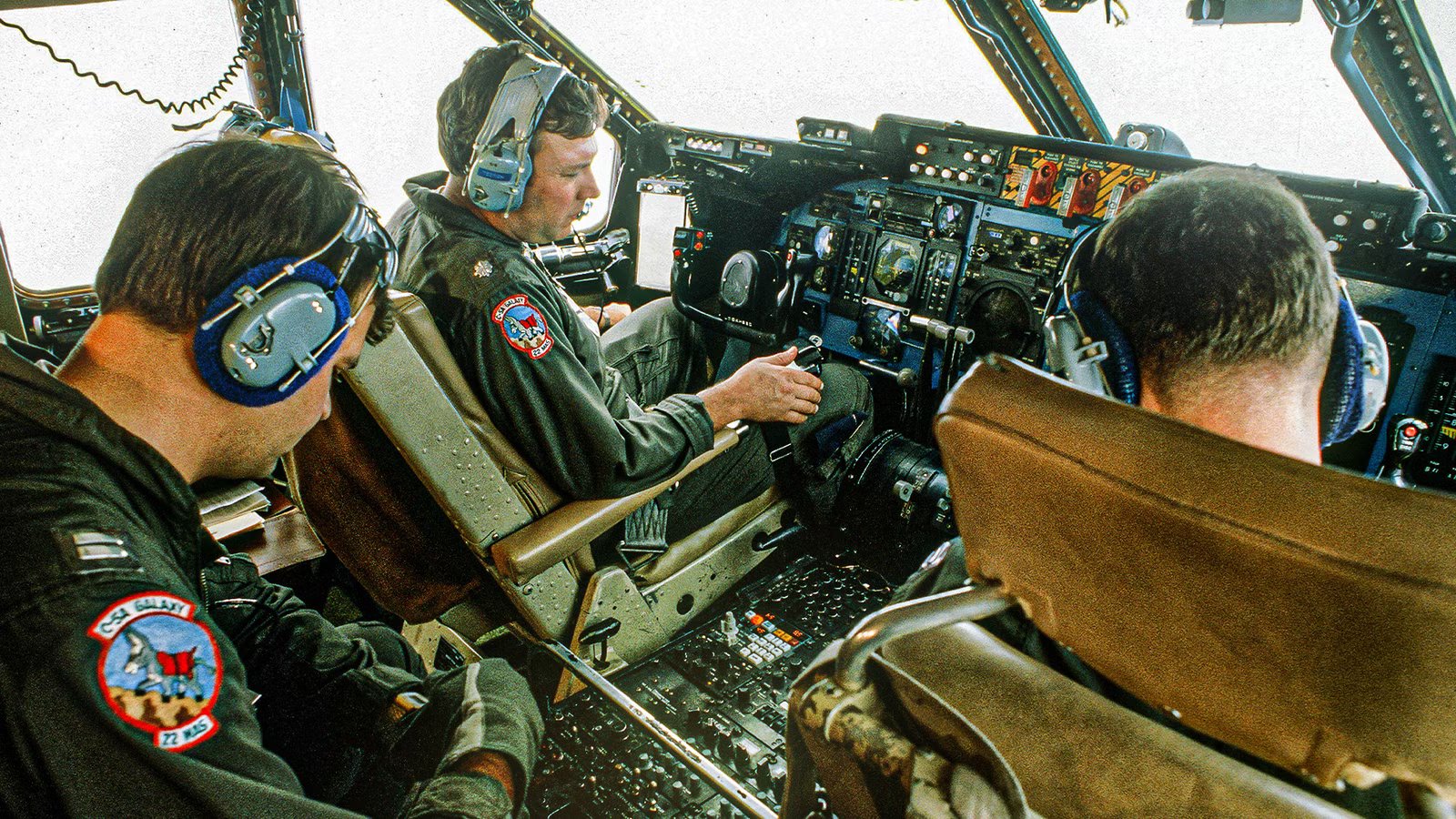
The Lockheed C-5 Galaxy was first delivered to the United States Air Force in 1970 and is still flying today in its upgraded C-5M form. Interestingly, it was operated for decades without a glass cockpit primarily because its 1960s-era design prioritized mechanical reliability over digital avionics, and retrofitting modern systems into a strategic airlifter measuring 247 feet 10 inches (75.3 meters) in length proved costly and complex.
Based on US Air Force modernization data and cockpit upgrade programs completed under Lockheed Martin‘s Avionics Modernization Program, the aircraft only transitioned to a digital flight deck in the 2010s, with LCD displays for both pilots, although some analog backups and mechanical controls remain for systems monitoring. For example, the Galaxy still requires a flight engineer, and its panel still retains many analog components.
Drawing on technical documentation, the key reason is its mission-driven design: the C-5 was built to carry payloads exceeding 120 tons into austere environments where system redundancy and field repairability outweigh automation. This matters particularly in a US context, as the C-5 remains a backbone of Air Mobility Command operations, directly supporting global deployments and logistics chains tied to NATO and US-based forces.
In this article, we will analyze three core factors behind the delay in digitalization: design-era limitations, military mission priorities, and the complexity of large-scale avionics upgrades, while also comparing the C-5’s evolution to that of commercial aircraft and newer platforms such as the C-17 Globemaster III.
What Is The Short Answer?

The simplest explanation is that the C-5 Galaxy was designed in the 1960s, long before glass cockpits existed, and that its military mission did not justify the immediate need or cost of upgrading to digital avionics until much later in its service life. Unlike commercial aircraft, which evolve rapidly due to competition and efficiency demands, military aircraft often prioritize proven systems that operate reliably in harsh, unpredictable environments.
When the C-5 first flew in 1968, cockpit technology was entirely analog. Pilots relied on round dials, mechanical gauges, and dedicated system panels. These systems were standard on all aircraft back then, as they were the only available option. Even as digital avionics began to appear in commercial aviation in the 1980s, the C-5 continued to operate with its original configuration because it still met mission requirements.
Over time, however, modernization became unavoidable. The US Air Force eventually introduced the C-5M Super Galaxy, which finally featured a glass cockpit, upgraded engines, and avionics. This transition illustrates an important point: the absence of a glass cockpit was never about inability, but rather about timing, cost, and operational necessity.
Factors To Consider Before Going Fully Digital
Several overlapping factors explain why the C-5 Galaxy lagged behind commercial aircraft in adopting a glass cockpit. First is the era in which it was designed. The aircraft emerged from a Cold War requirement for a strategic airlifter capable of transporting oversized cargo across intercontinental distances, such as during the Vietnam War. At that time, avionics technology was limited to analog systems. Retrofitting an entirely new digital architecture decades later is not as simple as replacing a few displays, as it requires redesigning how the aircraft processes and distributes information.
Second is the mission profile. The C-5 was built to carry tanks, helicopters, and other outsized military equipment into environments that are often austere, remote, or even hostile. According to discussions among aviation professionals, including this Reddit thread:
Military aircraft are often designed with field repairability in mind. Analog systems, while less sophisticated, can sometimes be easier to troubleshoot and repair under challenging conditions using simple tools than complex digital avionics.
Third is cost. Upgrading a fleet of large aircraft like the C-5 is an expensive undertaking. Unlike airlines, which can justify investments through fuel savings and operational efficiencies, military budgets must balance a wide range of priorities, from personnel to weapons systems. As a result, modernization programs are often delayed or phased over many years.
Fourth is integration complexity. The C-5 is a highly specialized logistics platform with interconnected systems for cargo handling, flight control, and mission planning, and not the cargo planes used in the commercial sector. Introducing a glass cockpit requires ensuring compatibility with all these systems, a process that can be both technically challenging and time-consuming.
These factors collectively explain why the aircraft remained analog for so long, even as the rest of the aviation world moved toward digital flight decks.
Commercial Vs Military Priorities

Aviation experts consistently highlight the fundamental differences between military and commercial aircraft design. One useful perspective comes from Aviation Stack Exchange, which discusses why aircraft like the C-5 were never adapted for commercial airline use. The discussion emphasizes that the C-5 was designed specifically for military logistics, not for efficiency or passenger operations, or, simply, comfort. Its high-mounted wings, unique landing gear, and cargo systems are optimized for flexibility rather than aerodynamic efficiency or cost-effectiveness. This design philosophy extends to the cockpit as well.
In commercial aviation, the adoption of glass cockpits was driven by clear economic incentives. Digital displays reduce pilot workload, improve situational awareness, and allow for more efficient crew training across fleets. Airlines quickly embraced these benefits because they translate directly into lower operating costs and improved safety.
Military aviation, however, functions under a different set of constraints. The aircraft’s upgrades were carried out gradually, with a strong focus on keeping mission readiness intact. Implementing new technology involves extensive testing, certification, and training, all of which must be carefully managed to prevent operational disruption. Experts also note that military crews are typically highly specialized and trained for specific aircraft types. This reduces the urgency to standardize cockpits across platforms, a major driver of glass-cockpit adoption and cockpit familiarity in commercial fleets.
C-5M Super Galaxy vs Boeing 747-400F – Similar Yet Very Different


The contrast between the C-5 Galaxy and the Boeing 747 is particularly revealing, despite some similarities between the two aircraft, which seem to “eat the cargo” in the same way, though the nose cargo door is under the cockpit. The main difference, however, is in their different cockpit philosophies.
The 747, which first flew around the same time as the C-5, evolved rapidly over subsequent decades. By the time the 747-400 entered service in the late 1980s, it featured a fully digital glass cockpit. This upgrade allowed airlines to reduce cockpit crew from three to two, eliminating the need for a flight engineer and significantly lowering operating costs.
For airlines, such changes are transformative. They improve efficiency, reduce training complexity, and enhance safety through better automation and situational awareness. These benefits create strong financial incentives to adopt new technology as quickly as possible.
Aircraft (Per Aviator Joe) | C-5M Super Galaxy | Boeing 747-400F |
|---|---|---|
Primary Role | Strategic military airlift | Commercial cargo freighter |
Entry into Service | 1970 (C-5A) / 2006+ upgrade (C-5M) | 1989 |
Cockpit Crew | Four (pilot, co-pilot, two flight engineers) | Two (pilot, co-pilot) |
Additional Crew | Three loadmasters | Typically none |
Maximum Payload | 281,001 lbs (127,460 kg) | ~273,000 lbs (124,000 kg) |
Cargo Volume | Extremely large, oversized cargo (tanks, helicopters) | High-density palletized cargo |
Cargo Access | Nose + tail loading (drive-through) | Nose door + side cargo door |
Pallet Positions | 36 pallets | ~30 main deck pallets |
Max Takeoff Weight | 840,000 lbs (381,000 kg) | 875,000 lbs (396,900 kg) |
Cruise Speed | ~Mach 0.71 | ~Mach 0.845 |
The C-5, on the other hand, had no such pressure. Its mission did not require reducing crew size or maximizing fuel efficiency in the same way. Instead, the priority was ensuring that the aircraft could reliably transport massive loads under a wide range of conditions. Another key difference is the operating environment.
Indeed, commercial aircraft typically operate from well-equipped airports with extensive ground support. The C-5 must be capable of landing at less developed airfields, sometimes with minimal infrastructure. In such scenarios, robustness and simplicity can be more valuable than advanced automation. This divergence in priorities explains why the 747 embraced glass cockpit technology decades earlier than the C-5, though both aircraft were developed in the same period.
The Challenges Of Digitalization

It’s important to clarify that the C-5 Galaxy now features a glass cockpit, at least in its modernized form. The C-5M Super Galaxy, introduced as part of the Avionics Modernization Program and Reliability Enhancement and Re-engining Program, brought the aircraft into the digital age.
The upgraded cockpit features modern displays, advanced navigation systems, and improved autopilot capabilities. These changes enhance situational awareness, reduce pilot workload, and align the aircraft more closely with contemporary aviation standards.
However, achieving this transformation was not without challenges. Retrofitting a glass cockpit into an existing airframe is a complex process. It requires not only installing new hardware but also redesigning how information is presented and processed. Extensive testing is needed to ensure that all systems work together seamlessly.
There are also risks associated with increased complexity. Digital systems can offer greater capability, but they can also be more difficult to repair in certain conditions. This is one reason why the military often approaches modernization cautiously, balancing the benefits of new technology against potential vulnerabilities.
Another consideration is training. Transitioning from analog to digital cockpits requires retraining pilots and maintenance crews, which adds to the overall cost and complexity of the upgrade. Despite these challenges, the success of the C-5M program demonstrates that such upgrades are both feasible and valuable when carefully implemented.
The Bottom Line

The absence of a glass cockpit in the original C-5 Galaxy is not a sign of technological backwardness, but rather a reflection of its time, mission, and operational priorities. Designed in the 1960s, the aircraft relied on the best available technology of its era. Analog instrumentation was reliable, robust, and well understood. As aviation technology evolved, so too did the C-5.
However, unlike commercial aircraft, which are driven by competitive pressures and economic incentives, military platforms evolve more slowly, guided by considerations of cost, reliability, and mission effectiveness. Today, the C-5M Super Galaxy stands as a bridge between these two worlds. It combines the proven capabilities of a Cold War-era design with the advantages of modern avionics, including a glass cockpit that enhances both safety and efficiency, while keeping the flight engineer, which is a rarity nowadays.
In the future, military transport aircraft will almost certainly incorporate advanced digital systems from the outset. However, the story of the C-5 Galaxy serves as a reminder that in aviation, progress is about choosing the right technology at the right time, and ensuring that it serves the mission above all else.