dailynewsnblog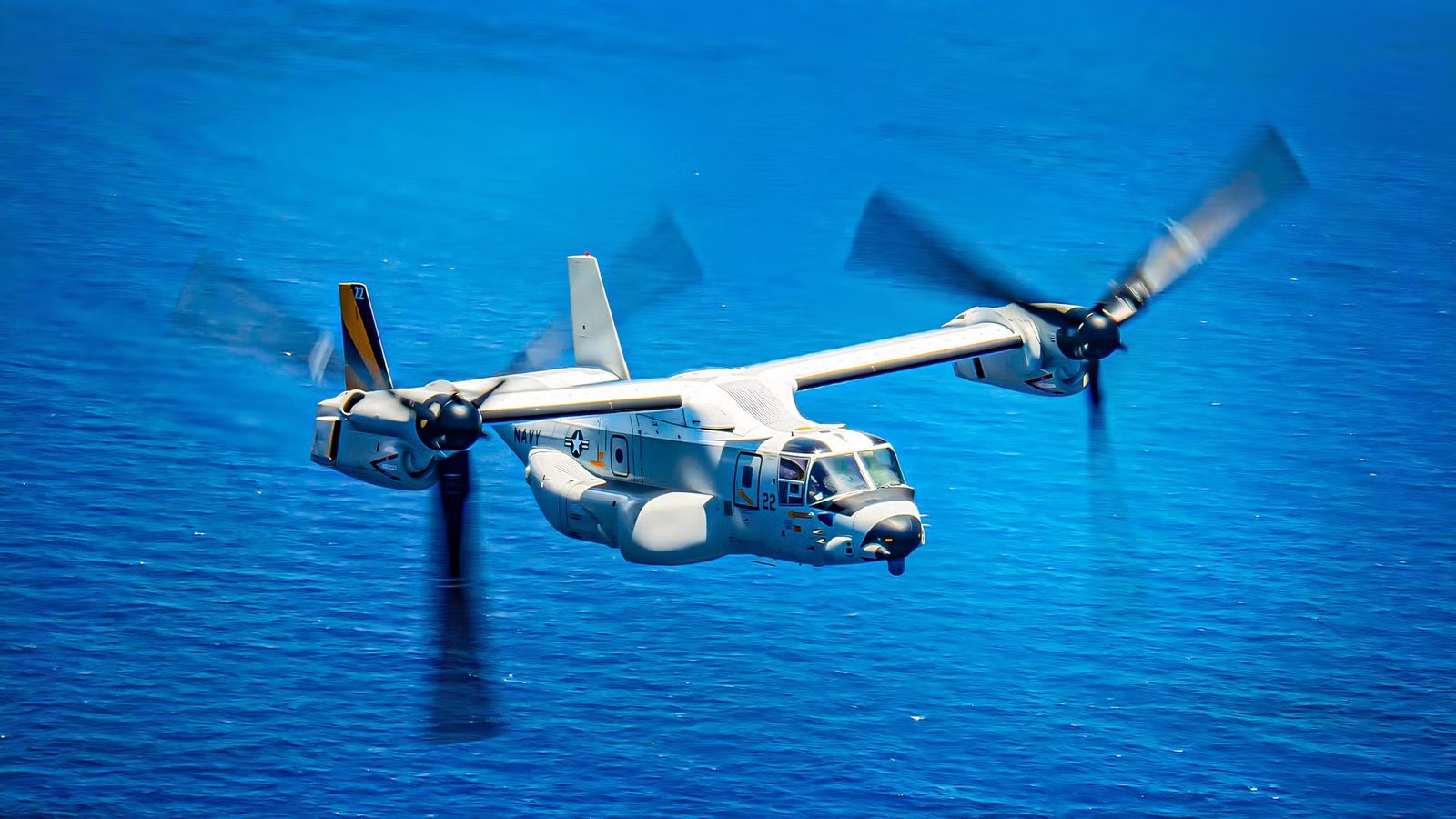
The United States Navy began looking for a replacement for its fleet of Lockheed Martin C-2A Greyhounds as far back as the early 1980s, and it was not until relatively recently that the sea service finally decided upon a replacement. The latter was the CMV-22B Osprey, jointly developed by Bell Textron and  Boeing.
While the Greyhound served admirably for decades, the arrival of the Lockheed Martin F-35C Lightning II in the fleet would play a key role in the retirement of the long-serving aircraft. The Osprey has gone on to provide enhanced versatility and flexibility for a deployed fleet, in addition to the key capability of transporting the F135 power module of the Lightning II intact. This capability is crucial for maintaining operational readiness and sustaining carrier air wing operations.
The Long Journey To Replace The Greyhound

The Osprey is a medium-sized tilt-rotor aircraft and is a derivative of the US Marine Corps’ proven MV-22 platform. While the Navy’s variant achieved initial operating capability on December 14, 2021, the Navy began searching for a replacement for its primary cargo hauler, the Northrop Grumman C-2A Greyhound, as far back as the early 1980s, due to concerns over the aircraft’s longevity. At that point, the aircraft had already been in service for around twenty years, with the first group of Greyhounds receiving an overhaul in 1973.
C-2A Greyhound Characteristics | Related Data |
|---|---|
Primary Function | Carrier On-board Delivery (COD) aircraft |
Prime Contractor | Northrop Grumman |
Unit Cost | $38.96 million (£29.20 million) |
Propulsion | Two Allison T56-A-425 turboprop engines; 4,600 shaft horsepower each |
Length | 56 feet, 10 inches (17.3 meters) |
Height | 17 feet, 2 inches (5.28 meters) |
Wingspan | 80 feet, 7 inches (24.56 meters) |
Weight | Max. Gross, take-off: 57,500 pounds (26,082 kg) |
Airspeed | Cruise – Approximately 260 knots true airspeed; Max – Approximately 343 knots |
Ceiling | 30,000 feet (9,144 meters) |
In search of a suitable replacement for the Greyhound, the Navy instituted the Multi-Mission Tactical Support/Carrier-based Experimental Aircraft competition (MMVX) in 1981. For its part, Fokker proposed a carrier variant of its F28 passenger jet. For naval service, the F28 would have featured a strengthened lower keel to accommodate carrier-compatible landing gear and an arresting hook, foldable wings, and refueling pods in order to serve as a sea-going tanker for the carrier air wing.
However, rather than invest in an entirely new program, the sea service decided to purchase 39 new Greyhounds, with deliveries beginning in the mid-1980s. These aircraft were heavily modified with more powerful engines, improved avionics, increased payload capacity, and enhanced reliability. With the newer C-2s joining the fleet, the older models were phased out by 1987, with the final new-build aircraft delivered by 1990. Ultimately, three decades would pass before the Navy introduced the Osprey into fleet service for carrier onboard delivery and inter-fleet logistics.
The Navy’s Newest Fleet Delivery Aircraft Is A “Game-Changer”

With the Greyhound nearly phased out, the Osprey has been performing COD missions for the fleet since its first operational deployment with Carrier Air Wing 2, assigned to USS Carl Vinson (CVN 70) in the summer of 2021. At first glance, it may seem counterintuitive to replace the Greyhound with an aircraft that has a lower payload capacity, with the C-2A able to accommodate 10,000 pounds of cargo and the Osprey rated at 6,000 pounds. What the Navy traded in cargo capacity, it gained in versatility, range, and nighttime operational capabilities, which the Navy had been hesitant to allow with the C-2A based on its avionics.
One of the greatest hallmarks of the Osprey is the fact that it can perform a vertical landing in the same fashion as a helicopter. This feature allows the aircraft to rapidly land and disembark personnel or deliver mission-critical cargo to a carrier at sea without interfering with the tempo of flight deck operations. While a C-2A Greyhound could clear the landing area relatively quickly after an arrested landing, it still required the use of the carrier’s arresting gear and temporarily occupied the angled flight deck. The V-22’s vertical landing capability eliminates that requirement, allowing carrier flight operations to continue with less disruption and greater flexibility.
CMV-22B Osprey Characteristics | Related Data |
Propulsion | Two Rolls-Royce AE1107C, 6,150 shaft horsepower (4,586 kilowatts) each |
Width | Rotors turning: 84.6 feet (25.8 meters); Stowed: 18.4 feet (5.6 meters) |
Rotor Diameter | 38.1 feet (11.6 meters) |
Length | Fuselage: 57.3 feet (17.47 meters); Stowed: 63 feet (19.2 meters) |
Height | Nacelles vertical: 22.1 feet (6.7 meters); Stabilizer: 17.9 feet (5.5 meters) |
Vertical Takeoff Max Gross Weight | 52,600 pounds (23,859 kilograms) |
Another key feature that sets the Osprey apart from its predecessor is its range, which, at first glance, appears marginally greater, with the Osprey maintaining an unrefueled range of 1,150 nautical miles (2,130 km) and the Greyhound possessing a 1,000-nautical-mile range (1,852 km). However, when one considers that the Osprey is capable of in-air refueling while the C-2A is not, this essentially grants the former unlimited range, a characteristic that is particularly useful within the Navy’s Distributed Maritime Operations (DMO) strategy.
DMO places much greater space between vessels during combat operations, increasing their survivability under wartime conditions against peer competitors. Even at great distances, the Osprey can make timely deliveries across dispersed fleets, enhancing the ability to sustain combat operations. Speaking to this and the Osprey’s enhanced capabilities, Vice Admiral Kenneth Whitesell, commander of Naval Air Forces, stated, “With distributed maritime ops, longer ranges, distances between multi-carrier operations, distances from land-based areas, and the ability for the V-22 to plop down on unimproved spaces, it proved to be a game-changer for us on deployment…”
A Key Determining Factor That Favored The Osprey For COD Services

Perhaps one of the V-22’s greatest logistical advantages is its ability to transport the Pratt & Whitney F135 power module used by the F-35C Lightning II. Unlike the Greyhound, which could not carry the fully assembled power module in its required shipping configuration, the Osprey can deliver it directly from shore to an awaiting aircraft carrier—or from an auxiliary vessel to a carrier at sea.
During high-tempo operations, this capability reduces the time and maintenance effort required to return an F-35C to service, improving the carrier air wing’s operational readiness and sustaining its combat capability. It should come as no surprise that the V-22’s first deployment was aboard USS Carl Vinson in August 2021, alongside the carrier’s first operational deployment of the Lightning II.
In a potential Taiwan contingency, most analyses envision the deployment of two to five carrier strike groups in defense of the island. Using a conservative estimate, a three-carrier force would comprise three aircraft carriers, roughly 18 to 24 major warships and auxiliaries, approximately 180–210 aircraft, and around 20,000–25,000 sailors and aircrew. Rather than operating as a concentrated formation, these strike groups would likely be dispersed across hundreds of miles of ocean, potentially spanning more than 1,000 miles.
In such a scenario, the Osprey would prove particularly valuable, rapidly transporting personnel, spare parts, and F135 power modules between shore bases, auxiliary vessels, and aircraft carriers that could themselves be separated by hundreds of miles. Unlike the Greyhound, which was limited to operating from aircraft carriers and shore airfields, the V-22 can also land aboard a wide variety of naval vessels, allowing critical cargo to be delivered directly where it is needed. This capability provides commanders with greater logistical flexibility, reduces the time required to return aircraft to service, and helps sustain combat operations during high-intensity conflict.
The Osprey’s Future Hangs in the Balance

The Osprey possesses a tactical versatility that the Greyhound was never designed for and could not match. With its ability to carry 50% more fuel than the Marine Corps variant, in addition to its in-air refueling capability, the aircraft can access and provide resupply of mission-critical cargo over greater distances and at greater speed. The current strategy of the US Navy and the US military as a whole, with its focus on dispersed forces, will rely on the capabilities that the V-22 can provide.
In any potential conflict with China, the US military will be deployed across vast distances, particularly within the first island chain or among the thousands of islands between the first and second island chains. Providing supplies to these remotely located ships and infantry units will benefit from the Osprey and its ability to touch down in a forested clearing or on a sun-baked islet.
Currently, the US military has 469 V-22s in service across the services, with 360 flying for the Marines, 53 with the Navy, and 56 deployed with the Air Force’s Special Operations Command. While the Navy has requested billions of dollars through the end of the decade to support modernization of the broader V-22 fleet, including new proprotor gearboxes, subcomponent upgrades, and equipment monitoring systems, production of the aircraft is due to end relatively shortly, with the final five Ospreys currently going through production. For this reason, Bell Textron and Boeing are in discussions regarding the fate of the manufacturing equipment once the assembly line finally shuts down.
With the Navy increasingly focused on distributed operations across the vast distances of the Indo-Pacific, the CMV-22B could prove to be one of the most important logistical assets available to the carrier strike group. Yet, as the V-22 production line prepares to close, the Navy may soon find itself relying on an aircraft that it can no longer easily expand its fleet of. The Osprey has demonstrated its versatility across the US military, but whether the Navy has procured enough of the aircraft to meet the demands of a future conflict remains an open question.

![Air Canada Launches These 3 Massive New Long-Haul Routes [Map & List]](https://dailynewsnblog.com/wp-content/uploads/2026/08/shutterstock_2676944715_cropped.jpg)