dailynewsnblog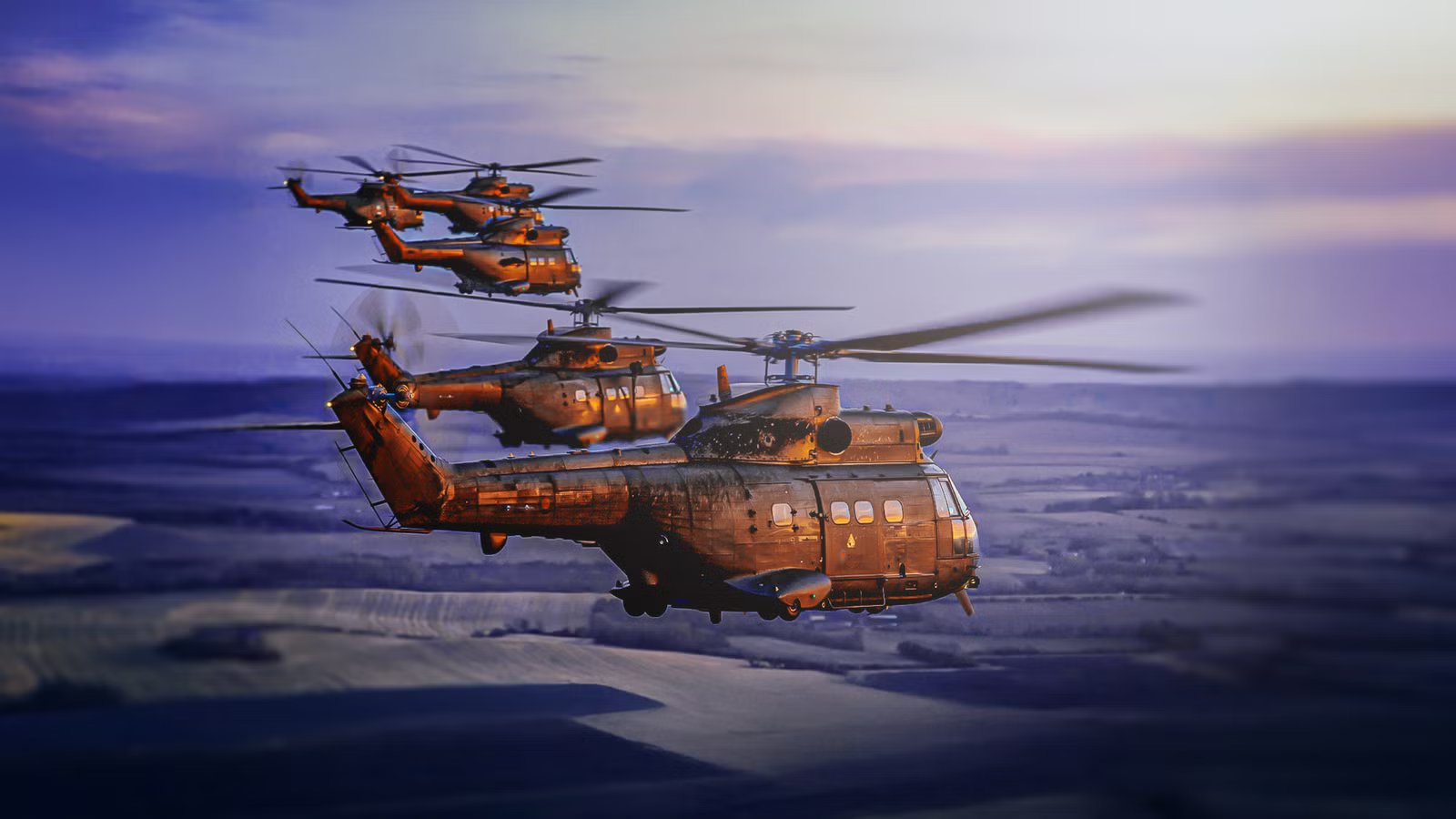
Britain’s military helicopter fleet is entering one of its most significant periods of transition since the end of the Cold War. While the Ministry of Defence (MoD) has announced major investments in new aircraft and, especially, autonomous technologies, the timing of those programs means the armed forces will soon have fewer helicopters available than they have operational requirements for. The most critical period begins in 2027, when the British Army starts retiring its AgustaWestland Wildcat AH1 fleet years before its long-term replacement is ready.
The resulting capability gap is complex and is not just about replacing one helicopter with another. It reflects a broader shift in British defense strategy that prioritizes autonomous systems, such as advanced drones, networked warfare, and future rotorcraft concepts over maintaining existing crewed fleets. Until those ambitions become reality, however, the RAF, British Army, and Royal Navy will have to balance troop transport, reconnaissance, search-and-rescue, overseas commitments, and amphibious operations with a shrinking inventory of operational helicopters.
Britain Is Entering A Helicopter Procurement Gap

The UK’s helicopter shortage did not emerge overnight. Instead, it is the product of several procurement decisions that overlap in unfortunate ways, similar to some NATO fighter jet retirements without replacement being ready. Basically, the retirement of legacy fleets has been scheduled years before their permanent replacements become operational, creating what defense analysts increasingly describe as a procurement trough rather than a simple modernization program.
The first major milestone came with the retirement of the Royal Air Force’s Puma HC2 helicopters in 2025. After more than five decades of service, the type left RAF inventories without a direct replacement already available. Although the Puma modernization program had extended the fleet’s operational life considerably, the aircraft had reached the point where further investment no longer made economic or operational sense. According to Airforce Technology, the retirement formed part of a broader restructuring that also affected other rotary-wing capabilities.
The next challenge will arrive in 2027 when the British Army begins retiring its 34 Wildcat AH1 helicopters, despite the aircraft entering service only around a decade earlier. The retirement is driven less by airframe age than by changing operational priorities and budget allocation toward autonomous reconnaissance systems, as per The Aviationist, analysis of the Wildcat AH1 retirement and Let’s Data Science report on the 34-aircraft retirement.
The AW149 Will Eventually Replace Puma, But Not Before 2030

The government has already selected the helicopter intended to replace much of the Puma’s capability. In March 2026, Leonardo secured the New Medium Helicopter (NMH) competition with its AW149, winning a contract worth approximately £1 billion ($1.3 billion) for 23 aircraft.
The problem is timing rather than aircraft selection. According to Breaking Defense and Airforce Technology, deliveries will not begin until the summer of 2030 and will continue through 2033. That creates a gap of roughly six years between the Puma’s retirement and the arrival of enough operational AW149s to restore lost capability.
2026 UK Military Helicopters Currently In Service (UK Government) | ||||||||
Helicopter | Operator | Primary operational role | Crew | Troop capacity | Max speed | Range | Max takeoff weight | Number in service |
Boeing AH-64E Apache Guardian | British Army (Army Air Corps) | Attack helicopter optimized for close air support, armed reconnaissance, anti-armor warfare, and deep strike | 2 | — | 205 mph (330 km/h) | 295 mi (476 km) | 17,077 lb (7,746 kg) | 50 |
Leonardo Wildcat AH1 | British Army | Battlefield reconnaissance, command & control, liaison, and light utility support (retirement begins in 2027) | 2 | Up to 6 troops | 193 mph (311 km/h) | 480 mi (777 km) | 13,448 lb (6,100 kg) | 34 |
Boeing CH-47 Chinook HC5/HC6/HC6A | Royal Air Force | Heavy-lift transport, air assault, logistics, special forces support, humanitarian relief | 4 | Up to 55 troops | 184 mph (296 km/h) | 460 miles (741 km) | 50,000 lb (22,680 kg) | 50 |
Leonardo Merlin HC4/HC4A | Royal Navy (Commando Helicopter Force) | Royal Marines assault support, amphibious operations, battlefield transport and logistics | 2-4 | Up to 24 troops | 193 mph (310 km/h) | 519 miles (835 km) | 34,392 lb (15,600 kg) | 25 |
Leonardo Merlin HM2 | Royal Navy (Fleet Air Arm) | Anti-submarine warfare (ASW), anti-surface warfare (ASuW), airborne surveillance, maritime search and rescue | 3-4 | Mission dependent | 193 mph (310 km/h) | 575 miles (926 km) | 34,392 lb (15,600 kg) | 30 |
Airbus H145 Jupiter HC2 | Joint Aviation Command | Utility transport, CASEVAC/MEDEVAC, firefighting, and overseas operations in Cyprus and Brunei | 1-2 | Up to 8 passengers/troops | 152 mph (246 km/h) | 414 miles (666 km) | 8,157 lb (3,700 kg) | 6 |
Airbus H145 Jupiter HT1 | Royal Air Force | Advanced multi-engine helicopter training | Instructor + trainee | Training only | 152 mph (246 km/h) | 414 miles (666 km) | 8,157 lb (3,700 kg) | |
Airbus H135 Juno HT1 | Royal Air Force | Basic helicopter flight training | Instructor + trainee | Training only | 160 mph (259 km/h) | 394 miles (635 km) | 29 | |
The AW149 itself represents a significant capability improvement. It offers greater payload, modern digital avionics, improved survivability systems, and better interoperability with NATO partners. However, even once deliveries begin, Britain will receive only 23 helicopters compared with the larger combined fleets they effectively replace. Consequently, the new aircraft improve quality but not necessarily overall fleet size, which raises some questions regarding the premature retirement of the current fleet.
Airbus H145s Provide Only A Temporary Solution

Recognizing that overseas commitments could not simply be suspended and wait until 2030, the Ministry of Defence moved to acquire six Airbus H145 helicopters designated Jupiter HC2. Instead of replacing Puma across the entire force, these helicopters are intended to support operations of 84 Squadron at RAF Akrotiri in Cyprus, as per Airforce Technology, and in Brunei, according to the UK Government, where lighter utility missions can be performed efficiently.
According to The Defense Post coverage and the UK Defense Journal, the H145 fleet is expected to achieve full operational capability by the middle of the year, with some being extensively tested right now. Their introduction ensures that Britain’s permanent overseas garrisons retain some aviation support despite the Puma’s withdrawal.
Nevertheless, just six light helicopters cannot compensate for the retirement of dozens of medium utility helicopters. The H145 carries fewer troops, less cargo, and possesses a significantly shorter range than Puma or the future AW149. Its mission profile is therefore highly specialized and can be used as a temporary “gap filler” rather than representing a comprehensive fleet replacement. The limited purchase illustrates how the Ministry of Defence is increasingly treating traditional helicopters as bridging assets while preparing for a much broader transition toward autonomous aviation systems.
Britain Is Betting That Drones Can Replace Traditional Helicopter Missions

Perhaps the most significant feature of Britain’s latest Defence Investment Plan is not a helicopter purchase at all. Instead, the government intends to spend approximately £5 billion over four years expanding uncrewed systems across multiple military domains, including rotary-wing operations. According to Aviation Week analysis of the Defence Investment Plan and DSEI Gateway overview of the same plan, these investments will support reconnaissance, logistics, surveillance, and eventually maritime aviation roles.
This strategy explains why the Wildcat AH1 is being retired relatively early. Rather than purchasing another dedicated reconnaissance helicopter, the Army expects unmanned aircraft to assume many intelligence, surveillance, target acquisition, and reconnaissance (ISTAR) missions. Some publications report that many utility and reconnaissance tasks previously assigned to Wildcat will gradually migrate toward autonomous platforms.
But the main challenge is that drones cannot yet perform every helicopter mission. Combat search-and-rescue remains one of the most demanding aviation operations, requiring crews capable of making complex tactical decisions, sometimes in hostile environments while physically extracting personnel. Likewise, Royal Marines amphibious assaults continue to depend on helicopters capable of transporting fully equipped troops, a role that autonomous aircraft have yet to demonstrate at operational scale.
The Royal Navy’s Wildcat HMA2 fleet currently remains unaffected, but long-term planning documents suggest even those helicopters may eventually give way to autonomous systems during the next decade, when they become more sophisticated.

Britain is not attempting to solve its long-term helicopter requirements alone. It is one of several NATO members participating in the Next Generation Rotorcraft Capability (NGRC) program, which seeks to develop an entirely new family of military rotorcraft capable of replacing current helicopters beginning in the late 2030s.
The program recently entered Concept Study Five involving Airbus, Leonardo, and Sikorsky. Airbus has already unveiled conceptual rotorcraft designs, while Lockheed Martin confirmed Sikorsky’s continued participation in the next phase of development. NATO expects to identify a preferred solution around 2027, but operational deliveries are not anticipated until approximately 2038.
British Military Helicopter Transition Timeline | ||
Year | Key event | Operational impact |
2025 | Puma HC2 retired | RAF loses medium-lift capability |
2026 | Six H145 Jupiter HC2 reach full capability | Limited overseas gap mitigation |
2027 | 34 Wildcat AH1 retire | Army reconnaissance fleet shrinks dramatically |
2030 | First Leonardo AW149 deliveries | Long-term replacement begins |
2030–2033 | Remaining AW149 deliveries | Medium helicopter capability gradually restored |
~2038 | NATO NGRC target entry into service | Potential next-generation fleet begins replacing current helicopters |
The timeline demonstrates why defense strategists are concerned about the period between 2027 and roughly 2032. During those years, Britain will simultaneously operate fewer utility helicopters, fewer reconnaissance helicopters, and rely much more on technologies that remain in early operational development rather than mature military service.
The Capability Gap Is About More Than Aircraft Numbers

At first glance, Britain’s helicopter transition appears to be a straightforward fleet modernization program. Older aircraft retire, newer aircraft arrive, and autonomous systems gradually assume appropriate missions. In practice, however, the overlap between retirements and delayed procurements creates several years during which available helicopter capacity will almost certainly be lower than operational demand.
This matters because helicopters remain uniquely flexible military assets, and, sometimes, the only viable options for some missions. Whether transporting Royal Marines from amphibious ships, evacuating casualties, inserting special forces, supporting overseas garrisons, or conducting combat search-and-rescue, many missions still require crewed aircraft capable of carrying people doing things with their own hands rather than relying solely on sensors, robots or AI. Even rapid advances in autonomous technology have yet to fully replicate those human skills and capabilities.
Britain is therefore making a calculated strategic gamble. If drone technology develops as quickly as experts expect, and if the AW149 enters service on schedule before NGRC follows in the late 2030s, today’s procurement trough may eventually be remembered as a temporary transition. If either assumption proves optimistic, however, the years beginning in 2027 could represent one of the leanest periods for British military helicopter capability in decades.