dailynewsnblog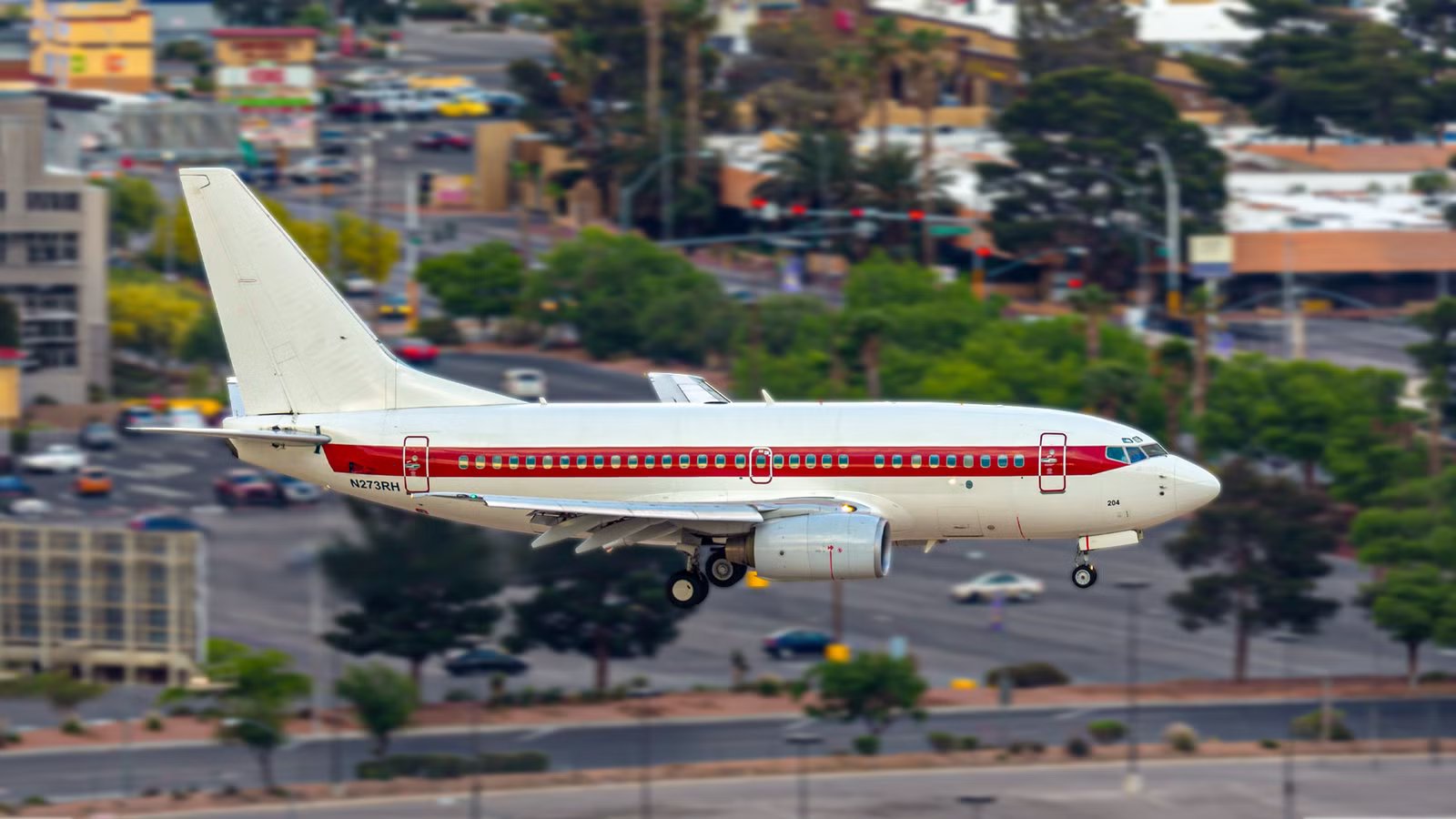
There is an airline operating out of Las Vegas that has no website, no published schedule, and no logo on its fuselage — yet it runs up to 190 flights per week and moves over a thousand workers per day to facilities that do not appear on any public map. It is called Janet, and it is the United States government’s most classified commuter operation, flying Boeing 737-600s and Beechcraft turboprops to destinations including Area 51 and the Tonopah Test Range under a contract currently held by defense giant Amentum.
Drawing on the US Air Force’s November 2023 Request for Information, fleet records from ch-aviation, and ground infrastructure data from Dreamland Resort, this guide examines everything that is publicly known about Janet — from its Cold War origins and unmarked aircraft to its extraordinary crew hiring standards, its tightly controlled radio procedures, and what the raw sortie numbers reveal about the true scale of America’s most invisible airline.
The Airline That Doesn’t Officially Exist

Janet’s origins are rooted in the Cold War logic of operational security. The first flights under what would become the JANET callsign were performed in 1972 by a Douglas DC-6 operated by EG&G, the defense contractor tasked with managing the Nevada Test Site and its surrounding classified facilities.
The mission was straightforward: the government needed a reliable, controlled way to move workers between Las Vegas and Area 51, the facility at Groom Lake that served as the testing ground for the Lockheed U-2 spy plane, the A-12 Oxcart, and a succession of aircraft programs that could not be acknowledged publicly. A second DC-6 was added in 1976, and the operation has grown steadily ever since.
The name itself carries that particular brand of government dry wit. JANET is said to stand for either “Just Another Non-Existent Terminal” or “Joint Air Network for Employee Transportation,” and as reported by wingborn.com, according to the Nevada Aerospace Hall of Fame, the name was chosen by Richard A. Sampson, a former Area 51 commander, after his wife. Whether that story is apocryphal or not, the acronym captures the essential contradiction at the heart of this operation: a highly organized, professionally run airline that is simultaneously not supposed to be there at all.
Today, Janet is operated for the United States Air Force by Amentum, a Maryland-based defense and infrastructure contractor that inherited the contract through its acquisition of AECOM’s defense contracting ventures. Before AECOM, the contract was held by URS Corporation, which itself emerged from the merger with EG&G. The operator has changed names over the decades; the mission has not. Janet transports military personnel, Department of Defense civilians, and contractor employees to Special Access Program Facilities (SAPFs) — installations that exist within layers of classification so deep that the work conducted inside them cannot be discussed in any open forum. This is the foundation on which every other operational detail of Janet rests.
A Fleet Built For Secrecy, Not The Spotting Book

Janet’s fleet is small by any commercial standard, but its composition tells a precise operational story. The backbone is a set of Boeing 737-600s — the rarest and shortest variant of the 737 Next Generation family. Boeing produced only 69 of them, and today, only a handful of operators still fly the type worldwide.
According to planespotters.net, Janet’s 737-600s were originally delivered to  Air China and China Southwest Airlines, with four of the six having flown for the now-defunct Chinese carrier before being transferred to US Air Force operations between 2008 and 2009. They were initially processed at Wright-Patterson Air Force Base before being repositioned to Las Vegas, where they have operated ever since.
Alongside the 737s, Janet flies a complement of five Beechcraft King Air B200C twin-engine turboprops. These smaller aircraft serve a different operational function: where the 737-600 is suited to the main Las Vegas–Groom Lake corridor, the King Airs can access shorter or more restricted airstrips, carry smaller groups, and draw considerably less attention. Together, the two types give Janet a layered capability — volume and efficiency from the narrowbodies, flexibility and discretion from the turboprops.
The livery, or rather the deliberate absence of one, is perhaps the fleet’s most striking characteristic. Every Janet Boeing 737 aircraft carries a white fuselage with a single red cheatline running along the window line. There is no airline name, no tail logo, no registration displayed in any prominent position, and no cabin branding that would identify the operator. It is a livery designed to suggest commercial normality from a distance while providing nothing useful to an observer. As Simple Flying has previously noted, the decision to minimize external markings is a deliberate operational security measure that has been maintained consistently across every generation of aircraft the fleet has operated.
Area 51: What Really Goes On At The US Air Force’s Most Secret Base?
Conspiracy theories, urban legends, and related movies, TV shows, video games, and whatnot aside, what’s the real deal with Area 51?
The Terminal At The Edge Of The Map

Janet’s ground operations at  Harry Reid International Airport (LAS) in Las Vegas are as revealing as the aircraft themselves. The airline operates from a standalone, restricted private terminal on the western perimeter of the airport — a facility that is physically separated from the commercial concourses and entirely inaccessible to the public. It has no departures board, no check-in counter in any conventional sense, and no information visible to anyone without the appropriate clearance. Passengers arrive, clear security, and board. The process is invisible to the rest of the airport.
What makes the terminal particularly striking from an analytical standpoint is its parking infrastructure. According to Dreamland Resort, the Janet terminal features approximately 1,740 marked car spaces and 72 dedicated motorcycle spaces — a scale of provision that is wholly inconsistent with a marginal or experimental operation. Parking infrastructure of that size implies a workforce of well over a thousand daily commuters, a figure consistent with the operational tempo described in USAF procurement documents. These are not occasional flights. This is a structured daily commute for a substantial professional population whose workplace simply happens to be located inside one of the most restricted airspaces in the United States.
The public fascination with Janet was crystallized recently when an aviation enthusiast created a detailed mock safety card for the airline — complete with Janet-appropriate iconography, evacuation procedures for classified destinations, and the kind of dry humor that emerges when someone applies the visual grammar of commercial aviation to an operation that actively resists it.
The card went viral on Reddit’s r/aviation community, accumulating thousands of upvotes and a comment thread that ranged from technical admiration to genuine curiosity about what a real Janet safety briefing might contain. The episode is a useful reminder that the secrecy surrounding Janet does not diminish public interest, but, on the contrary, amplifies it.
Inside Janet Airlines: Secret Callsigns, Hidden Radio Procedures, And Area 51 Station Codes

Janet’s radio procedures add another layer of controlled ambiguity, though less is publicly confirmed than often claimed. Flights departing Las Vegas typically use the “Janet” callsign while operating in civilian-controlled airspace around Harry Reid International Airport and during transit through the Nellis Air Force Base region. Aircraft are associated with the ICAO designation “WWW,” which appears as restricted or blocked in official listings, but the details behind its assignment are not publicly explained.
There is evidence from radio monitoring that callsigns may change once flights enter highly restricted airspace near Area 51, although the exact structure and consistency of these alternate identifiers remain undocumented. Claims about so-called “Groom callsigns” — informal names unrelated to flight numbers — originate largely from enthusiast observations and have not been confirmed in official sources.
Similarly, Janet destinations are sometimes described using internal “station numbers,” such as Station 3 for Groom Lake and Station 7 for the Tonopah Test Range Airport. These identifiers do appear in administrative or reference material, but there is little evidence that they are used in routine air traffic control communications. Groom Lake itself carries the ICAO identifier KXTA, and Jeppesen approach charts for the facility have become public through FOIA releases—offering a rare glimpse into an otherwise highly compartmentalized system.

Las Vegas Bound: A Look At The Private Jet Flown By The Caesars Palace Casino
The casino company currently flies a Gulfstream G550.
The Price Of Clearance: Hiring For The Invisible Airline

The hiring process for Janet crew is one of the most demanding in civil aviation — not in terms of flight hours or type ratings, but in terms of security vetting. Every captain, first officer, and flight attendant employed by the operation must hold a top-secret government clearance, obtained through a Single Scope Background Investigation (SSBI).
The SSBI is the most comprehensive form of security clearance investigation conducted by the US government, covering financial history, foreign contacts, personal conduct, and psychological evaluations over a period that can take months to complete. As documented by Popular Mechanics, job openings for Janet crew do appear occasionally on public hiring platforms, which is a paradox that reflects the practical reality that even a classified airline needs to recruit from the civilian labor market.
Crew members must maintain their authorization throughout their employment, submitting to periodic re-investigations and lifestyle monitoring. Reports from aviation professionals who have applied or been approached for Janet positions describe a process that filters aggressively for anyone with foreign financial ties, complex personal histories, or the kind of professional network that intersects with foreign nationals. Even highly experienced former military pilots with existing clearances have reportedly been rejected. The result is a crew corps of exceptional operational discipline and, by necessity, extraordinary discretion.
What the hiring requirements reveal, beyond the obvious security rationale, is the nature of the workforce Janet serves. The facilities these aircraft fly to, Area 51 and the Tonopah Test Range most prominently, are Special Access Program Facilities, meaning access requires specific program authorization, not just a generic clearance level. The people boarding Janet every morning are among the most rigorously vetted professionals in the United States defense system. It follows, logically, that the crew transporting them would be held to a comparable standard.
190 Flights A Week: What The Numbers Actually Reveal

The clearest window into Janet’s true operational scale came in November 2023, when the US Air Force published a Request for Information as part of a preliminary process to identify a potential new contractor for the fleet’s operation. The document, while carefully worded and non-binding, contained specific procedural parameters that reframed public understanding of what Janet actually is.
The new operator would be required to support up to 190 sorties per week — a figure that could increase to 200 “with prior coordination.” Each 737-600 in the fleet was expected to accumulate approximately 1,700 flight cycles and 850 flight hours annually. The planned contract would run for ten years, beginning October 1, 2025, with a provision that the USAF “may begin a fleet replacement initiative” during that period, signaling that the 737-600s, now averaging over two decades in service, may eventually give way to a newer type.
At 190 weekly sorties, Janet operates at a cadence comparable to a moderately busy regional airline. Spread across six 737-600s, that represents roughly 27 sorties per aircraft per week. Such a utilization rate is rather modest by commercial standards but entirely consistent with a mission-driven schedule structured around worker shift patterns rather than fare revenue. The future of the fleet and its operator remains formally unresolved. As of the time of writing, Amentum continues to hold the contract, and no public announcement of a replacement has been made.
The USAF’s RFI specified that the new operator must be a FAR Part 121 certificated carrier and a Civil Reserve Air Fleet (CRAF) member — criteria that open the field to legacy carriers including  United Airlines,
  Delta Air Lines, and
  American Airlines, as well as a number of smaller operators. What will not change is the fundamental nature of the mission. Janet exists because the United States government concluded, more than fifty years ago, that certain work requires a highly protected commute that leaves no trace.


![19-Hour Nonstop Flights: Singapore Airlines’ 10 New Ultra-Long Routes 2026 [Updated]](https://dailynewsnblog.com/wp-content/uploads/2026/05/singapore-airlines-airbus-a350-900-taxiing.jpg)