dailynewsnblog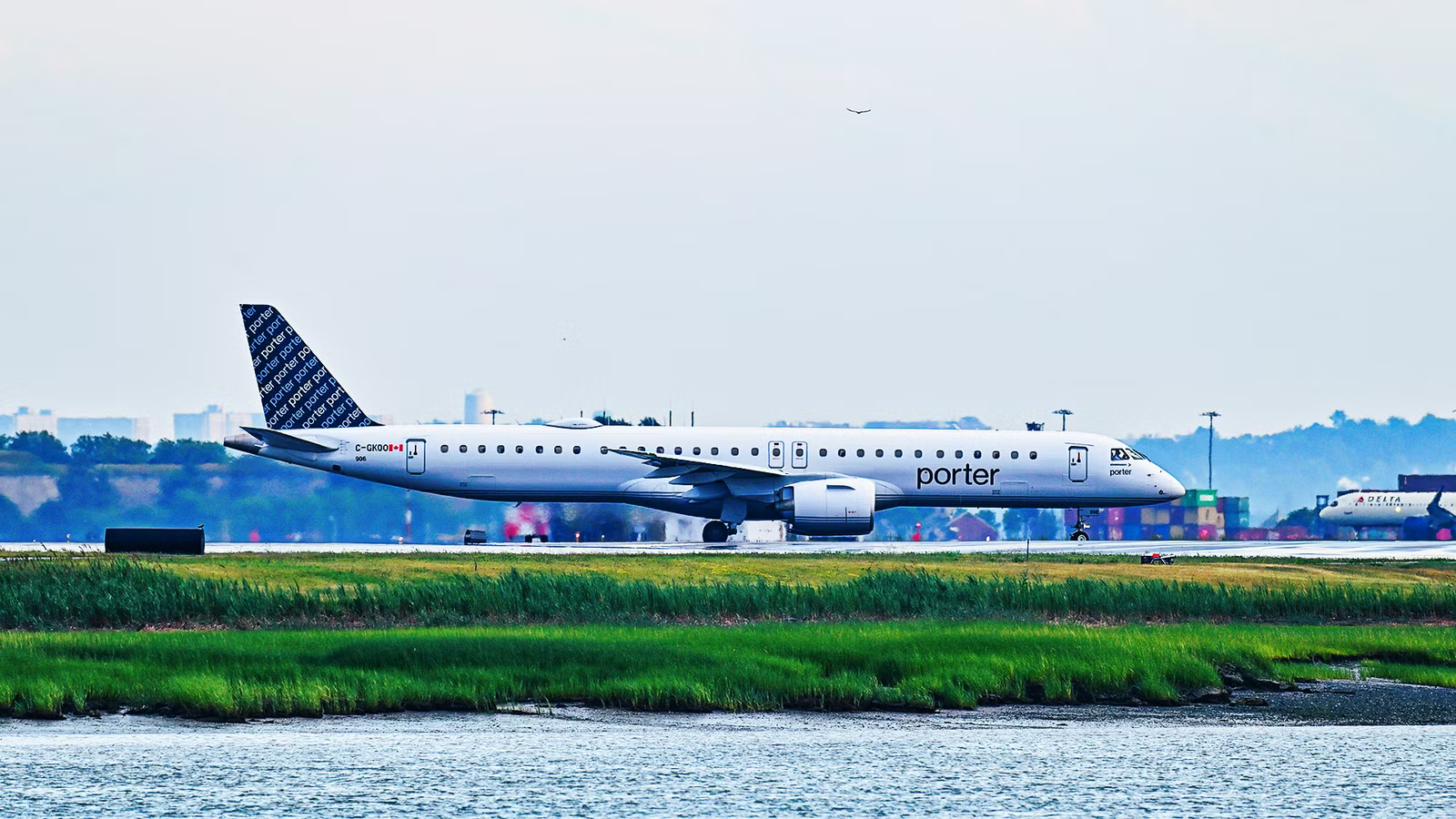
This past winter, a very surprising visitor sat on the tarmac at Phu Quoc Airport (PQC). The Vietnamese island, renowned for its white-sand beaches and luxurious resorts, is accustomed to seeing a wide diversity of airlines and aircraft, from large widebodies jetting in from faraway Prague or Seoul, to regional puddle-jumpers that connect the island to the mainland. But this visitor was remarkably different — a regional jet, which is not at all uncommon, but this one had just flown over 2,500 miles nonstop from the steppes of Mongolia.
Hunnu Air is a tiny airline of five aircraft based at Chinggis Khaan International Airport (UBN) in the Mongolian capital of Ulaanbaatar. It specializes in seasonal charters, but notably, has taken delivery of two Embraer E195-E2 aircraft over the past year. In perhaps the most extreme demonstration yet of how far the Embraer E2 has moved beyond traditional regional routes, Hunnu Air operated seasonal winter charters from Ulaanbaatar to Phu Quoc, covering 2,598 miles (4,180 km), with the E195-E2 flights sometimes spending more than six hours airborne.
Similar experiments are appearing thousands of miles apart. Porter Airlines is sending E195-E2s from Canada deep into Mexico, Costa Rica and the Caribbean; South Africa’s Airlink is opening long routes across the Indian Ocean; TUI fly in Belgium flies the type for more than five hours from Antwerp to Tenerife; and Widerøe previously sent the smaller E190-E2 from Norway to the Canary Islands. These aircraft may wear a regional-jet label, but airlines are increasingly using them to open long, thin leisure routes that would struggle to support the capacity of an Airbus A320 or Boeing 737.
The Regional Jet That Grew Into A Small Narrowbody

The second-generation E-Jet family consists of the E190-E2 and stretched E195-E2. The latter is the largest regional airliner in service, and can accommodate up to 146 passengers in high-density layouts, while a more typical single-class configuration at 31-inch pitch has 132 seats. Most importantly for these unusual missions, Embraer quotes a full-passenger range of 3,000 nautical miles (5,556 km), and says the E195-E2 burns 29% less fuel than the previous-generation E-Jet it replaces. Passengers also get a 2+2 cabin without middle seats.
The E2 is no longer a niche program. Embraer’s first-quarter 2026 figures showed 504 firm orders, 213 deliveries and a 291-aircraft backlog. Porter is the largest current operator with over 50 E195-E2s in service out of an order book of 75, while other large customers with deliveries and firm commitments include Azul Linhas Aereas (75), Avelo Airlines (50),  SAS (45), and KLM (35).
Aircraft Type | Firm Orders | Deliveries | Backlog | Options |
|---|---|---|---|---|
E195-E2 | 439 | 175 | 264 | 234 |
E190-E2 | 65 | 38 | 27 | 64 |
Total E2 family | 504 | 213 | 291 | 298 |
Most of those aircraft are still doing what passengers would expect from a regional jet: feeding hubs and linking medium-sized cities. KLM, for example, deploys its E195-E2 fleet to secondary destinations throughout Europe, with current missions topping out at its route from  Amsterdam Schiphol Airport (AMS) to Catania / Fontanarossa Airport (CTA) at 1,140 miles (1,835 km). That is precisely why the five- and six-hour holiday flights stand out. They are not normal E2 utilization; they show airlines deliberately exploiting a capability most operators rarely need or haven’t considered.
North America: Porter Turns The E195-E2 Into A Holiday Jet

No airline has taken the idea further at network scale than Porter. The Canadian carrier began as a Q400-focused operator from downtown Billy Bishop Toronto City Centre Airport (YTZ), but the E195-E2 allowed it to build a second business around longer routes from  Toronto Pearson International Airport (YYZ), Ottawa Macdonald-Cartier International Airport (YOW), Montréal–Trudeau International Airport (YUL) and other Canadian cities. By July 2026, Porter said it had received 54 aircraft against 75 firm orders, while its winter 2026/27 schedule contained more than 40 warm-weather routes.
Some are now genuine five- to six-hour sectors. Ottawa to Liberia’s Guanacaste Airport (LIR) is the longest route at 2,468 miles (3,972 km) with a scheduled outbound block approaching six hours, while the new Ottawa to Los Cabos International Airport (SJD) route that starts this winter will have the longest block time at exactly six hours. Toronto–Liberia and Toronto–San José provide similar missions from the airline’s largest market.
Porter E195-E2 Route | Distance | Westbound Block Time | Role |
|---|---|---|---|
Ottawa – Liberia | 2,468 miles (3,972 km) | 5h 53m | Costa Rica leisure |
Ottawa – Los Cabos | 2,444 miles (3,933 km) | 6h 00m | New winter 2026/27 |
Ottawa – Puerto Vallarta | 2,389 miles (3,845 km) | 5h 55m | Mexico leisure |
Toronto – San José | 2,342 miles (3,769 km) | 5h 30m | New winter 2026/27 |
Toronto – Liberia | 2,312 miles (3,721 km) | 5h 15m | Costa Rica leisure |
Montreal – Vancouver* | 2,286 miles (3,679 km) | ~5h 42m | Domestic comparison |
*Included to show that Porter also uses the E2 on long non-leisure/transcontinental missions.
Porter’s advantage is not simply that the aircraft can physically make the trip. It’s that the E195-E2s have only 132 seats, so a city such as Ottawa does not need enough Costa Rica or Mexican demand to fill a 180- or 190-seat narrowbody several times each week. The same 2+2 configuration that differentiates the E2 on a one-hour flight also becomes considerably more valuable after five hours, while lower trip costs let Porter try markets that could be commercially uncomfortable with a larger aircraft.
Africa: Air Peace Set The Benchmark, Airlink Is Picking It Up

Nigeria’s Air Peace was the early African pioneer. Its route from  Lagos Airport (LOS) to
  Johannesburg Airport (JNB) stretched roughly 2,809 miles (4,521 km) and became one of the longest scheduled E195-E2 routes anywhere, with block times of around six hours. However, it should now be viewed as a historical benchmark: Air Peace withdrew from Johannesburg last year, with its final weekly E195-E2 service operating in February.
Airlink is now taking the concept further from Southern Africa. On October 2, it will launch twice-weekly flights from Cape Town International Airport (CPT) to Mauritius’ Sir Seewoosagur Ramgoolam International Airport (MRU), with the route covering 2,557 miles (4,115 km), with the schedule allowing over five hours outbound. Its aircraft will contain just 124 passengers — 12 in business class and 112 in economy — putting Airlink into a leisure market that is also served with much larger Airbus equipment, but without requiring comparable volumes.
Airline | Route | Distance | Westbound Block Time |
|---|---|---|---|
Air Peace | Lagos – Johannesburg | 2,803 miles (4,511 km) | 6h 20m; ended Feb. 2025 |
Airlink | Cape Town – Mauritius | 2,557 miles (4,115 km) | 6h 20m; starts October 2 |
Airlink | Cape Town – Zanzibar | 2,325 miles (3,742 km) | 5h 40m; starts October 3 |
Airlink delivery flight* | São José dos Campos – Cape Town | 3,925 miles (6,317 km) | Just under 8 hours |
*Not a normal passenger service, but useful as an illustration of the aircraft’s physical capability.
One day after Mauritius launches, Airlink will start another new route from Cape Town to Zanzibar’s Abeid Amani Karume International Airport (ZNZ), which will clock in at 2,325 miles (3,742 km). The carrier specifically designed its Saturday schedule so that holidaymakers avoid middle-of-the-night or pre-dawn departures and arrivals.
There is also an extraordinary capability footnote: Airlink’s first E195-E2 flew 3,925 miles (6,317 km) nonstop from the Embraer factory at São José dos Campos to Cape Town in September 2025. It covered the distance in just under eight hours, although it is worth noting that a lightly loaded delivery flight is very different from regular passenger operations.
Europe: Five Hours To The Sun From Small Airports

Widerøe was the Embraer E190-E2‘s launch operator, and its former route from Bergen Airport, Flesland (BGO) to Lanzarote Airport (ACE) remains one of Europe’s clearest examples of regional-jet range being used for leisure flying. At 2,336 miles (3,760 km), the route would exceed five hours outbound. By contrast, Widerøe’s three 110-seat E190-E2s normally fly short routes within Norway to small communities, or shorter European missions, emphasizing how unusual the Canary Islands operation was.
Catch what other flight trackers miss
Emergency squawks, holds, NOTAMs — live signals, no signup.
Open tracker
Catch what other flight trackers miss
Emergency squawks, holds, NOTAMs — live signals, no signup.
Open tracker
TUI fly Belgium supplies the current example. Its Antwerp – Tenerife route, which runs seasonally until mid-November, covers 1,936 miles (3,116 km) and carries a scheduled time of 5h05. TUI’s 136-seat E195-E2s are also deployed on three other sunseeker routes from Antwerp, including Palma de Mallorca until mid-October, and Malaga and Alicante, which run through to March.
Airline | Route | Distance | Westbound Block Time |
|---|---|---|---|
Widerøe | Bergen – Lanzarote | 2,336 miles (3,760 km) | 6h 20m; ended Feb. 2025 |
TUI fly Belgium | Antwerp – Tenerife | 1,936 miles (3,116 km) | 5h 05m |
Antwerp (ANR) also demonstrates an advantage that has little to do with headline range. Its runway is only 4,955 feet (1,500 meters), limiting conventional A320/737 operations and making the E195-E2 especially useful. Unfortunately, as well-suited as the aircraft is for the routes, it cannot meet demand: TUI is reducing its Antwerp program and plans to leave the airport entirely in March 2027.
Asia: Hunnu Air Pushes Closest To The Edge

Hunnu Air has perhaps the purest example of what extra E2 range can accomplish. Its Ulaanbaatar – Phu Quoc charter operation covers 2,598 miles (4,180 km). The Mongolian airline previously operated the holiday market with its older Embraer E190, but needed an intermediate fuel stop at Yichang Sanxia Airport(YIH) in Hubei, China. The E195-E2 turned it into a nonstop and removed one of the biggest inconveniences from a long leisure journey.
What makes Phu Quoc particularly remarkable is that Hunnu is not merely operating an unusually long E2 route for Asia — it is also the longest regularly operated Embraer route anywhere in the world, exceeding Porter’s Ottawa – Liberia service by 138 miles (221 km). Recent Hunnu flights have taken as long as 6h25, further underlining just how close the airline is pushing the regional jet toward genuine long-haul territory.
Airline | Route | Distance | Westbound Block Time |
|---|---|---|---|
Hunnu Air | Ulaanbaatar – Phu Quoc | 2,598 miles (4,180 km) | 6h 20m |
Hunnu Air | Ulaanbaatar – Sanya | 2,035 miles (3,275 km) | 4h 55m |
Phu Quoc is also not an isolated mission. Recent E195-E2 operations between Ulaanbaatar and Sanya — a major resort city on China’s Hainan Island — cover approximately 2,035 miles (3,275 km), with tracked flights ranging from about 4h20 outbound to almost five hours on the return. Hunnu has also deployed the aircraft on lengthy Japanese charter flights to Yamagata and Nagoya, making tourism one of the most visible ways the small airline is exploiting its new aircraft’s additional capability.
Why Holiday Routes May Be The E2’s Secret Sweet Spot

The common denominator in all of these examples is gauge. A 180-seat narrowbody may have an excellent cost per seat, but that advantage doesn’t matter if an airline can’t consistently sell all those seats. The E195-E2 lets carriers trade some seat-density efficiency for lower trip cost and substantially less capacity risk. That is particularly attractive on seasonal routes where demand may be strong enough for nonstop service but nowhere near strong enough for several weekly flights with nearly 200 seats.
Holiday markets magnify that advantage because they are often thin, seasonal, and geographically scattered. Porter can link Ottawa directly with Costa Rica instead of forcing passengers through Toronto; Airlink can bypass Johannesburg for travelers heading between Cape Town and Indian Ocean resorts; TUI can serve Antwerp rather than asking passengers to begin their holidays from Brussels. As Embraer itself puts it.
“The real advantage of the E2 is not simply that it can fly for five or six hours. It is that it can do so while asking an airline to fill roughly 120–135 seats instead of nearly 200.”
What makes the trend worth watching is the pipeline. Avelo has 50 E195-E2s set to arrive from 2028, and a penchant for secondary cities and leisure markets. SAS has 45 on order with first deliveries starting next year, and leisure routes from secondary cities like its existing Gothenburg – Gran Canaria service at 2,450 miles (3,943 km) appear a perfect fit for the E2. Similarly, the first of Finnair‘s 18 examples arrives next year, and the capacity benefits could be used to turn long sectors such as Helsinki Airport (HEL) to Faro or Madeira from once or twice-weekly operations into daily service.
With a backlog of nearly 300 aircraft, Embraer still has many more E2s to deliver in the coming years. Many will spend their lives on ordinary short and medium-haul services. But as more E2s enter service, more airlines will have an aircraft that can test a thin five-hour market without flooding it with seats. That means the “regional jet” label increasingly describes where the E2 came from—not necessarily where airlines are willing to send it.