dailynewsnblog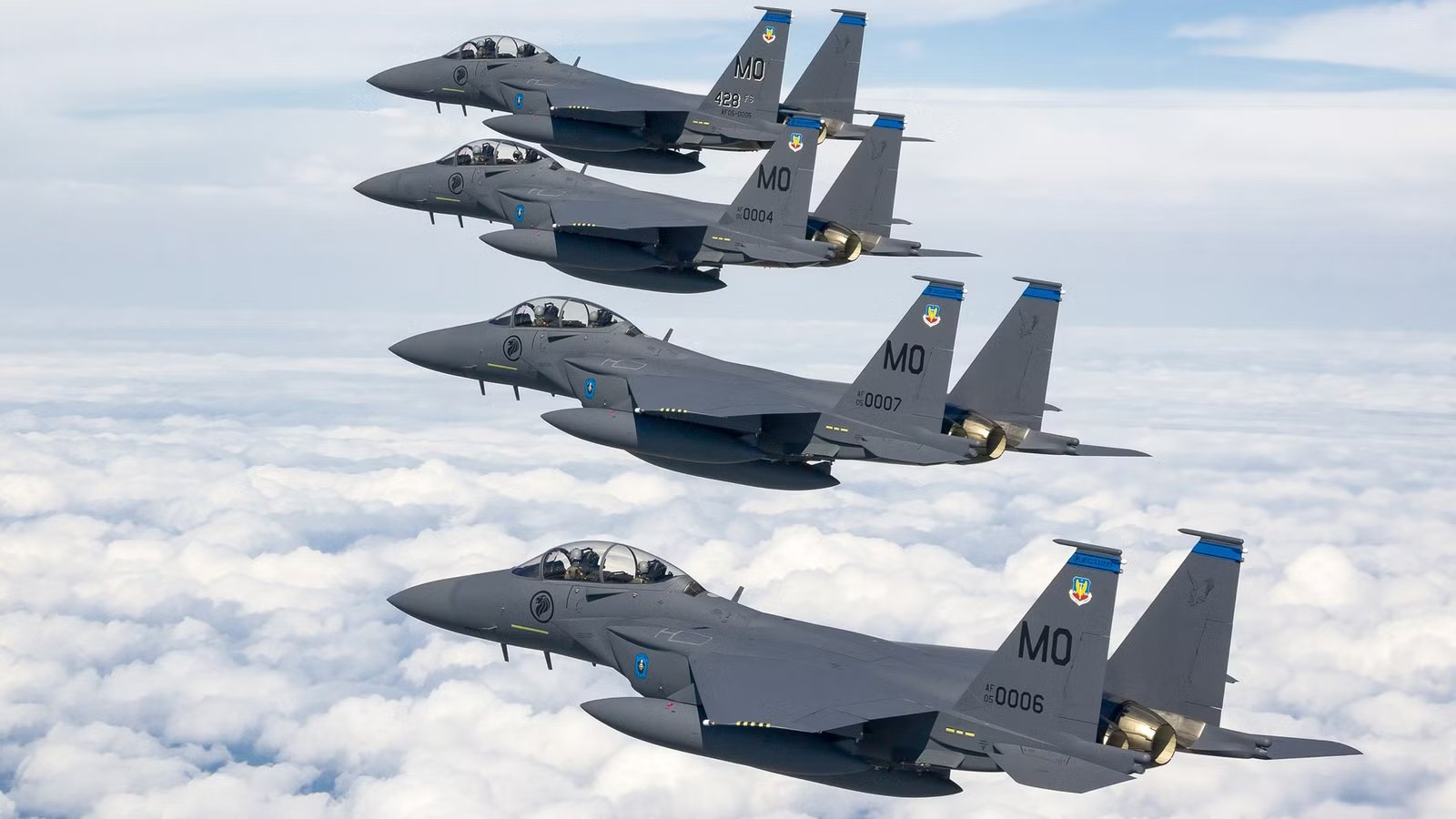
For the first time in its history, the United States Air Force gave a brand-new weapons system to the Air National Guard before handing it to the active-duty force. On July 12, 2024, the Oregon Air National Guard’s 142nd Wing unveiled the first two operational  Boeing F-15EX Eagle IIs at Portland Air National Guard Base, becoming the flying branch’s first mission-ready F-15EX unit anywhere in the country and ahead of any active-duty wing.
Two more Guard units, in Fresno, California, and Belle Chasse, Louisiana, followed onto the F-15EX’s delivery schedule, while active-duty squadrons at Kadena Air Base, Japan, are still waiting. The sequencing runs against decades of acquisition custom, in which the newest hardware flows to active-duty units first and reaches the Guard only after years of hand-me-down service. What made these three part-time squadrons the priority?
A Fleet Running Out Of Airframe

The answer starts with metal fatigue. More than 75% of the Air Force’s remaining F-15C/D fleet is now performance-limited. That means restricted in top speed, in G-loading, or both, because of structural fatigue accumulated over four decades of flying, according to a November 2025 Air Force report to Congress. The jets at the center of the F-15EX rollout were built in the late 1970s and early 1980s, designed for roughly 4,000 flight hours but, in practice, averaged more than double that figure by the time replacement planning began.
Cannibalization, or pulling parts from one airframe to keep another flying, has risen sharply as McDonnell Douglas stopped making components for a design that first flew in 1972. The Air Force has openly described new F-15EX purchases as urgent precisely because of how fast the C/D fleet has been forced out of service.
The last active-duty F-15Cs left Kadena Air Base on January 24, 2025, ending a 104-0 air-to-air combat record without a single loss, but closing that chapter for reasons of airframe health rather than performance. Kadena’s Guard-flown counterparts weren’t so lucky as to retire outright: their replacement had to arrive on a schedule dictated by fatigue, not preference. That timeline raises an immediate question: if the whole C/D fleet is wearing out, why did Guard squadrons, rather than active-duty units, get first call on the replacement?
The Mission That Wouldn’t Wait

The answer is that many of the aging F-15C/D squadrons are also the ones standing on continuous alert for North American Aerospace Defense Command. The 142nd Wing’s 123rd Fighter Squadron flies the Western Air Defense Sector’s air sovereignty mission around the clock, intercepting and identifying unidentified aircraft entering US airspace on NORAD’s behalf.
Louisiana’s 159th Fighter Wing keeps armed jets and crews on a minute’s notice to defend the Gulf Coast under the same Aerospace Control Alert construct, and the 144th Fighter Wing in Fresno has performed the alert mission for the western continental United States for more than a decade. These are not training or reserve-only units. They are the aircraft the nation actually depends on to scramble against a real-world threat.
A former Air Force pilot who flew such intercepts told Air & Space Forces Magazine that raw speed to intercept position, not hard maneuvering, is what the mission demands. That is precisely the performance margin that fatigue-based flying restrictions erode. That combination of homeland-defense units flying the fleet’s oldest, most restricted jets made the Guard’s F-15C/D squadrons, not the active-duty force’s, the leading edge of the retirement plan.
What The Eagle II Actually Adds

The F-15EX is not a cosmetic update. It is the first Eagle variant built from the outset with digital fly-by-wire flight controls, a touch-screen glass cockpit, and an Open Mission System software architecture meant to allow rapid capability upgrades without a hardware overhaul. Its AESA radar, derived from elements of the Lockheed Martin F-22 Raptor, gives it long-range detection and the ability to simultaneously track multiple targets. It comes paired with the EPAWSS electronic-warfare suite for self-defense and jamming.
In terms of kinetic enhancement, the F-15EX has two additional weapon stations, bringing the type’s payload to roughly 29,500 lb (13,380 kg) across 12 hardpoints. That allows a single aircraft to carry up to 12 AIM-120 AMRAAM or AIM-9X missiles, giving it a deeper magazine than any other US fighter, alongside heavier air-to-ground ordnance such as JASSM cruise missiles. Twin F110-GE-129 engines push the jet past Mach 2, and the airframe carries a rated service life of 20,000 flight hours, or roughly double what an F-15C was designed for.
For the alert mission specifically, that combination of restored speed margin, a modern radar that can hand off targeting data to stealth aircraft, and an airframe rated for decades more flying answers the immediate operational need. It does not, however, explain why Portland, Fresno, and New Orleans specifically were chosen over the Guard’s other F-15C/D wings. A decision the Air Force has framed as more than simple, first-come, first-served.
The Logic Behind The Top Brass’ Base Choices

The Department of Defense makes decisions weighed on mission requirements, existing infrastructure, cost, and community and local support, with site surveys conducted at each candidate location before a final call. Portland’s 142nd Wing was named the preferred first operational unit as early as August 2020, converting after the schoolhouse it depended on had trained instructors, with the Redhawks of the 123rd Fighter Squadron flying the type’s first real-world missions starting in 2024.
Catch what other flight trackers miss
Emergency squawks, holds, NOTAMs — live signals, no signup.
Open tracker
Catch what other flight trackers miss
Emergency squawks, holds, NOTAMs — live signals, no signup.
Open tracker
Fresno’s 144th Fighter Wing was announced as a preferred F-15EX location on April 18, 2023, edging out a rival scenario in which the wing would instead have relocated entirely to Naval Air Station Lemoore to fly Lockheed Martin F-35A Lightning IIs had that base been chosen for the Joint Strike Fighter instead. Fresno leaders had spent more than a year publicly lobbying to keep the wing’s roughly 1,100 personnel and its jobs in the city, a reminder that local support in the Air Force’s own language translates into sustained congressional and municipal pressure.
Louisiana’s 159th Fighter Wing, headquartered at Naval Air Station Joint Reserve Base New Orleans, was selected the same month to receive 18 F-15EXs of its own, with its commander framing the decision as recognition that the wing is a premier organization entrusted with defending the Gulf Coast. All three conversions were explicitly billed as replacements for jets, many of which are approaching or above 40 years in age.
A Program Whose Case Isn’t Uncontested

The homeland-defense justification for the Eagle II has always coexisted with an unresolved debate about whether the Air Force should purchase it at all rather than more F-35s. Both aircraft had similar prices during the program’s inception. While a switch to the F-35 would require months of retraining pilots, maintainers, and infrastructure, the Air Force contended that squadrons operating the F-15C could transition to the F-15EX in a matter of weeks. Since then, such cost parity has diminished.
The F-15EX’s flyaway price climbed from an initial Boeing estimate near $80 million to about $90 million in its second production lot, and $97 million in the third. Those figures now exceed the F-35A’s average flyaway cost of about $85 million across recent lots. The Heritage Foundation has warned that the legacy of this decision could burden the Air Force for decades, arguing that the F-15EX would cost more to acquire and operate over its service life than the F-35 while providing fourth-generation capability insufficient for a battle against a peer adversary from the day it enters service.
Proponents argue that the comparison undervalues what the F-15EX is actually designed to do: its 20,000-hour rated airframe life is roughly double that of a typical F-35A, its payload and combat radius are suitable for homeland-defense and Indo-Pacific missile-truck roles where low observability is not a deciding factor, and its ability to pass long-range radar tracks to stealth aircraft via data link allows it to complement, rather than replace, the F-35 in a mixed fleet.
What Comes Next For The Guard

In the foreseeable future, growth will likely collide with a training system that is still catching up. As the expanded 267-aircraft order proceeds through a strategic basing process, the Air Force has said that more Guard, Reserve, and active-duty basing choices would be made beyond Portland, Fresno, New Orleans, and Selfridge. Legislation would allow the Air Force to purchase up to 329 of these aircraft.
The Air Force cannot deliver Fresno’s F-15EX jets until it expands training capacity beyond Seymour Johnson. Secretary Ashworth promised to fix this bottleneck but has not given a start date. To fill the gap, the military is retaining 21 of its best older F-15C/D models. A November 2025 force-structure report labeled these jets ‘Platinum’ Eagles, keeping them stationed at Fresno through fiscal year 2031.
The oldest aircraft will continue to fly for years after their scheduled retirement thanks to this choice. The most obvious indication of how tightly stretched the transition has become is at the same base where their replacement is scheduled to arrive. The next detail to watch is whether Fresno, New Orleans, and the more recent Selfridge squadron all reach full F-15EX strength on anything like their original schedules.