dailynewsnblog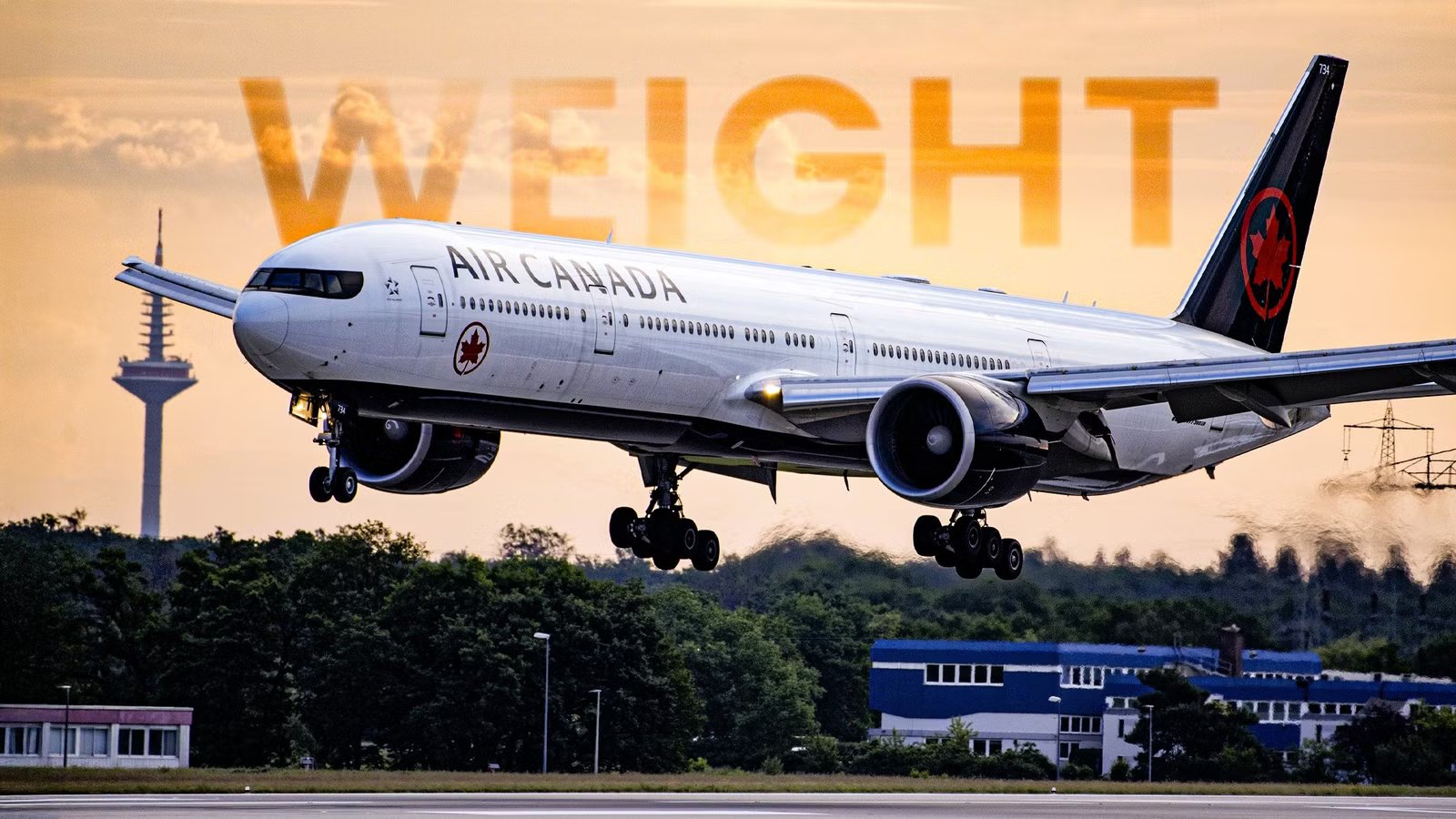
 Air Canada‘s flagship is the Boeing 777-300ER, and it is hardly short on brute force. At its highest certified weight, the twinjet can begin its takeoff roll at 351.5 tons, considerably more than an Airbus A350-1000. Yet Air Canada has chosen the lower-MTOW Airbus to lead the next generation of its long-haul fleet, ordering eight with purchase rights for another eight. But for a carrier that has long turned to
  Boeing for its long-haul fleet, why did it make that switch?
The key is that maximum takeoff weight alone does not determine how much useful payload an aircraft can carry. Every departure must divide that allowance among the airplane itself, fuel, passengers, baggage, and cargo. Weight assigned to cargo (revenue) versus fuel (costs) dramatically changes the yield equation, and that distinction becomes especially important on Air Canada’s longest missions from its primary base at  Toronto Pearson International Airport (YYZ).
The 777 starts heavier and requires more fuel, while hot summer temperatures can reduce the performance-limited takeoff weight below the aircraft’s 351.5-ton structural ceiling. The A350-1000, by contrast, combines a lighter structure, lower fuel burn, and longer-range capability, which can preserve substantially more payload margin on longer routes, and potentially make entirely new markets commercially viable.
Air Canada’s 777-300ERs Carry A Lot Of Airplane

Air Canada currently operates 19 777-300ERs with an average age of 16.3 years, alongside six smaller Boeing 777-200LRs, and the -300ER remains the airline’s highest-capacity long-haul aircraft. Seven of these aircraft have more recently been adapted into very high-density 440-seat configurations. That combination of seats, large belly capacity, and long range explains why the type continues to appear on major European and Asian trunk routes rather than simply being pushed toward retirement.
The difference lies in how the two generations achieve that capability. The 777-300ER combines an enormous gross weight with GE90-115BL engines and a large fuel capacity. Airbus instead built the A350 with over 70% of its airframe made from advanced materials like composites, and says its operating weight empty (OWE) is 20 tons lower than the 777-300ER it replaces. Airbus currently advertises a 9,100-nautical-mile maximum range for the -1000, despite the aircraft’s much lower MTOW, while claiming a 25% fuel-burn and emissions advantage over previous-generation competitors.
Metric | Boeing 777-300ER | Airbus A350-1000 | Why It Matters |
|---|---|---|---|
Length | 242.3 feet (73.9 meters) | 242.1 feet (73.8 meters) | Almost identical physical size |
Wingspan | 212.6 feet (64.8 meters) | 212.4 feet (64.8 meters) | Similar airport footprint |
Maximum takeoff weight | 351.5 t | 324.0 t | 777 has 27.5 t more structural gross weight |
OWE | 175.0 t | 155.0 t | A350 starts 20 tons lighter |
Maximum zero-fuel weight | 237.7 t | 223.0 t | Caps aircraft + commercial payload before usable fuel |
Structural payload | 62.7 t | 68.0 t | A350 has 5.3 t more non-fuel payload allowance |
Maximum published range | 7,930 nm (9,128 miles; 14,685 km) | 9,100 nm (10,472 miles; 16,850 km) | A350 delivers longer range at lower MTOW |
Air Canada fleet/order | 19 operating | 8 firm + 8 purchase rights | Replacement plus potential growth |
That 20-ton advantage doesn’t mean the A350 automatically gains 20 tons of extra payload. The older Boeing still has substantially more gross-weight allowance because of its 351.5-ton MTOW. The meaningful calculation is instead the permitted takeoff weight, minus operating weight, minus required fuel. Whatever remains is available to accommodate revenue payload, subject to variable factors such as weather. That is why, when we dig deeper, it becomes clear the A350 has significant advantages, especially in Toronto (and elsewhere) on hot summer days.
Tokyo Shows What Happens On A Hot Toronto Afternoon

The best real-world way to illustrate this is with Air Canada Flight AC1 from Toronto to  Tokyo Haneda Airport (HND). Air Canada currently schedules the 6,464-mile (10,401 km) flight daily with a 417-seat 777-300ER, and the westbound journey is scheduled for as much as 14 hours. Using EUROCONTROL’s real-world fuel-burn modeling, we can determine that the 777-300ER trip burns an estimated 94.8 tons of fuel, versus 79.7 tons for an A350-1000 operating on the same route. Adding a standardized allowance for contingency and reserves gives illustrative departure-fuel loads of 104.5 tons and 88.1 tons, respectively.
Now put those numbers into the weight equation. A 175-ton 777 loaded to its calculated 62.7-ton structural payload limit and carrying 104.5 tons of departure fuel would weigh 342.2 tons, leaving 9.3 tons below structural MTOW. By comparison, an A350-1000 loaded to its higher 68-ton structural payload limit and carrying 88.1 tons of estimated departure fuel would weigh just 311.1 tons, leaving 12.9 tons below its own lower MTOW.
YYZ–HND Weight Comparison | Boeing 777-300ER | Airbus A350-1000 | A350 Advantage |
|---|---|---|---|
Operating weight used | 175.0 t | 155.0 t | 20.0 t lighter |
Structural MTOW | 351.5 t | 324.0 t | 777 +27.5 t |
Maximum zero-fuel weight | 237.7 t | 223.0 t | 777 +14.7 t |
Maximum structural payload | 62.7 t | 68.0 t | A350 +5.3 t |
Estimated trip fuel | 94.8 t | 79.7 t | A350 uses 15.1 t less |
Estimated departure fuel | 104.5 t | 88.1 t | A350 carries 16.4 t less fuel |
Takeoff weight at max. structural payload | 342.2 t | 311.1 t | A350 is 31.1 t lighter |
Margin below structural MTOW | 9.3 t | 12.9 t | A350 +3.6 t margin |
In other words, the A350-1000 can carry 5.3 tons more structural payload on the same mission, while still retaining roughly 3.6 tons more gross-weight margin. The advantage comes not from a higher MTOW, but from needing less airplane and far less fuel to do the same job.
Why Toronto’s Summer Heat Makes The A350’s Advantage Even More Important

The challenge grows more pronounced when Toronto heats up. YYZ sits 569 feet (173 meters) above sea level, and although Runway 05/23 measures 11,120 feet (3,390 meters), its published takeoff distance available is 10,775 feet (3,284 meters). Boeing’s 777-300ER performance data indicate that a maximum-weight departure requires approximately 10,550 feet (3,215 meters) at sea level and 86°F (30°C). At Pearson’s higher elevation, higher temperatures reduce air density and takeoff performance, lowering the aircraft’s maximum takeoff weight.
Toronto Temperature | 777-300ER Takeoff Situation | Impact On YYZ–HND |
|---|---|---|
59°F (15°C) | Near-standard conditions with strong takeoff performance | No constraint: The 777 should retain enough margin to carry its planned payload. |
86°F (30°C) | Boeing’s generic MTOW takeoff field length reaches 10,550 ft (3,215 m) at sea level | Margin gets tight: Performance becomes much more sensitive to conditions. |
95°F (35°C) | Higher temperature further reduces takeoff performance | Payload becomes vulnerable: Cargo or other weight may need to be removed. |
This is where the A350’s advantages become particularly valuable. In our Toronto–Tokyo example, the A350 can carry 5.3 tons more structural payload while still sitting 12.9 tons below its MTOW, compared with just 9.3 tons for the 777. Those figures measure structural weight margin rather than actual hot-weather runway performance, but the A350 also benefits from newer takeoff-performance technology. Airbus says recent improvements have increased the A350-1000’s allowable takeoff weight from limiting runways by an average of 2.5 tons, providing additional flexibility in challenging conditions.
Catch what other flight trackers miss
Emergency squawks, holds, NOTAMs — live signals, no signup.
Open tracker
Catch what other flight trackers miss
Emergency squawks, holds, NOTAMs — live signals, no signup.
Open tracker
The commercial consequence is straightforward: when heat reduces the allowable takeoff weight below the planned departure weight, something must be left behind. On a flight lasting more than 13 hours, you can’t sacrifice fuel, and removing booked passengers creates disruption. Belly cargo is therefore the most practical adjustment, but it sacrifices valuable freight revenue. The A350’s lower fuel requirement and improved performance can help preserve payload and yields. To be clear, heat does not create the A350’s efficiency advantage; it makes the pre-existing advantage more valuable when every ton matters.
Why The A350 Needs Less Weight To Do The Same Job

The most important number in the HND example is not the 20-ton empty-weight difference but the 16.4 tons less estimated departure fuel. That saving does not automatically become extra cargo, because both types remain governed by zero-fuel and structural limits. However, it does mean the A350 needs less total mass to fly the same long sector. The aircraft can therefore retain more margin before deteriorating operating conditions begin, forcing changes to the payload or fuel plan.
The technology behind that result is cumulative. Airbus says up to 54% of the airframe is composite; its current production standard has also removed additional structural weight, while the A350-1000 uses the Rolls-Royce Trent XWB-97 and an adaptive, high-efficiency wing. Airbus claims a 25% fuel-burn advantage over previous-generation competitor aircraft and has specifically improved takeoff software and landing-gear retraction to increase available takeoff weight from limiting runways by an average of 2.5 tons on newer A350-1000s.
Those gains become progressively more valuable as missions get longer. Extra fuel itself must be carried, so an aircraft that burns more fuel must also expend additional fuel transporting that fuel during earlier stages of the flight. That is why a relatively modest efficiency gap compounds across 13, 15 or 17 hours, and why Air Canada’s commercial chief has emphasized not only raw range but payload and cargo capability. A 9,000-nautical-mile-class aircraft is most useful on routes well shorter than its maximum range because it can operate them with fewer compromises.
The Bigger Prize Could Be Routes Air Canada Cannot Justify Today

The A350’s value extends beyond making today’s routes cheaper to operate and driving up yields. Air Canada has said that the type will also unlock new long-haul possibilities, and Airbus specifically names India and Southeast Asia as targets. Bengaluru Airport (BLR), at 8,264 miles (13,300 km) from Toronto, stands out as a top option because there is currently no nonstop, and the market combines technology-sector business traffic, diaspora demand and cargo. The A350’s surplus range would be especially useful when geopolitical airspace constraints force a longer-than-great-circle routing, turning nominal range into commercially useful payload margin.
Southeast Asia offers two more compelling possibilities. Toronto to  Bangkok Suvarnabhumi Airport (BKK) would span 8,484 miles (13,653 km), while Tan Son Nhat International Airport (Ho Chi Minh City) (SGN) is 8,663 miles (13,941 km) away. Air Canada has already proved demand for Thailand by extending Vancouver International Airport (YVR) to Bangkok to year-round operation. Meanwhile, the Vietnam case has moved beyond pure speculation: following an expanded bilateral agreement, Air Canada said in September that it intends to pursue scheduled Ho Chi Minh City service in 2027. The A350-1000 could eventually make Toronto a logical second Canadian gateway for either market.
Potential Toronto Route | Distance | Current Nonstop From YYZ? | Why It Could Matter | A350-1000 Case |
|---|---|---|---|---|
Bengaluru (BLR) | 8,264 miles (13,300 km) | No | Technology, diaspora, cargo, India growth | Range and payload margin on extended routings |
Bangkok (BKK) | 8,484 miles (13,653 km) | No | Proven Air Canada Thailand demand | Long-range economics with useful cargo capacity |
Ho Chi Minh City (SGN) | 8,663 miles (13,941 km) | No | Air Canada actively pursuing Vietnam service | Strong fit for future Toronto expansion |
Johannesburg (JNB) | 8,297 miles (13,352 km) | No | Business, mining, diaspora and connections | Nonstop becomes materially more feasible |
Cape Town (CPT) | 8,156 miles (13,125 km) | No | Premium leisure and seasonal demand | Attractive northern-winter long-haul deployment |
Singapore (SIN) | 9,323 miles (15,004 km) | No | Star Alliance hub and premium market | Technically possible, but at the extreme end economically |
South Africa may be the most intriguing unserved region.  Johannesburg Airport (JNB) and Cape Town International Airport (CPT) have no nonstop Canadian service, yet the US carriers have demonstrated persistent appetite for the market.
  Delta Air Lines continues to deploy A350s to Johannesburg and Cape Town, while
  United Airlines has expanded South African flying, with the country’s tourism ministry calling its Washington DC–Cape Town route “hugely successful.” That does not disclose route-level yields, but repeated capacity commitments on ultra-long sectors suggest a market capable of supporting strong premium and leisure demand.
Air Canada Is Buying More Than A 777 Replacement

The A350-1000 order itself reinforces the point that it is more than a 777 replacement. Air Canada has 19 777-300ERs but only eight firm A350-1000s, rising to 16 if every purchase right is exercised. The carrier is simultaneously adding 14 Boeing 787-10s, so the post-2030 widebody fleet will not be a simple one-for-one substitution of Airbus jets for 777s. Instead, the A350 can become the highest-capability tool in a broader fleet, with the 787 family covering missions where its lower capacity and trip costs make more sense.
That makes the eight additional purchase rights especially significant. Air Canada has explicitly described the A350 as supporting international network growth, with its range giving it optionality to reach new continents and operate existing routes better. If all 16 eventually arrive, they could therefore do more than retire aging 777s. They could support frequencies and destinations that Air Canada’s present fleet cannot reach, or can reach only with less attractive payload, fuel, or seasonal economics.
Passengers will see a different side of the upgrade, and the A350s will use the carrier’s next-generation cabin standard. Air Canada’s Glowing Hearted interiors have already debuted with the Airbus A321XLR, with further premium changes coming on the 787-10. But the bigger transformation happens before anyone boards: the A350 needs less airplane and less fuel to perform a long-range mission. On a hot Toronto afternoon, that additional margin could mean keeping freight onboard; later, it could mean putting Toronto on the map from Bengaluru, Bangkok, or Cape Town.