dailynewsnblog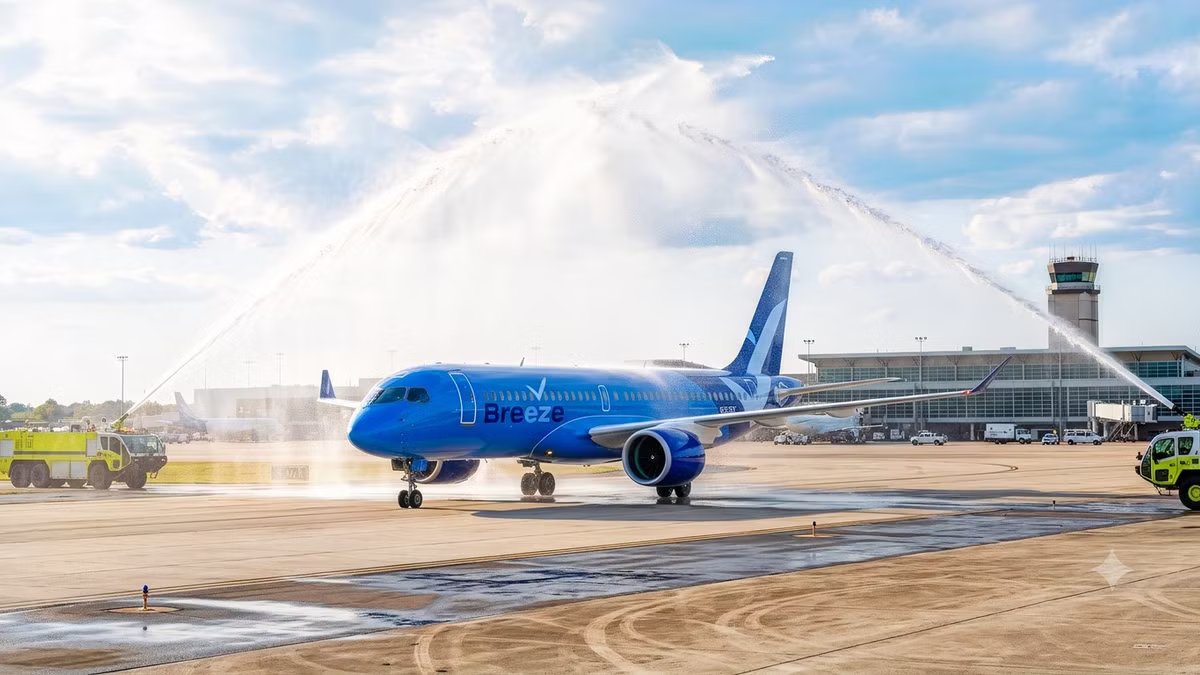
Welcome to my 215th weekly routes article! While 110+ links started in the examined period, only a small selection is included in this article. Six mini-stories were chosen; all the services launched between July 1 and 8. You can see last week’s jam-packed edition here.
Four US Airlines Begin 23 Routes
When the networks of all the main US airlines were explored, only four carriers (Breeze Airways, Delta Air Lines, Frontier Airlines, and United Airlines) started or resumed routes in the period covered by this article. Breeze commenced 19 airport pairs in just three days; you can read all about them here.

Delta Connection began Austin to Phoenix (up to two daily SkyWest E175), Frontier inaugurated Kansas City to Las Vegas (four weekly A320neo) and Memphis to Orlando (three weekly A320neo/A321neo), and United Express introduced Houston Intercontinental to Natchez (daily SkyWest CRJ200).

United Express’ debut in Natchez, Mississippi, near the border with Louisiana, is highly notable. Influenced by funding from the Small Community Air Service Development Program, the carrier’s arrival marked the first scheduled service in over 30 years. The city is known for the Natchez Trace Parkway and a considerable number of well-preserved homes built before the Civil War. I’d like to see them in person!
Frequency | Houston To Natchez | Netchez To Houston |
|---|---|---|
Daily | 11:55 AM-1:10 PM | 1:45 PM-3:05 PM |

Ethiopian Airlines Arrives In…
Another European airport has joined Ethiopian Airlines’ passenger network. On July 2, the Star Alliance member took off from its Addis Ababa hub to Lyon, stopping en route in Geneva. Much of the carrier’s European network would not be sustainable without being served on a nonstop basis.

While Geneva has seen the airline since 2018, Lyon is brand-new to Ethiopian’s map. Flights operate three times a week, initially using the 343-seat A350-900, before switching to the 313-seat 787-9, and returning to the A350-900 from August 1.
Flights primarily leave Addis at 12:10 AM, arrive in Switzerland at 6:30 AM local time, leave at 7:30 AM, and get to France at 8:15 AM. No traffic rights exist between Geneva and Lyon.

Like many of Ethiopian’s European routes, the operating frame remains on the ground all day. Having arrived in Lyon at 8:15 AM, the aircraft departs at 7:20 PM, gets to Geneva at 8:05 PM, leaves at 9:05 PM, and arrives home at 4:55 AM+1.
This full two-way schedule entirely exists to maximize connectivity across Africa. While not large markets, important targets include Cape Town, Douala, Johannesburg, Kinshasa, the Seychelles, Yaoundé, and Zanzibar.
Syria Regains Flights To Northern Europe
Due to the end of the long-running civil war in Syria, flights from the country have gradually started to resume. On July 2, it was the turn of Northern Europe, as Syrian Air took off from Damascus to Amsterdam after a 14-year absence.

The country’s flag carrier runs three times weekly using a 12-year-old A320ceo, with 180 seats, that is wet leased from the Lithuanian carrier Heston Airlines. Use of this aircraft is presumably because of the sanctions that are still placed on Syrian Air.
Presumably due to safety concerns and the consequent impact on insurance, the aircraft remains in Amsterdam. The aircraft leaves Schiphol at 10:20 AM and gets back at around 9:00 PM the same day. The aircraft then operates the same service two days later, which will come at a considerable cost.

Between 2004 and the start of the war, Syrian Air flew to nine or more cities in Northern Europe. Its network even included Manchester (until 2008). I have fond memories of seeing the carrier’s 747SPs, in particular, at London Heathrow.

Thai Airways Is Back In Amsterdam
It took 28 years, but Thai Airways has returned to the Netherlands. On July 1, the Star Alliance member reintroduced the link from Bangkok to Amsterdam. A daily flight is available. It is the third airline in the market, operating alongside KLM (daily) and EVA Air (three weekly; fifth freedom en route to/from Taipei).
While the local Bangkok market is a decent size (272,000 passengers), it isn’t overly high-yielding, which is from having fewer premium passengers. Obviously, Thai Airways will also target many passengers who will connect beyond Bangkok to destinations throughout Asia-Pacific.

Virtually all Thai Airways’ European flights leave Bangkok shortly before midnight to just after 1:00 AM. However, at 5:35 AM, flights to Amsterdam do not fit this pattern, which might be influenced by Schiphol’s lack of slots. Flights get back to Southeast Asia at 6:35 AM, which is in keeping with many of the airline’s other European arrivals.
Thai Airways’ last Amsterdam flights were in 1998, when they went via Zurich. The MD-11 and 747-400 were used. In 2026, the 321-seat A350-900 is deployed; it’ll be used on 44% of the carrier’s European services.

Air Canada Mainline Arrives In Berlin
On July 2,  Air Canada began the first-ever scheduled flights between Montreal and Berlin. Flights operate three times a week through September 5, when the final departure of the season will leave North America. It marked Air Canada’s return to Berlin after a seven-year absence, when its lower-cost unit, Rouge, flew from Toronto to the now-closed Tegel.

The 255-seat 787-8 (Air Canada’s lowest-capacity widebody) is initially deployed between Montreal and Berlin. The twin-aisle equipment will be flown through July 16, with the 182-seat XLR taking over on July 18. Originally, only the XLR was to be used.

Separately, Air Canada Express has inaugurated another new international service from Toronto Billy Bishop, the downtown airport. On July 1, a three times daily operation began to Boston, with all flights obviously being on the Q400. Unsurprisingly, Porter’s Q400s also serve this market with the same number of flights.
Air Congo Begins 1st Long-Haul Route
Air Congo is the flag carrier of the Democratic Republic of Congo, which is Africa’s second-largest nation by area. The airline’s slogan is ‘The Hope of Africa’. Despite launching in 2024 in partnership with Ethiopian Airlines, the carrier gets little attention. Perhaps that’s unsurprising, as it is tiny (six aircraft) and could be more of a political construct (the DRC government owns most of the airline) than anything else.

On July 1, Air Congo took off from Kinshasa (which has around 19 million people) to Brussels. Flights operate four times weekly on the carrier’s sole widebody, a 270-seat 787-8 leased from Ethiopian. As the DRC was once a Belgian colony, Brussels is the largest local market (119,000 round-trip passengers), although Paris CDG is close behind (111,000).

The carrier competes head-to-head with Brussels Airlines. It is the first time the market has had more than one operator since 2010, when the now-defunct Hewa Bora Airways pulled out. That carrier even flew the L-1011 TriStar (!) to Belgium until 2007.