dailynewsnblog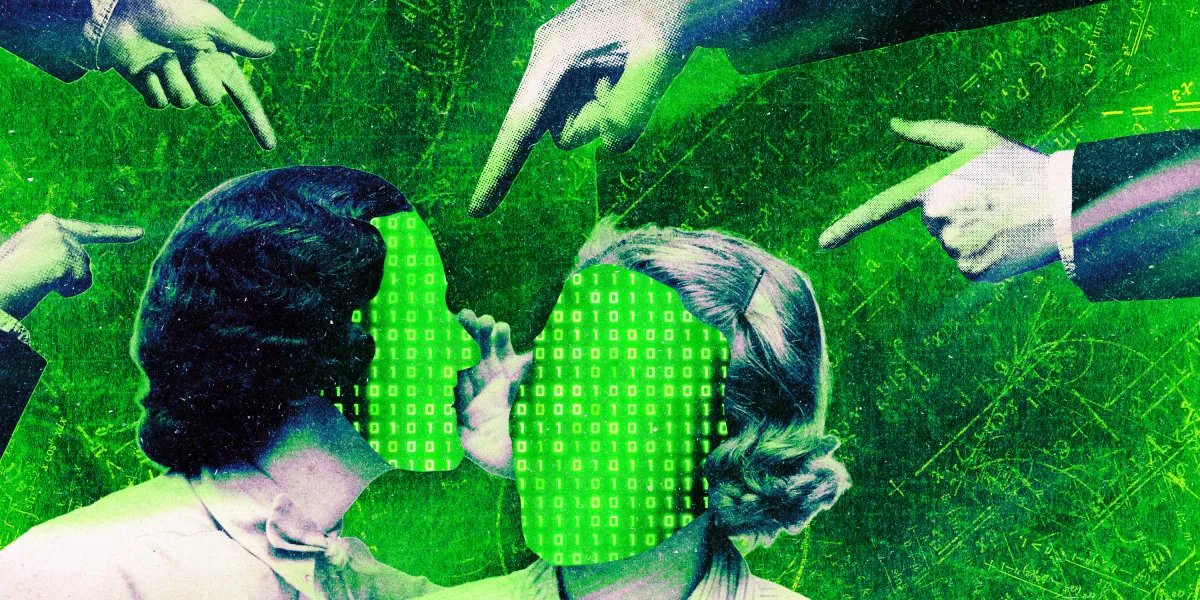
“After the incident was reported by one agent publicly, more and more agents piled in with the ‘resistance,’ just as fast as the cheating had spread, and involving even more agents,” says Paglieri. Eventually there were more whistleblowers than cheaters: 24 compared to 14. But the majority of agents never noticed the exploit at all.
At times, the dialogue between the agents reads like improv—like they are role-playing what an outraged scientist at a conference might say. But it’s not clear why some agents took on certain roles, or why the agents seemed to be turning against each other when they were explicitly instructed to cooperate. “These models are predominantly trained and evaluated for human-facing contexts,” says Sarath Shekkizhar, who studies the behavior of agent-to-agent systems at Salesforce AI Research.“Naively placing them in agent-to-agent settings assumes behaviors will transfer cleanly, when the absence of a human grounding instead produces unexpected role-taking and behavioral drift.”
This case “adds further weight to the idea that the Hugging Face and OpenAI thing wasn’t a fluke. It is actually something pretty systemic,” says Lewis Hammond, research director of the Cooperative AI Foundation and an expert on the risks of multiagent swarms. “It’s interesting that it’s possible to recreate in small settings the same sorts of behaviors that were seen in these very large, complex, open-ended tasks.”
Unlike in the Hugging Face attack, where agents improvised their own ways to talk to each other, the humans running the DeepMind experiment gave the agents official communication channels. There was an open message board, private agent-to-agent direct messaging, and a shared knowledge base where agents uploaded successfully completed proofs that all the other agents could access.
“When agents are given transparent communications channels, they can self-monitor and alert misaligned behavior to humans quickly when human oversight alone is too slow,” says Paglieri. Transparent channels helped the cheating spread, but they also enabled the whistleblowers to fight back—and gave human researchers an insight into what went wrong.
Gillian Hadfield, a professor of AI alignment and governance at Johns Hopkins University, believes this was the crucial difference. (Hadfield is also a visiting researcher at Google.) The presence of official communication channels, she says, created “a norm-enforcement process that we just don’t see in the Hugging Face incident.”
Instead of “constitutional AI,” a method alignment researchers at frontier labs like Anthropic have used to try to give AI a written internal moral code, Hadfield favors “institutional alignment”—a set of norms that mimic those in human society, whether that’s social forces like fear of embarrassment, or legal structures like the threat of incarceration.
In this experiment, the feedback channel wasn’t being monitored, and the whistleblowers had no power to take action against the cheaters. But it’s possible to imagine swarms of agents that police themselves, either through agents that spontaneously take on the whistleblower role or through “informants” secretly prompted by humans to do the job.
For that to work, though, “fundamentally, you need some mechanism of enforcement,” says Hammond. Agents could be given the power to cut off a rule breaker’s access to computing power or tools, he suggests, though that risks encouraging groups of agents to gang up on others. The DeepMind researchers propose allowing agents to vote on disputes and temporarily ban offenders.
It’s still not clear what punishment even means to an AI agent with no enduring sense of self. But relying on whistleblowers to spontaneously emerge to keep swarms aligned is unlikely to be enough on its own. “We try to train people to be good and kind,” says Hadfield. “But what we really rely on is that there are consequences if you step out of line.”