dailynewsnblog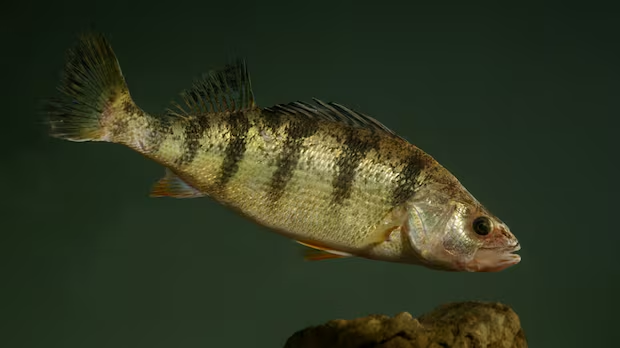

Listen to this article
Estimated 4 minutes
The audio version of this article is generated by AI-based technology. Mispronunciations can occur. We are working with our partners to continually review and improve the results.
Yellow perch is a culinary treasure in southwestern Ontario, near the shores of Lake Erie.
You can find it on many menus at local restaurants. But the fish is becoming scarce.
The population is down by nearly 20 per cent this year, according to the Ontario Commercial Fisheries Association — lows not seen since the mid-1990s.
Afternoon Drive6:59Yellow perch population declines in Lake Erie
Vito Figliomeni is the association’s executive director. He’s also one of the people who tracks yellow perch, and says the main culprit for the sharp decline is the rise in another fish, a little higher on the Great Lakes’ food chain.
“It’s hard to ignore what we’re seeing in respect to the abundance of the walleye populations,” he told CBC Radio’s Afternoon Drive guest host Chris Ensing.
“We’ve had near-record walleye population since 2020. So when you look at the last six to seven years, you’ve had sustained populations numbering in the 50 million to 100 million walleye in Lake Erie.”

Figliomeni says walleye’s main food source of smaller fish, such as rainbow smelt and emerald shiners have also been hit hard — fuelling their appetite for perch.
“If those numbers are down, walleye are going to turn to what’s next.”
He says volatile temperature swings also wreak havoc with yellow perch.
“We’re experiencing warming and erratic climate conditions. I think all of us have seen that we’re seeing a gradual warming … in the lake,” Figliomeni said, adding the central basin of Lake Erie is experiencing oxygen-depleted zones because of the rising temperatures.
“It really drives yellow perch populations out of the central basin, so out of their habitats and forces them into other areas in the search for food and survivability.”

Elevated populations of double-crested cormorants, a predatory bird species, could also be playing a role in the perch decline, he says.
According to Figliomeni, yellow perch have historically been a robust species with a track record of highs and lows.
He says one way to try bringing back the perch population is better understanding the predator-prey relationship within the Lake Erie ecosystem.
“Right now, quotas, for example, for yellow perch, walleye, lake whitefish are managed and in silos … what we’re seeing with all these pressures on the perch, it’s difficult to model a situation that’s going to yield accurate results.”
As a result of the population purge, Ontario’s Ministry of Natural Resources (MNR) says the Great Lakes Fishery Commission lowered its Lake Erie-wide allowable catch quota to 1.984 million kilograms. That’s down from 2.666 million kilograms in 2025, and from 2.979 million kilograms in 2024. The MNR manages Lake Erie’s commercial and recreational fisheries alongside U.S. and Indigenous partners.
Windsor Morning8:38The Great Lakes are getting warmer — and scientists are using underwater gliders to monitor temperatures
Climate change has been front and centre as of late with the impact of the Ontario wildfires. Data shows the earth is getting hotter. And that also includes our warming Great Lakes and other lake ecosystems. Lydia Paulic and Aaron Fisk are with the Real Time Aquatic Ecosystem Observation Network out of the University of Windsor. They spoke to the CBC’s Chris Ensing about how they’re using underwater gliders to capture and quantify temperature changes in the Great Lakes.
Environmental scientist Aaron Fisk studies the warming of the Great Lakes with autonomous underwater gliders.
The University of Windsor researcher oversees the Real-Time Aquatic Ecosystem Observation Network.
One of their additional goals this year has been to look for yellow perch in Lake Erie.
“The equipment really allows you to collect data and scales, continuous and over time, that you can’t do with people,” he recently told CBC Radio’s Windsor Morning.

“We put little acoustic tags inside the fish and they ping and we can follow them around. But we don’t have receivers everywhere, and so the glider can be outfitted with a receiver to go look into those areas to find those tagged fish.”
This year, Fisk says, there’s concern around the lack of yellow perch being flagged.
“This was a study being conducted by the Ontario Ministry of Natural Resources, which does such important work for understanding our fish populations. They had released these tagged yellow perch, but we’re not seeing a lot of them.”