dailynewsnblog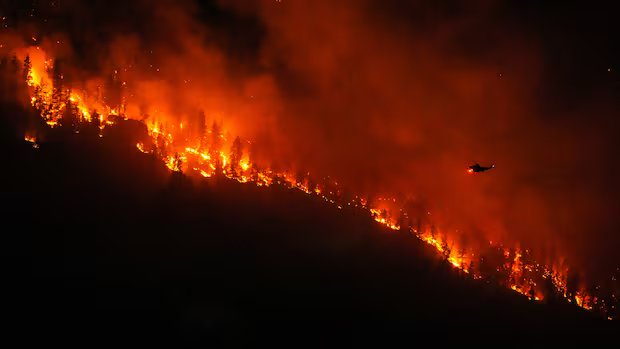
The latest on the wildfires:
- Air quality warnings are in effect for much of the southern part of the province as wildfire smoke drifts and settles into areas not directly affected by wildfires.
- The B.C. Wildfire Service is asking people recreating on Okanagan Lake to clear the way for firefighting aircraft that are gathering water to battle nearby fires.
- A pilot was taken to hospital after a helicopter crash while fighting wildfires in the South Cariboo.
- Officials say about 120 properties, not including the Village of Clinton, have suffered structural loss as a result of the Pear Lake wildfire in the Cariboo, while at least 200 homes have been destroyed by the Bradley Creek wildfire, west of Vernon.
- Across B.C., about 8,000 people are under evacuation order and 7,100 are under evacuation alert.
- Wildfire officials say conditions are “explosive and extremely dangerous,” with a forecast of hot temperatures and potential lightning ahead.
Hotter weather returns
The period of cooler, more humid weather that provided some relief for crews battling the Pear Lake wildfire has come to an end, according to the B.C. Wildfire Service (BCWS).
It says hotter, drier conditions have returned and are expected to increase fire activity in the coming days.
In the southern Interior, temperatures are expected to hit the mid-30s this week, with the possibility of dry lightning.
As of 4:40 p.m. PT, there are 115 wildfires burning across B.C. Nine started in the last 24 hours, and 54 are burning out of control.
A total of 85 of the fires currently burning are believed to have been caused by lightning.
According to Natural Resources Canada, nearly half of all wildfires in Canada are caused by lightning on average. Lighting strikes are on the rise, and are expected to increase with climate change.
Experts say that while fire is a natural part of Canada’s forests, human-caused climate change has led to more extreme and more frequent natural disasters, including wildfires.

Two large wildfires continue to burn near Vernon, B.C., with hot, dry weather raising fears the situation could get worse. Mayor Victor Cumming says the city is preparing for possible evacuations as residents cope with poor air quality.
The BCWS said Wednesday that winds are forecast to remain “light” in most areas.
That’s a welcome reprieve from last weekend when 80 km/h winds and 115 km/h gusts quickly spread the Bradley Creek fire near Vernon.
“We are seeing fuel conditions that we have never seen before. We are seeing fire behaviour and fire growth that we have never experienced in B.C. up until this point,” said BCWS director of wildfire operations Cliff Chapman Tuesday.
“It is an explosive and extremely dangerous situation.”
Homes destroyed
So far this year, 3,166 square kilometres have been scorched by wildfires throughout the province. Most of the area lost to fires is in the Cariboo region.
Hundreds of properties have been damaged or destroyed as a result.
The Thompson-Nicola Regional District says about 120 properties have experienced structure loss from the Pear Lake wildfire, excluding the Village of Clinton.
The hardest-hit places include Big Bar Lake, south of Clinton near Highway 97, an area west of Clinton around Kelly Lake Road and the Chasm area north of the village.
District spokesperson Colton Davies said the number will likely increase as crews safely reach more affected areas.
West of Vernon, Okanagan Indian Band Chief Dan Wilson estimates the Bradley Creek wildfire has destroyed at least 200 homes, though the figure is preliminary.
He said the fire has been “one of the most devastating events in our history,” and many people in the community have lost everything they own.
“For many people watching, this wildfire is measured in hectares and structure loss. For our community, it’s measured in homes, family histories and places people have spent all their lives,” he told CBC News.

B.C. Hydro says an early investigation has found “significant damage” to its infrastructure in some areas. Public affairs coordinator Dave Cooper said at least 150 power poles in the Bradley Creek fire area will need to be replaced.
Crews have not yet been able to finish their assessment of the area around the Quilpituk Creek fire, but Cooper said he expects there will be more poles there that need to be repaired and replaced.
He said crews will begin work once it’s safe to do so.

Evacuation orders
About 8,000 people across B.C. are under evacuation order, while another 7,100 are under evacuation alert and have been told to be ready to leave at a moment’s notice.
Anyone placed under an evacuation order should leave the area immediately.
Emergency support services are available for evacuees throughout the province. The Ministry of Emergency Management and Climate Readiness said anyone in immediate need of financial support or help finding lodging should head to the nearest reception centre or call 1-800-387-4258.

Many of those impacted are being threatened by the Quilpituk Creek and Bradley Creek wildfires, both burning along Okanagan Lake.
The Central Okanagan Emergency Operations Centre says 2,223 properties remain under evacuation order due to the Quilpituk Creek fire, while another 425 properties are under evacuation alert.
The Regional District of Northern Okanagan expanded an evacuation order on Tuesday, as a result of both fires, to include several dozen more properties.

Evacuation orders also cover the Okanagan Indian Band.
The Spallumcheen evacuation order and alert areas related to the Bradley Creek fire were shrunken on Tuesday.
Those in need of emergency support services are being directed to the Westbank Lions Community Centre in West Kelowna and Kal Tire Place in Vernon.
Wildfire officials say firefighting aircraft are active on Okanagan Lake, and are asking people recreating on the lake to make space for them.

Evacuation orders remain in effect for the French Bar Creek fire in the Thompson-Nicola Regional District, the Pear Lake fire near Clinton and the Brunswick fire complex near Boston Bar, which is now more than 781.79 square kilometres in size.
An evacuation order issued by the Lytton First Nation due to the Riley Creek wildfire was downgraded to an alert earlier this week.
In the East Kootenay, an evacuation order was partially downgraded to an alert on Sunday after crews made progress on the Wait Creek wildfire.
Road closures
According to DriveBC, several major routes remain closed because of wildfire activity.
Highway 1 is closed between Yale and south of Boston Bar at Uztlius Creek Forest Service Road, and there is no estimated time of reopening. Drivers are being directed to use Highway 3 or Highway 5.
The Big Bar Reaction Ferry, which runs across the Fraser River 72 kilometres west of Clinton, is not currently operating due to wildfires in the area.
Highway 97 is closed through Clinton, for a 60-kilometre stretch between Loon Lake Road and 76 Mile Frontage Road. Traffic is being detoured using Highway 1 through Kamloops, then to Highway 5 and Highway 24. Big Bar Road is also closed between Jesmond Road and Highway 97.
Westside Road along Okanagan Lake is closed between Shelter Cove and Highway 97 north, cutting off a key route for residents to the west of Okanagan Lake. The road is open as far as Shelter Cove, with Highway 97 serving as the alternate route.
Highway 95A near Kimberley is closed in both directions between Thomason Road and the Highway 93/95 Junction.
Toward the U.S. border, Silver Skagit Road is closed south of Flood Hope Road to the Canada-U.S. border because of the Hozomeen Mountain wildfire. Silver Lake remains open, but Ross Lake Campground and Skagit Valley Provincial Park are closed.
Pilot injured in helicopter crash while fighting wildfires
A pilot has been taken to hospital after a helicopter crashed while working to put out wildfires in B.C.’s South Cariboo region.
A statement from BCWS says it happened Tuesday morning during operations in the Big Bar wildfire complex.

The service says the helicopter landed in a lake near 70 Mile House, an area where buildings and homes have been burned on about 120 properties.
It says the pilot was the only occupant and suffered minor injuries.
The service, the Transportation Safety Board, and the provincial worker compensation agency WorkSafeBC are investigating.
About 1,400 firefighting personnel are working on wildfires across B.C. as of Wednesday afternoon.
Air quality
Smoke from the wildfires has spread over most of southern B.C., and much of the Interior is under an orange air quality warning, meaning the air is so poor that the risk to health is “very high.”
Orange warnings are in effect for areas around 100 Mile House, the Eastern Fraser Valley, the southern Fraser Canyon, the Skagit Valley and the Nicola, South Thompson and Similkameen regions.
Yellow warnings — indicating a moderate impact — have been issued across Metro Vancouver, the Okanagan, the Central Fraser Valley, north Fraser Canyon, West Kootenay, Shuswap, Cariboo and Boundary regions.

Environment and Climate Change Canada says exposure to high smoke levels can be harmful to anyone’s health, but can be particularly dangerous for those with lung and heart conditions, young children, people over 65, anyone with a chronic condition and pregnant people.
The weather agency advises residents to avoid strenuous activity outdoors, and to instead stay indoors where the air is cleaner.
Do you have a story to share?
If you’ve been affected by the B.C. wildfires and want to share your story, email cbcnewsvancouver@cbc.ca.