dailynewsnblog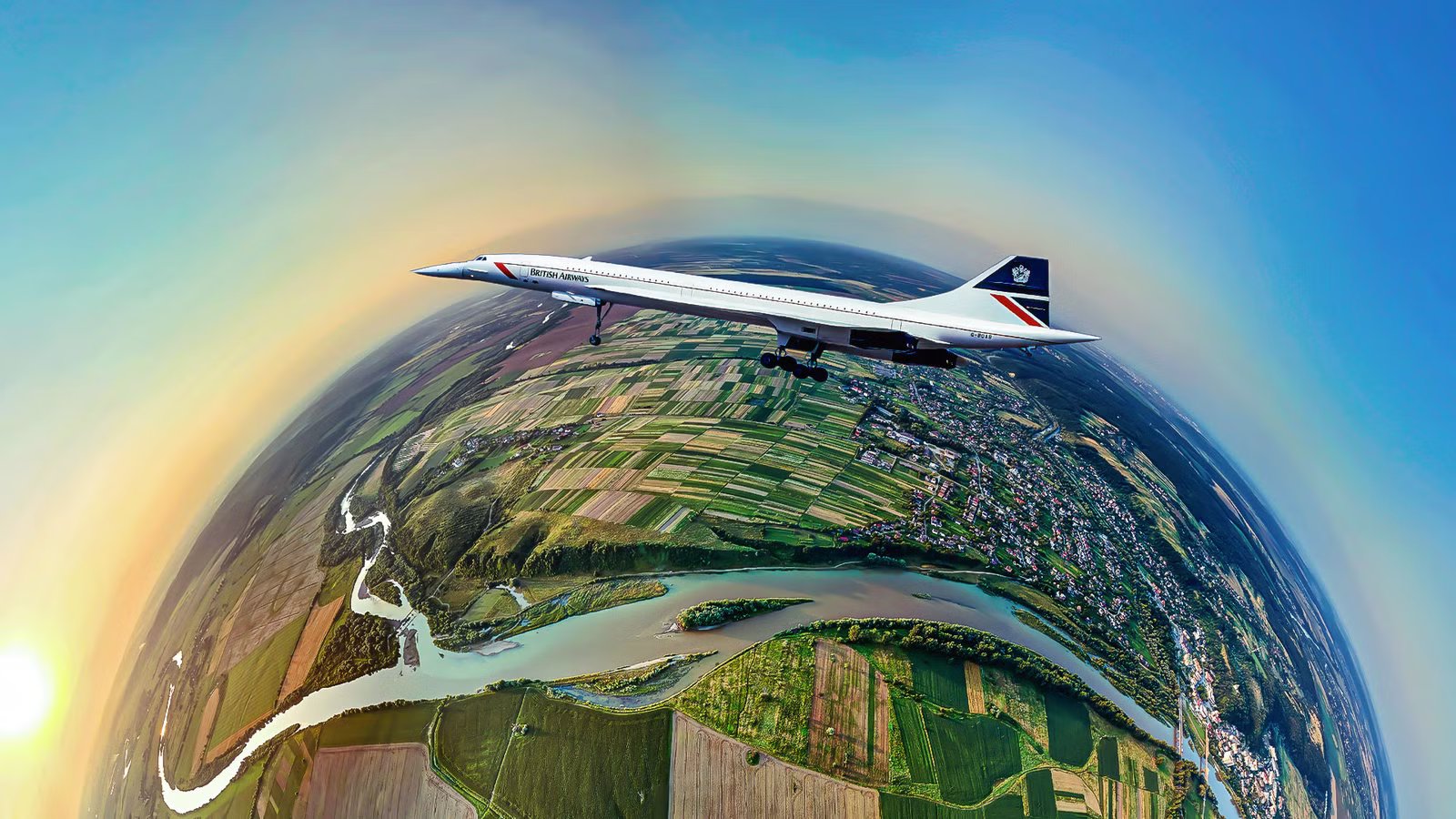
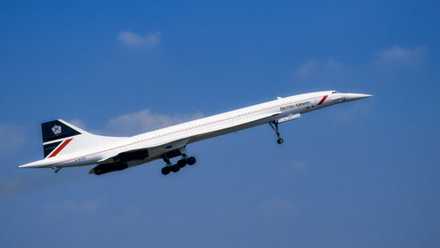
Concorde is a classic tale of a technology ahead of its time. While Concorde had up to 100 option orders at one point, only 14 were ever made and flown by two airlines: seven for  British Airways and seven for
  Air France.
Concorde was revolutionary in that it was created by the British and French working together, an initiative that would pave the way for what is now the world’s largest commercial aircraft manufacturer: Airbus. Unfortunately, the plane itself was expensive to fly, cost both governments billions of dollars, and its enormously loud “sonic booms” caused nearly every nation on Earth to ban supersonic flights over land.
Flying Concorde to its limit

The other issue with Concorde was its impracticality. Despite being nearly as long as a Boeing 777, the supersonic transport could only seat 100 passengers in a four-abreast layout. The fuel consumption of its thirsty Rolls-Royce/Snecma Olympus engines meant that, despite carrying 210,940 lb (95,680 kg) of fuel, it could only fly a maximum distance of 3,900 nm (7,222.8 km), less than a Boeing 757.
- Length: 203 ft 9 in (62.1 m)
- Wingspan: 83 ft 8in (25.5 m)
- Seats: 100
- MTOW: 185T
- Engines: 4x Rolls-Royce/Snecma Olympus 593
While British Airways and Air France were the only companies that owned Concordes, there was another airline whose colors flew on the supersonic jet.
Singapore Airlines sold tickets from Singapore to London with a stopover in Bahrain. Taking off from the old Singapore International Airport in Paya Lebar, SQ 301 would fly for four hours and 25 minutes until it reached Manama. After refueling, Concorde would then take off again as BA301 for four hours and 15 minutes before landing at London’s Heathrow Airport.
|
Leg |
Flight Number |
Frequency |
|---|---|---|
|
Singapore – Bahrain |
SQ 301 / SQ 17 |
3x weekly |
|
Bahrain – London/Heathrow |
BA 301/ BA 17 |
3x weekly |
|
London/Heathrow – Bahrain |
BA 300 / BA 16 |
3x weekly |
|
Bahrain – Singapore |
SQ 300 / SQ 16 |
3x weekly |
The flight numbers were originally SQ 301/BA 301 to London, and SQ 300/BA 300 back to Singapore. These would later be changed to SQ 16/17 and BA 16/17.
At nearly four and a half hours of flight time, this was the longest regularly scheduled Concorde non-stop flight ever conducted.
This arrangement was unique in that the aircraft was owned by British Airways and flown by British Airways pilots, while the cabin crew were a mix of British Airways and Singapore Airlines flight attendants. The aircraft, G-BOAD, flew with the Singapore Airlines livery on the left and with British Airways colors on its right.
Singapore Airlines found Concorde to be too expensive to own, and as such reached an agreement to operate the flight jointly with British Airways as a lease agreement. The leg between Singapore and Bahrain was operated as Singapore Airlines, while flights to and from London were sold as British Airways.
The services were terminated in late 1980 due to heavy losses, and G-BOAD would serve British Airways until 2003. This aircraft is currently on display at the Intrepid Air and Space Museum in New York.
Catch what other flight trackers miss
Emergency squawks, holds, NOTAMs — live signals, no signup.
Open tracker
Catch what other flight trackers miss
Emergency squawks, holds, NOTAMs — live signals, no signup.
Open tracker
More boundary-pushing routes

While the Singapore to Bahrain route was the longest regularly scheduled non-stop route operated by Concorde, there were other flights that pushed the boundary of what the plane could do.
Though Concorde was best known for flying between Europe and the United States, the US initially prohibited Concorde from their airspace. Until the exhaustive battle with the FAA and Port Authority of New York/New Jersey concluded in 1976 and 1977, respectively, the two airlines had to find other uses for the jet.
British Airways’ Saturday service from Heathrow to Bridgetown, Barbados, clocked in at three hours and 45 minutes, crossing a distance of 3,646 nm (6,752 km), which is actually more than the distance from Bahrain to Singapore.
The Concorde service between Bahrain and Singapore traveled a further overall distance than the British Airways flight to Barbados due to airspace restrictions, necessitating a longer routing.
Concord one-stop flights
In addition to the Singapore and Barbados flights, the two airlines also flew numerous long-distance routes with a fuel stop en route.
British Airways and Air France’s first Concorde flights to the US landed at Washington Dulles International Airport. In the case of the Air France flight, the routing came close to the advertised range of the aircraft. Air France served Dulles with Concordes until 1982, and British Airways pulled Concorde service in 1994.
Some of these Concordes then continued to Dallas, and were then sold and operated by Braniff International Airways. The planes were given US registrations, flown by Braniff crews, and flew subsonic between Dulles and Dallas-Fort Worth. These services lasted between 1978 and 1980.
In addition to the Dallas flights, both companies operated tag-on flights from Washington Dulles. British Airways served Miami until 1991, while Air France sent Concorde on to Mexico City. This service only lasted until 1982.
Concorde’s longest flight
Air France flew a number of routes to South America, which all required a stop for refueling. In fact, the inaugural Concorde flight for Air France was from Paris to Rio de Janeiro, with a stop in Dakar, Senegal.
One of Air France’s South America routes was to Caracas, Venezuela. Typically, the flight would require a stop in the Azores. However, on occasion, favorable winds and a light load allowed the plane to fly directly to Paris without refueling. With a distance of 4,123 nm (7,635 km), this was the longest non-stop Concorde flight ever recorded, with a typical flight time of four hours and 10 minutes.
With such a limited range, it’s no wonder that Concorde saw such limited use, and this shortcoming is one that Boom promises to address with the Overture.
Using Concorde in a different way

With its speed, 60,000 ft cruising altitude, and sheer rarity, Concorde was one of the most iconic aircraft ever made. As such, both British Airways and Air France began using the supersonic jet for charter operations. These flights flew all the way around the world and were booked by tour companies offering multi-stop voyages on the only Western supersonic transport.
These tours could range from as long as weeks to the 29-hour-59-minute voyage taken by a British Airways Concorde in 1996, covering 28,238 miles (45,061.6 km).
40 Years On: When Concorde Flew Golfers To Scotland
Between Heathrow and Leuchars, it took 43 minutes at Mach 0.95.
Concorde in the final days

While Concorde flew across the world for much of its life, towards the end, the planes nearly exclusively flew to New York JFK. The aircraft were thirsty, aging, and had limited use. The ban on supersonic flights over land meant that there were few destinations the two airlines could serve, while the limited range narrowed it down even further.
In 1976, the year that Concorde entered service, the Boeing 747-200B had a range of 6,560 nm (12,150 km), and other widebodies had an even shorter range. By the 1990s, however, the Boeing 747-400 could fly over 7,000 nm (12,964 km), with the Airbus A340 and Boeing 777-200ER matching in the late 1990s.
As such, one-stop services were no longer as common as in the 70s, further reducing the use case for the type. Really, though, New York was the only destination within reach where Concorde, with 100 seats priced at or above First Class prices, made any sense. Air France operated a daily Concorde service from Paris, while British Airways sent two per day.
After the tragic 2000 crash of Air France 4590, the entire Concorde fleet was grounded for modifications. However, the accident sullied the aircraft’s reputation. Combined with the decline in air travel post 9-11 and the increasing difficulty of operating the aging jets, Air France flew their last Concorde flight in May 2003, with British Airways following suit in November.
Where to find Concorde today

Whereas most aircraft are simply scrapped after their useful service lives, the majority of Concordes sit proudly on display. While most Concordes are located in Europe, four can be found in North America: three in the United States, and one in Barbados. The rest can be found in exhibitions across France and the UK. One Concorde, F-BVFD, was scrapped in 1994, while F-BTSC crashed as Air France 4590.
The future of supersonic flight is uncertain. The Boom Overture promises to be more efficient with a longer range. However, there are doubts about whether the jet will make it into production. Concorde may have been an impractical blunder, but there is no doubt that the plane was the most technologically ambitious aircraft of the 20th century.