dailynewsnblog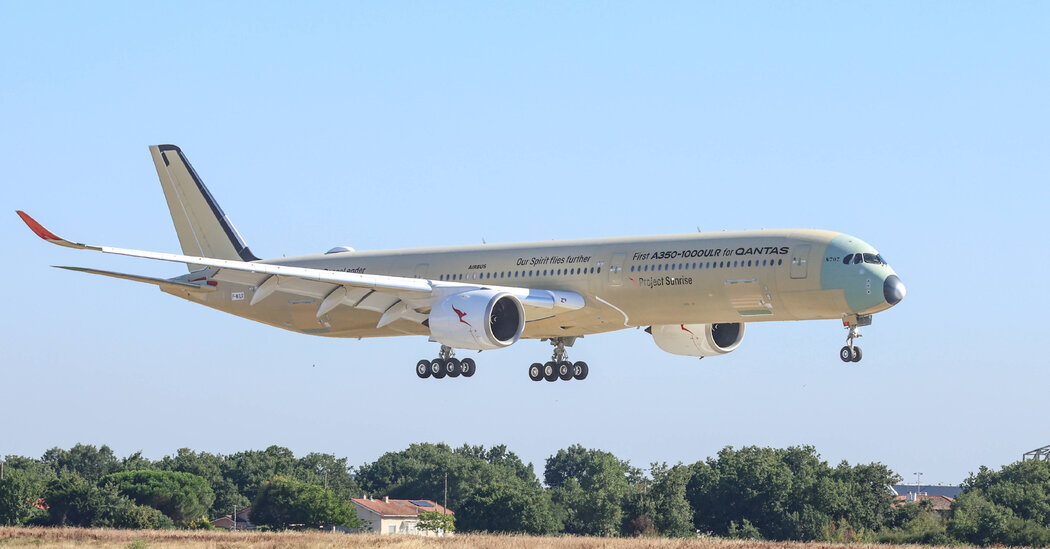
Millions of people were following online as an Airbus jet operated by Qantas touched down in Toulouse, France, on Tuesday. It had just completed a marathon: flying 12,460 nautical miles in 24 hours and 24 minutes nonstop from Melbourne, Australia.
Only the specially manufactured plane wasn’t carrying any passengers. It was a test for the airline’s long awaited Project Sunrise, which aims to offer the first nonstop flights between Sydney and London starting next year.
The route would become the world’s longest commercial passenger service and usher in a new era of ultralong-haul travel. It has also raised a host of questions. How can a plane fly for so long without refueling? How do humans survive that many hours in the skies? And would anyone want to take such a trip?
Here are some answers.
What is Project Sunrise?
In 2017, Qantas announced plans to connect Australia to London and New York with direct flights that would reduce current travel times by up to four hours by doing away with transfers in Asia, the Middle East or North America.
To do this, in 2022, Qantas ordered 12 specially modified Airbus A350-1000ULR jets. After several delays, test flights began last month. The first major one was a flight from Toulouse, Airbus’s headquarters, to Melbourne, a journey that took 19 hours and 12 minutes.
The return flight this week took longer, as the flight team — consisting of several Airbus flight test crew members, two design engineers and two Qantas technical pilots — tried to simulate the longest potential commercial route and account for unexpected diversions, according to Airbus.
“This was the longest flight ever flown by an Airbus aircraft,” a spokesman for the company said in a statement on Wednesday. “We are now evaluating the data with the relevant authorities to determine if it also qualifies as an official world record.”
Qantas anticipates that the Sydney to London flight, which will take about 22 hours, will operate daily beginning in October 2027. There is no timing for the start of service between New York and Sydney, although further details are expected next year, the airline said.
How can the plane fly for so long?
Part of the reason that the customized Airbus A350-1000ULR can fly such long distances without refueling is because of the installation of an additional rear center fuel tank. That allows the aircraft to carry an additional 5,300 gallons of fuel and helps extend the plane’s range from about 9,100 nautical miles to 10,000 nautical miles, according to Airbus.
On the return flight this week, the team tested the fuel management and air conditioning systems, as well as the flight crew rest area. The new plane will be able to fly over the North Pole region, a first for an Australian commercial airline, according to a statement by Qantas’s chief technical pilot, Alex Passerini.
“There’s obviously lower density, less traffic and so on” near the North Pole, he said, “so we can get the best out of the airplane.”
The North Pole route will operate during winters in the Northern Hemisphere because of favorable jetstreams, with the airline flying more traditional routes at other times.
What will it be like for passengers?
The plane is designed with 238 seats across four cabins: first, business, premium economy and economy. This is fewer seats than on a standard long-haul flight and means more space for passengers.
Qantas said the plane will also have a “well-being zone” where passengers can get snacks and stretch. The airline said it had worked with a range of health and food experts, including from the University of Sydney’s Charles Perkins Center, to find ways to reduce jet lag and the effects of being in a plane for 20 hours.
Professor Stephen Simpson, who leads the center’s team working on Project Sunrise, said that plans include modifications to cabin lighting and meal ingredients. For example, breakfasts will contain caffeine or chili to help your body wake up, and the lights will be brighter.
A team of scientists flew on three specialized research flights — using another aircraft — from Sydney to New York and London in 2019 and monitored 23 volunteers. Those with specially designed menus, lighting, sleep and movement plans experienced less severe jet lag and better cognitive performance in the two days after the flight.