dailynewsnblog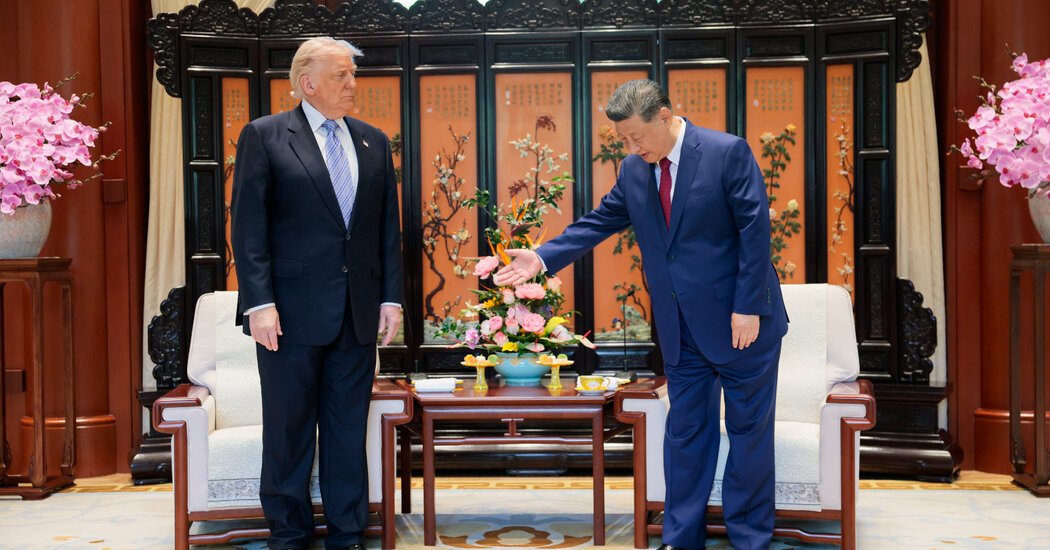
President Trump and China’s leader, Xi Jinping, emphasized stability during their second and final day of talks in Beijing on Friday, without announcing any clear resolutions on trade, Taiwan, the war in Iran or other points of contention.
The day’s events, including a working lunch and a garden tour, all took place at a compound where Mr. Xi and other officials from China’s ruling Communist Party live and work. Mr. Trump boarded a flight back to the United States a few hours later.
Here’s what to know.
The second day was shorter than the first.
The summit’s first day featured a ceremonial welcome at Beijing’s Great Hall of the People, a visit to an ancient temple and a lavish state dinner at which Mr. Trump invited Mr. Xi to visit the United States in September.
Mr. Trump began the second day by writing on social media that Mr. Xi had “elegantly referred” to the United States as “perhaps being a declining nation.” He said he was not offended by the remark, which he interpreted as a critique of President Biden’s administration. It was unclear whether he was referring to something Mr. Xi had said in private or public.
On Friday, Mr. Trump and Mr. Xi met at Zhongnanhai, the party’s walled compound. Outsiders, let alone a foreign leader, are rarely invited to enter.
After briefly shaking hands for the news cameras, they spent about two hours together. During another brief, joint appearance, Mr. Xi said that he had chosen to host Mr. Trump in the compound to reciprocate his welcome at Mr. Trump’s Mar-a-Lago estate in 2017.
Mr. Trump said Mr. Xi had “become really a friend” and that they felt similarly about the war in Iran. He also said that they had made “fantastic trade deals.”
“We’ve settled a lot of different problems that other people wouldn’t have been able to settle,” he said, without providing more details.
Mr. Xi later gave Mr. Trump a tour of the compound’s gardens, where he spoke about its trees and its roses. He said he would send seeds for the roses to Mr. Trump as a gift.
Mr. Trump departed for the United States on Air Force One later in the afternoon.
U.S. officials said progress was made on trade. China was noncommittal.
As of Friday afternoon local time, it was not immediately clear what trade deals Mr. Trump and Mr. Xi had signed, if any, at the summit.
Mr. Trump told Fox News on Thursday that Mr. Xi had agreed to order 200 airplanes from Boeing. A Boeing official referred a request for comment to the White House. At a news conference in Beijing on Friday, a spokesman for China’s foreign ministry did not directly answer a question about whether the country had agreed to buy Boeing jets.
Jamieson Greer, the U.S. trade representative, said in an interview with Bloomberg News that the United States and China would establish a board to oversee the reduction of tariffs on about $30 billion in goods. There was no immediate comment from the Chinese government.
The Chinese government has renewed export licenses for some U.S. slaughterhouses to sell American beef to China, but the number was unclear.
Mr. Greer also said that he expected China to agree to buy more than $10 billion in U.S. agricultural products. He did not say what, if anything, the United States had offered in return. A spokesman for China’s foreign ministry said only that economic ties between the two countries were mutually beneficial, and that China was ready to work on “economic understandings” reached by Mr. Trump and Mr. Xi.
The two sides did not discuss export controls on high-end chips, Mr. Greer said. That left Nvidia’s future in China unclear. Its chief executive, Jensen Huang, was among a delegation of business leaders who traveled with Mr. Trump to Beijing.
Treasury Secretary Scott Bessent said in an interview with CNBC on Thursday that the United States and China would set up a protocol to keep nonstate actors from accessing powerful artificial intelligence models. He did not offer details.