dailynewsnblog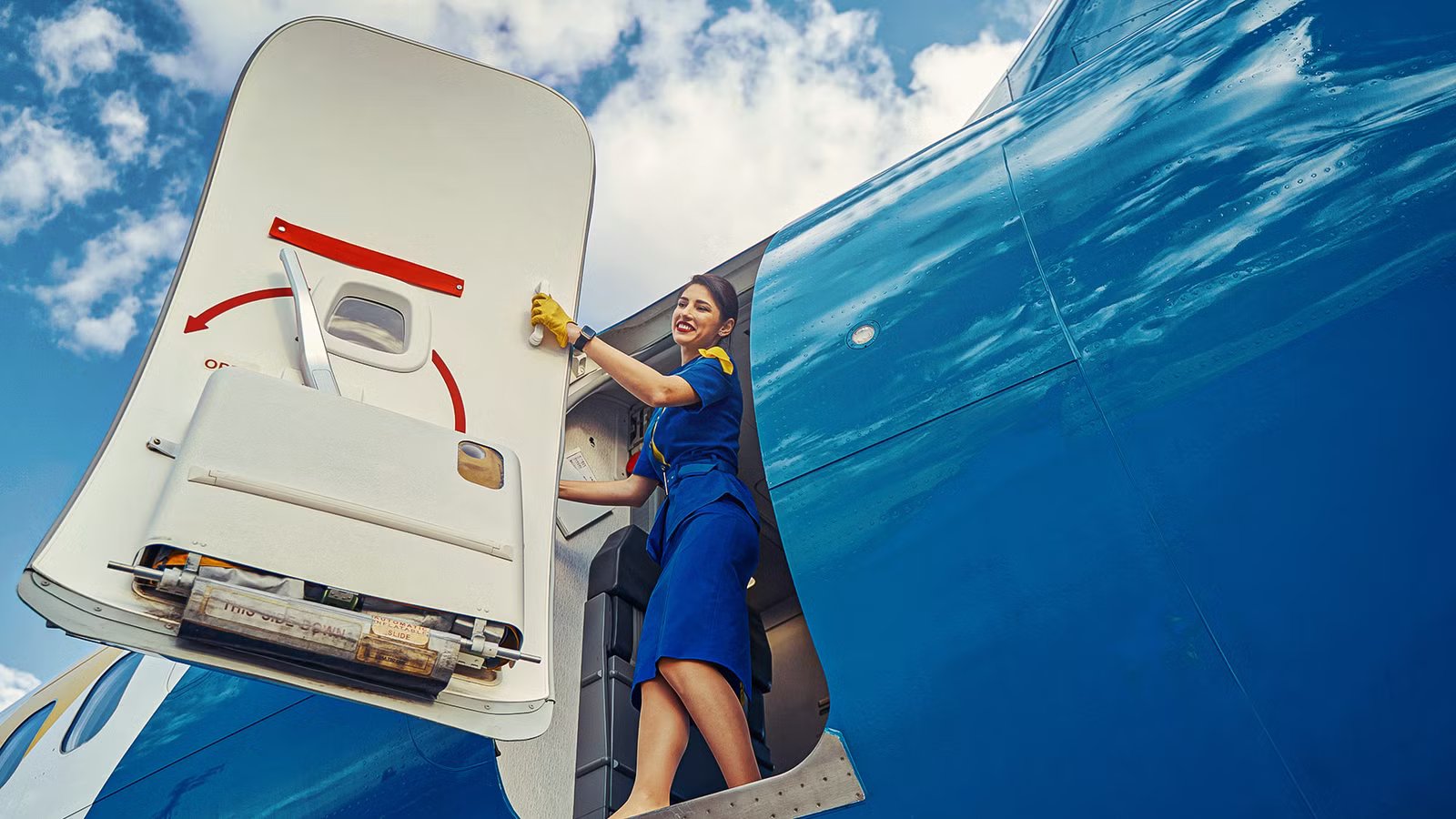
It’s a commonly heard phrase that you will hear on every flight, but have you ever wondered what it actually means? It’s actually a very crucial part of cabin safety procedures and happens exactly at the same time on every flight, between the time when the doors are closed and the aircraft starts pushing back. The flight crew or the senior crew member will ask the crew to arm the doors and cross-check.
The same procedure is done in reverse at the end of the flight, and the announcement will ask the crew to disarm the doors and cross-check. This takes place when the aircraft arrives at the stand and before the door is opened. It is very time-critical and has to be completed correctly with precision. This guide will look in detail at this procedure, what it actually does, and why it is so important for safety.
What It Means

When you hear an announcement “Cabin crew: arm the doors and cross-check” or “Cabin crew: doors to automatic and cross-check” just before pushback or departure, it’s a two-part safety instruction regarding the emergency evacuation slides. “Arm doors” means each crew member sets their assigned door into its armed (automatic) mode. This is typically by moving an arming lever, that connects the escape slide to the floor.
On Airbus aircraft, such as the Airbus A320 family, the arming lever is secured with a safety pin and operates with a pin-lever-pin process, whereas on Boeing aircraft it works differently. On the Boeing 737, for example, the slide is manually attached to the floor by the cabin crew physically attaching the girt bar to the bracket on the floor. Many modern Boeing mainline doors use different mechanical configurations for slide arming that do not rely on a separate removable safety pin in the same manner.
Once a door is armed, the slide is in position so that if the door is opened, it will automatically fall out and inflate within six to ten seconds, ready for an evacuation. There is also a manual inflation handle should the slide not immediately deploy. In short, the phrase is a concise, standardized way of telling the crew to put their doors in emergency mode. A door left disarmed in flight could mean a slide fails to deploy when every second counts in an evacuation.
Simple Flying Quiz
Think you really know Boeing?
Answer 10 questions and put your knowledge to the test
Think you really know Boeing?
Answer 10 questions and put your knowledge to the test
Easy (15s)Medium (10s)Hard (5s)
Cross-check Procedure

The “cross-check” is the built-in double-check: after arming their own door, each flight attendant turns and visually verifies that the door on the opposite side of the cabin has also been correctly armed. This is so that no crew station relies on a single person’s memory. It’s called a “cross-check” rather than just a “check” precisely because it’s an independent second confirmation and one crew member verifying another’s work, and stems from the same discipline pilots use.
There are visual indicators that a door is armed or disarmed that crew members check. There are indicators on the door that show whether the door is armed or not (disarmed is often green and armed red). The Boeing 737 has an orange streamer placed across the window when the door is armed. Airbus doors also have a floor indicator to check that the girt bar is positioned correctly and a slide-armed light. The senior crew member can also check on the flight attendant panel at the front of the aircraft.
After the cross-check is completed, the senior crew member will call all crew at their stations, and they will report in their door position (for example, L1, L2, L3 and L4, then R1, R2, R3 and R4 on larger aircraft) that the doors are armed/disarmed and cross-checked. The senior crew member then reports to the flight crew that all doors are armed/disarmed and cross-checked.
Disarming The Doors

The reverse command, “disarm doors and cross-check” (or “doors to manual”), is given after landing when the aircraft is about to reach the stand. The crew members move the lever to the disarmed position, check the indicators, and cross-check the opposite door in the same process. They report back to the senior during a crew call. Crew must then use the observation window to check if the airstairs or jet bridge are in place and wait for a knock on the door from the ground staff and a thumbs-up sign before the crew member carefully opens the door.
Moving the lever to the disarmed position disconnects the slide, so that the door can be opened normally. This is important as no one wants a slide deploying by mistake. The stakes on both sides are very real. A door left armed on arrival risks an expensive, dangerous inadvertent slide deployment when it’s opened at the gate and can cause serious injury. It is quite rare but still happens from time to time. Once the slide has started to deploy, it cannot be stopped and can be dangerous to anyone in the vicinity due to its powerful inflation mechanism.
It is also extremely expensive to repack (between $25,000 and $50,000), according toAerodynamiks. This can happen when the crew do not check that the door is disarmed before opening. Crew members may be rushed to depart, be fatigued, or be distracted by passengers. Airbus estimates that there are 30-40 cases every year on their aircraft worldwide. These are mostly at the forward left entrance door and the rear right loading door. According to Airbus, the minimum cost of an event involving a 90-minute ground delay is estimated at around $11,000. If it leads to a flight cancellation and a requirement to accommodate passengers in hotels is needed, the cost can rise as high as $200,000.
Evacuation Slide

During an evacuation, flight attendants deploy emergency slides, which are attached to either the door or the door frame, depending on the type. There may also be overwing exits that operate in a different manner. The slides are stowed in containers attached to the main cabin doors and are either in the armed or disarmed position. In the disarmed position, the door can be opened safely. In the armed position, the slide will inflate if the door is opened.
According to Smithsonian Magazine, when the door is opened from the inside and the door is armed, a lanyard triggers the slide deployment mechanism. Carbon dioxide is stored in a cylinder under pressure, which causes the slide to inflate. The pressurized gas passes through flexible hoses connected to an aspirator, which has small doors that open due to the vacuum created by high-speed air from the cylinder. This then draws in ambient air outside, which also helps the slide inflate.
The pressure of the cylinder can be viewed by an indicator on the slide stowage. Slide deployment is automatic when the door is armed, but if it fails to inflate, there is a manual inflation handle on the right-hand side of the slide. The slide can take between six and ten seconds to inflate to its full extent. Once inflation has started, it cannot be stopped.
What Passengers Should Know About Evacuations

Manufacturers have to prove that their aircraft can be evacuated in 90 seconds with half of the exits inoperable. Unfortunately, as we have seen in recent years, in real terms, that rarely actually happens. Passenger education is also needed to understand that taking baggage slows the evacuation, therefore risking the lives of other passengers and also the crew who leave the aircraft last, after checking that there are no passengers still onboard.
Carrying baggage down the slide can damage the slide and also injure yourself or another passenger. It is advisable to watch the safety demonstration as not all airlines or aircraft are exactly the same. It is advisable to count how many rows you are from the nearest exit, as if an evacuation were to occur, the cabin is likely to be dark, and there may be smoke. Always follow the instructions of the cabin crew, as they are trained meticulously in what to do in an emergency evacuation.
How should passengers leave the aircraft? The aim is to get everyone off the aircraft as quickly as possible. At the door, a passenger should step out over the slide so that you fall into a sit-and-slide position. If there is hesitation, crew are allowed to provide a gentle push. Arms should be crossed, hands touching the opposite shoulder. This keeps arms from flailing and getting burned. Lying flat means traveling faster and passengers may receive burns from the slide. If the correct position is taken, you should land on your feet. Move away from the end of the slide as quickly as possible and walk upwind of the aircraft.
Key Points

In brief, the command means that doors are to be set in emergency mode and confirm that each other’s doors are set correctly. Arming and disarming the doors are small but very important parts of the procedure. If doors are not armed correctly, the slides might not deploy in an emergency. The cabin crew would have to pull the manual inflation handle to inflate the slide, and those seconds could be saved in an emergency evacuation.Of course, if the door is opened whilst still armed, for example, when arriving at the stand, the slide will deploy. This is known as inadvertent slide deployment and can be both costly and dangerous. Once deployment starts, it cannot be stopped, and the slide has to be removed and repacked by engineers. This takes time, and the aircraft will not be able to operate until a new slide is fitted.
Passengers can take measures to prepare for an evacuation by leaving baggage behind, knowing how to sit and slide correctly, and following the crew’s instructions at all times. Watching the safety demonstration is wise, as all aircraft are different. Noting where the nearest emergency exit is and how many rows away it is could be a lifesaver in an evacuation.