dailynewsnblog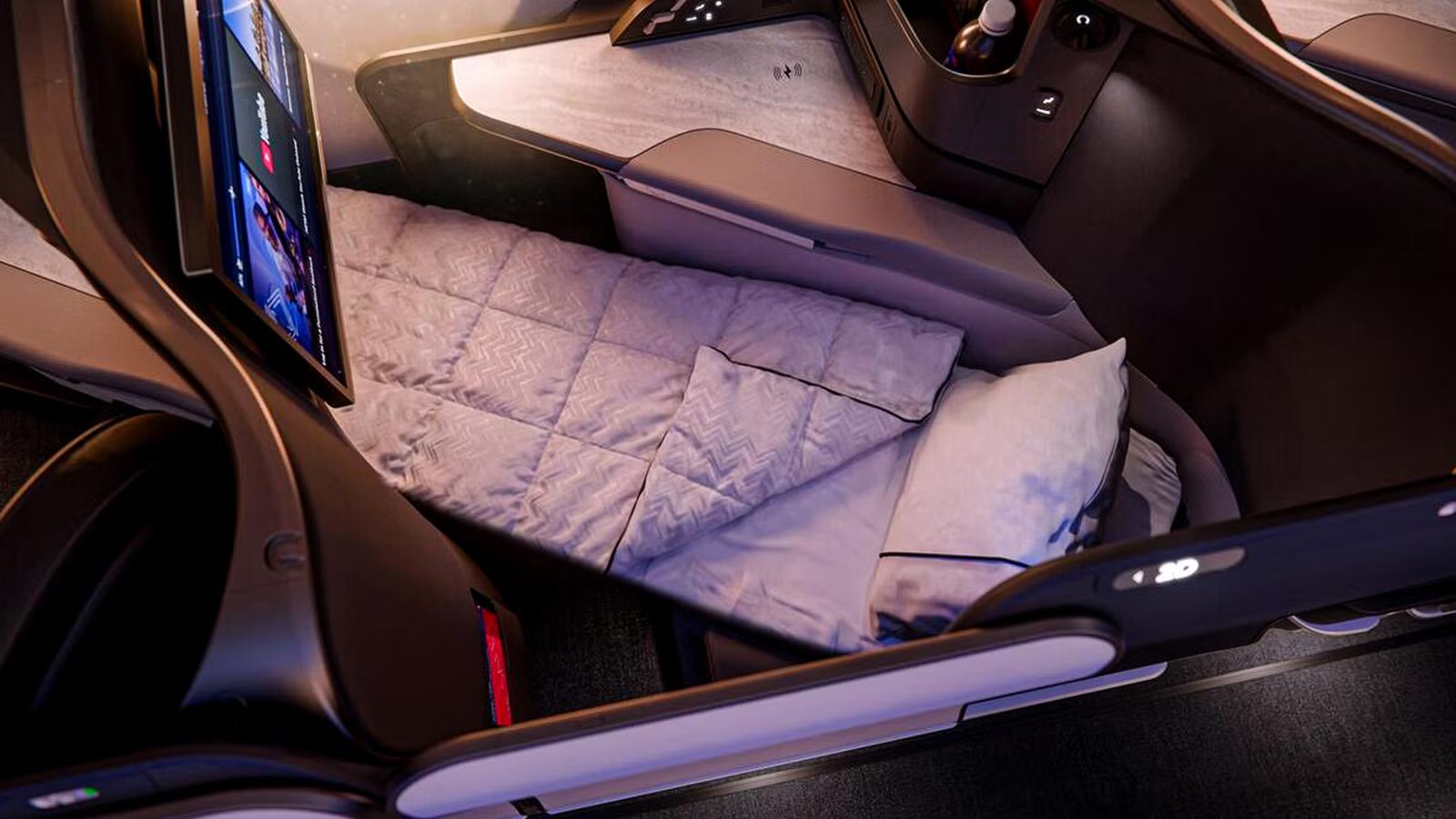
The US airline industry has essentially become a triopoly. The nation is dominated today by  American Airlines,
  Delta Air Lines, and
  United Airlines, and as each essentially sells the same product to customers (flights), they need to find other ways to differentiate, such as offering distinct onboard experiences. For American Airlines, the carrier’s primary premium cabin is its Flagship Business class, which will become its top cabin once the airline phases out Flagship First, while for Delta, its equivalent is DeltaOne.
Europe is both Delta’s and American’s largest international market, with the two competing against one another for connecting flows through their hubs. Boston competes against Philadelphia, while Detroit and Minneapolis compete against Chicago-O’Hare. Atlanta competes against Charlotte, Miami, and Dallas/Fort Worth, while Salt Lake City competes against Phoenix. However, the two airlines also directly compete on routes out of Los Angeles and New York-JFK, although the two opponents are hardly evenly matched.
Transatlantic Pricing For Delta And American

From Los Angeles, the only European destination that American Airlines directly serves is London Heathrow Airport, a route that Delta does not operate, but still has a presence on through its metal-neutral joint venture with Virgin Atlantic. In general, both airlines price one-way business class tickets between $3,000 and over $12,000, with little difference between Virgin Atlantic and American/British Airways. From Los Angeles, Delta serves Paris with its own aircraft, while also selling tickets on KLM’s route to Amsterdam.
In New York-JFK, however, the two carriers compete head-on more often. To London-Heathrow, American and Delta, as well as British Airways and Virgin Atlantic tend to price their tickets at similar prices, anywhere from $2,500 to over $10,000, and there are instances of both joint ventures undercutting the other in price. However, it’s the Delta/Virgin Atlantic joint venture that tends to price its tickets above $10,000 on select flights, whereas American and British Airways rarely set their fares this high.
On flights to other European destinations, Delta tends to match American on price or sets its business class fares higher, between one-and-a-half times to double what American is charging, while rarely undercutting American in price. In the industry, carriers regularly charge different prices depending on date as well as point of origination. While Delta often matches American on price for New York-originating tickets, it charges significantly higher fares on many more flights that originate in Europe. Likely, it’s relying on its premium brand image, while American is relying on its strong frequent flyer base in New York City.
The Mismatch Between American And Delta In New York

Delta and American are fairly evenly matched in Los Angeles regarding market share, but in New York, Delta has invested significant sums of money into expanding its operations and building a robust hub. It took years for Delta to make a profit from its New York operations, but the result is that it’s now the leading airline at  New York JFK Airport and at LaGuardia Airport. American has never held a huge presence at JFK, and instead operates it mainly as an O&D station (origin & destination).
American is unable to expand its presence at JFK easily because the airfield is slot-controlled, and it’s the number three airline at JFK (behind Delta and JetBlue) by market share, while sitting at number four in the New York metropolitan area (with United Airlines taking the number one spot via its Newark hub). American has a loyal AAdvantage following with a high number of credit card holders, but it serves fewer destinations than Delta, instead operating Philadelphia as its primary transatlantic hub.
In addition to pure scale, Delta also has an advantage with its brand image, which the carrier states allows it to command significantly higher fares versus the competition. While American has been making efforts to improve the passenger experience on its flights, it made a conscious decision to move down market and shift away from business traffic in the 2010s, which has hurt its pricing power. Furthermore, most of American’s European routes out of New York-JFK use the Boeing 777-200ER, which, in American’s layout, features more business class seats (37) than any aircraft that Delta operates out of JFK.

What Is The Busiest International Route From Europe?
Five airlines, six types of aircraft, one ocean and over 640 monthly flights.
Using Miles To Book Flagship Business And DeltaOne

American Airlines is a founding member of  oneworld, while Delta Air Lines is a founding member of
  SkyTeam. This means that there are countless partner programs to book award flights on both airlines, although the simplest way to book award tickets on these two airlines is through their own loyalty programs. For American Airlines, the carrier operates its AAdvantage program, while Delta has SkyMiles. These are both spend-based programs with dynamic pricing for award tickets, although American is unique in that it still publishes an award chart.
American Airlines advertises that a one-way Flagship Business ticket to Europe may cost roughly 75,000 miles, although it also states that this is only an estimate and that pricing changes based on demand. Some Flagship Business tickets can be less expensive, dropping to as low as 57,000 miles, but they can also spike much higher, with some tickets costing over 150,000 miles. Generally, American AAdvantage miles are valued at roughly 1.5 cents per mile, although Flagship Business redemptions can be a much better value.
Delta Air Lines does not publish an award chart, and pricing can be exorbitant. While you can find some deals for one-way DeltaOne tickets at 57,000 miles using partner programs, it’s common for award tickets to cost over 100,000 miles, and they frequently rise above 200,000 miles. On average, Delta SkyMiles are valued at only 1.1 or 1.2 cents per mile, which is fairly poor. However, Delta sustains this level of pricing power due to its strong brand value, and Delta SkyMiles is the world’s largest airline loyalty program.
The Onboard Experience In DeltaOne

Delta’s flagship product offering is the DeltaOne Suite, introduced in 2017 and based on the Thompson VantageXL. For years, this doored seat has been lauded as the best offered by any US airline, and is arguably still on par with the newer suites being introduced by American Airlines and United Airlines. However, the DeltaOne Suite was introduced on the Airbus A350-900, and the only European destinations that the A350 is serving in 2026 are Paris and Amsterdam, while the type is not based in New York-JFK or Boston, the carrier’s main transatlantic gateways.
While the A350 is also serving South Africa, Lagos, and Riyadh in 2026, Delta mainly relies on the Airbus A330 and Boeing 767 for transatlantic routes. The A330-900s also feature the DeltaOne Suite, but the A330-200s and A330-300s are currently equipped with the Safran Cirrus I, a seat that dates back to the late 2000s. Meanwhile, the 767-400ERs received an updated variant of the Thompson Vantage in 2019, with more privacy and updated technology but little personal space, while the 767-300ERs feature an older variant of the Vantage that dates back to the late 2000s.
|
Widebody Business Class Seat |
Aircraft |
Number Equipped |
Percentage Of Fleet |
|---|---|---|---|
|
Safran Cirrus I |
Airbus A330-200/300 |
42 |
23% (42 aircraft) |
|
Thompson Vantage |
Boeing 767-300ER |
36 |
32% (57 aircraft) |
|
Boeing 767-400ER (updated) |
21 |
12% (21 updated) |
|
|
Thompson VantageXL (DeltaOne Suite) |
Airbus A330-900 |
39 |
45% (80 aircraft) |
|
Airbus A350-900 |
41 |
||
|
Widebody Fleet Size |
179 |
Delta is planning on introducing a next-generation DeltaOne Suite on the Airbus A350-1000 in 2027, based on the Thompson VantageNOVA, but these planes will mainly operate transpacific routes. In addition, Delta intends to retrofit its A330-200s and A330-300s with the VantageXL, which will begin in 2027. Currently, however, the airline’s main advantage is that it tends to offer friendlier service more consistently to its premium customers, and its new DeltaOne Lounges are considered to be among the world’s best.
The Striking Differences Between Delta Premium Select & United Premium Plus
Despite enormous similarities, there are striking differences between the premium economy products on these two American giants.
The Onboard Experience In Flagship Business

While Delta generally has a superior brand image to that of American Airlines, the latter arguably offers a more consistent experience across its widebody fleet. On its Boeing 777-300ERs, the Fort Worth-based carrier installs the Safran Cirrus II, a newer variant of the Cirrus with improved privacy and more modern technology. Its 777-200ERs and Boeing 787-8s either feature the Safran Concept D, a custom seat that alternates between forward-facing reverse herringbone and rear-facing herringbone, or the reverse herringbone Collins Super Diamond. 22 787-9s also feature the Super Diamond.
More recently, American has been taking delivery of new Boeing 787-9s with new Flagship Suites, based on the reverse herringbone Elevate Ascent. This seat is the most private in American’s fleet, while also offering modernized screens and additional charging options. The Flagship Suite will be retrofitted onto all Boeing 777s in the future, and it also comes with a front-row Flagship Preferred suite with added space. Although Delta is reported to be planning a similar product, it does not currently offer a business class plus product.
|
Widebody Business Class Seat |
Aircraft |
Number Equipped |
Percentage Of Fleet |
|---|---|---|---|
|
Collins Aerospace Super Diamond |
Boeing 777-200ER |
28 |
49% (67 aircraft) |
|
Boeing 787-8 |
17 |
||
|
Boeing 787-9 |
22 |
||
|
Elevate Ascent (Flagship Suites) |
Boeing 787-9 |
11 |
8% (11 aircraft) |
|
Safran Cirrus II |
Boeing 777-300ER |
20 |
15% (20 aircraft) |
|
Safran Concept D |
Boeing 777-200ER |
19 |
28% (39 aircraft) |
|
Boeing 787-8 |
20 |
||
|
Widebody Fleet Size |
137 |
Apart from the new Flagship Suites, all of American’s widebody business class seats are modern 2010s-era reverse herringbone seats, while many aircraft in Delta’s fleet are equipped with late 2000s-era seats that have small screens and lack privacy. Of course, American’s onboard service is generally regarded as inconsistent, and its Flagship Lounges have not received the same level of praise as the DeltaOne Lounges.