dailynewsnblog
Saturdays are for… Wait, wrong game round up post. This isn’t a What are we all playing this weekend?, this is where we’ll be shouting about the gems (and lumps of coal) we’ve discovered in this week’s Steam Next Fest.
From June 15th – 22nd, Valve are hosting a section on Steam where developers can share demos of their upcoming games. Though, while it’s a good opportunity to find games to add to our wishlist, it is also a tad overwhelming. With roughly a gazillion demos to choose from, how on earth can you sift through them?
With the power of collective action!
We plan to play a fair stack of demos ourselves and write up many in individual posts, but there will be some that are best served with only a paragraph or two. We’ll share the short write ups below and link off to any longer ones we publish.
But, as great as our words may be, I’m honestly more interested in reading what you’ve been playing. Every time Valve run a big demo event, I find more good games through the comments left under articles than I do picking through the store myself.
So please, use this post as a place to share what you’ve been playing. What would you recommend? What would you avoid? What game has a mechanic you’ve never seen before? What lets you play as a new kind of character or in a totally new setting?
In a snake eating its own tail situation, we’ll likely end up playing what you’ve been recommending and writing about them here and elsewhere on the site. But together we can make a dent in this squirming mass of demos.
Right, onto what we’ve played so far.
Cloudbreaker

Very much in the vein of Vampire Survivors, Cloudbreaker puts you on the deck of an airship as it battles against growing waves of monsters. So far, so familiar. Though, its spin on the formula is that as you harvest the XP from enemies and unlock new weapons, you have to slot these into your airship’s chassis in a game of inventory Tetris.
There are only so many hard points on your ship and the weapons can come in awkward shapes and sizes. Plus, depending on the weapon, its placement in the ship can affect how it functions. If you want your melee weapon to swing at enemies below you, then you will need to make space for it on the undercarriage of your vessel. Other items offer buffs to connecting parts or any weapons it’s aligned with, so careful placement maximises the power of your arsenal.
It’s good fun, but it’s also nothing new. It’s a bit Vampire Survivors, a bit Drop Duchy.
Wall World Strategy
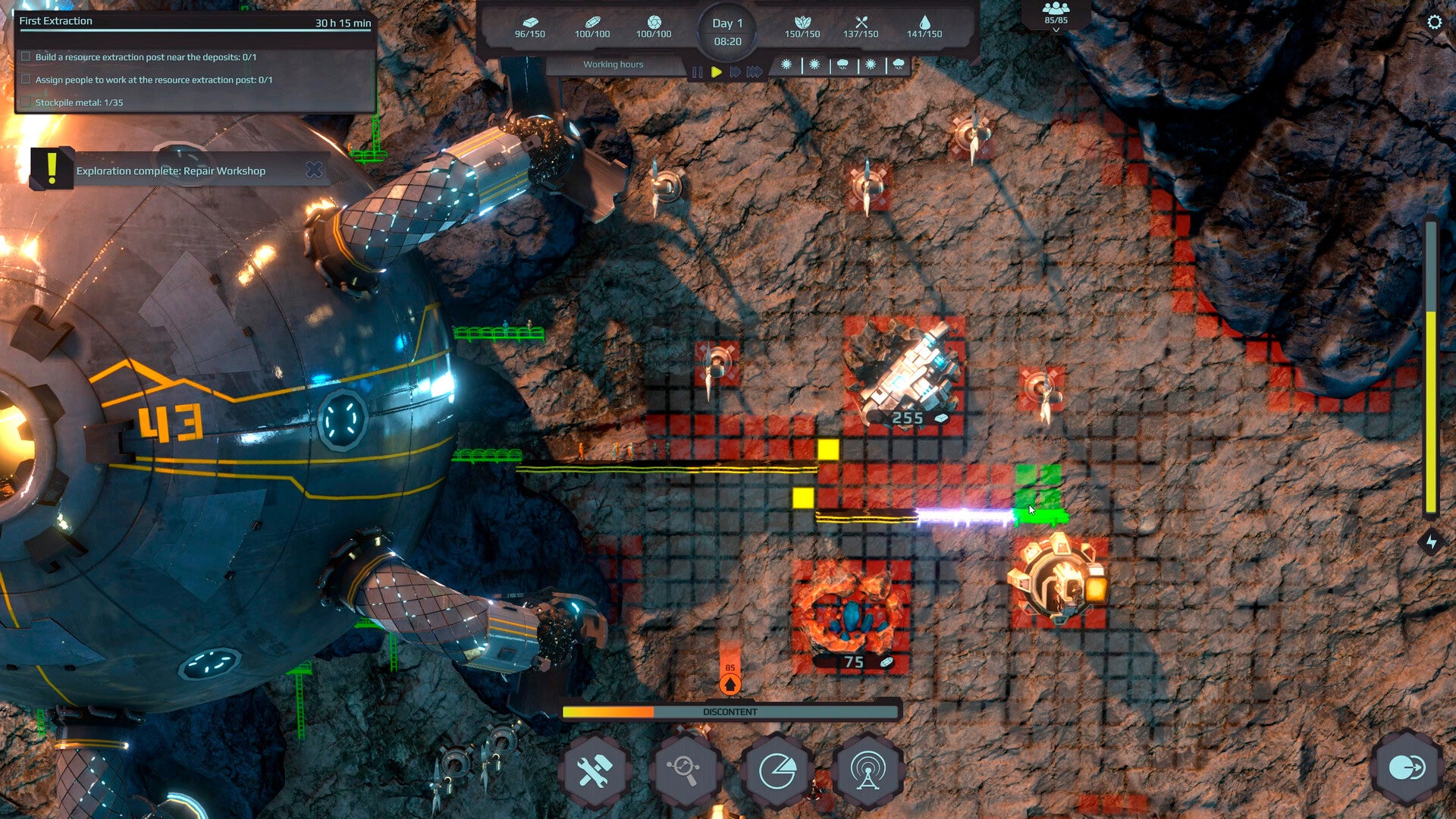
As I’ve said before, I’m a big fan of Wall World. The horizontal take on Dome Keeper, which sees you splitting your time between Manic Miner-style drilling for resources and a Missile Command-style battle against approaching aliens, is a wonderful fusion of genres. I am less of a fan of its sequel. And I am even less of a fan of its reincarnation as a real-time strategy game.
Wall World Strategy is one of the growing strand of vertical city builders, like DarkSwitch, which sees your metropolis not spawl but scale. It’s actually a perfect fit for Wall World, what with its world set on an impossibly tall wall, but unfortunately it doesn’t yet have any of the style or charm of the original game’s pixel art. Instead it’s been moved to a fairly functional 3D art style. And, while the mainline games see you playing a single builder, here you can send teams of builders into blocky mines to dig out resources to bring back your base.
While it’s all recognisably the Wall World game, it doesn’t currently grip me so immediately as the original.
Blood Dungeon

From Messhof, creators of Nidhogg, Blood Dungeon is the best thing I’ve played in Next Fest so Far. As I write about in my fuller post, yes, Blood Dungeon is another ‘It’s Vampire Survivors + …’ (in this case platforming) but it’s a genre blend that makes for something truly additive.
Traditionally, these games are top down and your movement falls into a familiar slow circle, kiting hordes of enemies behind you as your weapons pick off the nearest monsters. By making the game a platfomer, actually keeping away from enemies as they crowd in from the sides of the screen is much more difficult and demands quickthinking. You need to sprint, wall jump, climb ladders, and monkeybar along the underside of platforms to keep out of the reach of enemies.
And, for all of its slapdash appearance, the games 6-year-old let loose on MS Paint art style is characterful and charming.
Rivage

A Groundhog Day-style puzzle game set on a space station caught in a timeloop, Rivage puts you in the stranded space shoes of Miranda, one of the Ares’ occupants. When you wake up on the first day, the station is in a state of lockdown and you’re going to need to puzzle your way through its various security measures to find out what happened to the crew and activate an escape pod to get back to Earth.
The station is running on emergency power, and each time you open a door or use one of its major systems you drain a chunk of the battery. Empty the battery and you’ll need to restart the day. Though, restarts don’t wipe all of your progress. While unlocked doors slam down, the access cards and passwords you uncovered remain in your handheld computer, making progress a little faster.
Rivage’s demo is only a small chunk of the overall station, but its puzzles are diverting and its world intriguing. Though, I did brute force a couple of the problems and stumbled into the solution of another. That weak signposting may be because the developers have assembled a demo from different chunks of the game. One to flag with this one is that the developers say they used AI to prototype artwork that’s since been replaced by huma works.
Drill Deep

I’ll admit, I was hoping for more from Drill Deep. It’s an incremental game where you are drilling to the core of the Earth’s surface, and the trailer suggests your excavations are uncovering an Eldritch creature. From what I’ve played of the demo, that is all present and accounted for, it just doesn’t amount to a great deal.
After completing the story mode tutorial and getting into the game proper, you start each run with only a few seconds on the clock to dig for resources before your canary succumbs to the fumes of the mine and you must return to the surface. You spend resources on upgrades that let you dig for longer, for your mining pick to work faster, and for your extractions to be more valuable. So far, very much par for the incremental game course.
As you buy upgrades for your mining equipment, you see muscular organic growths appear in the background of the mine’s surface. These spread the more you buy, but that’s about it when it comes to Eldritch impact. Perhaps there is more the deeper you go, but as the game offers nothing that other incremental don’t, there’s not much compelling me to dig deeper.
Star Trek: Outposts Unknown

I enjoyed reading about the commitment to Starfleet’s noninterventionist policies in James’ write up of Star Trek: Outposts Unknown. You aren’t creating a colony in this colony builder, you’re instead working with a recently first-contacted civilisation to help them build a research station to study a radiation storm. Rather than throwing up housing and grabbing land from the locals, all of your work crew run to the Enterprise-like ship in orbit at night. Though, as James says:
As a determined 5pm finisher in real life, I should be supportive of my expedition’s creature comforts and work/life balance. Unfortunately, this is not real life. It is a sci-fi settlement builder, and if I know anything from other sci-fi settlement builders, it’s that nothing gets done if I can’t enforce backbreaking labour on sleepless underlings. At least thrice during my time with the demo did I quietly mouth “Where are you going?!” as my security offices and metal processors were left unfinished, workshy redshirts downing tools and heading back ship-side for their nightly banquets and cold plunges.
But, enough about what we’ve been playing. What would you recommend?