dailynewsnblog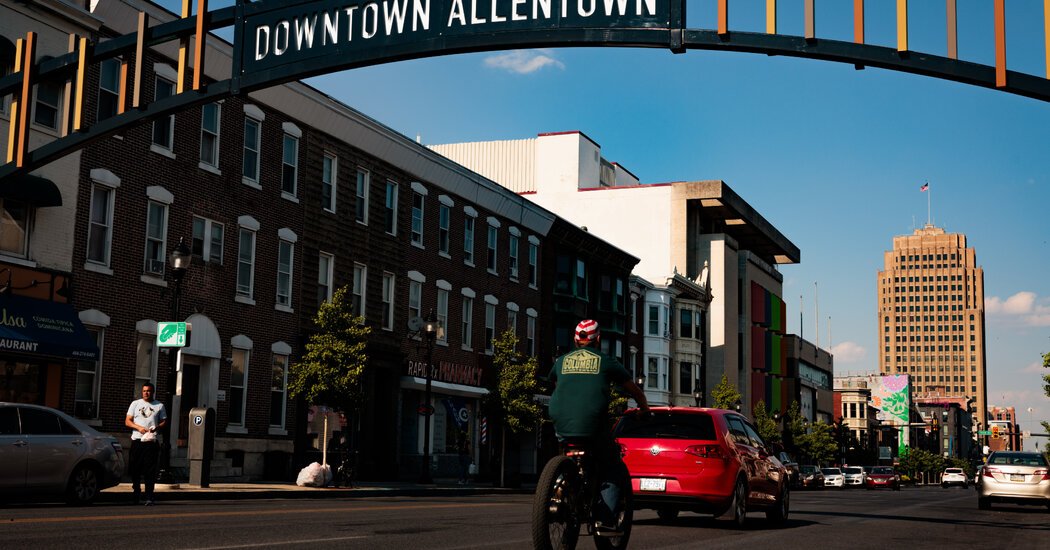
Pennsylvania’s Seventh Congressional District, on the state’s eastern edge, no longer evokes Billy Joel songs about dying factories. Allentown has a new boutique hotel, specialty coffee shops and high-rise loft apartments, the effects of an economic boom powered by logistics, biotech and high-tech manufacturing.
But that growth has driven up costs and squeezed the region’s predominantly working class population.
“It’s kind of scary,” said Brian Fasolino, 28, who recently returned to Jim Thorpe, a town in the north of the district, after six years in the military. He found a job installing piping systems, but said he is not making enough to move out of his parents’ house. “I was kind of hoping that things didn’t change all that much, and boy was I wrong.”
The Seventh District is one of two House seats in Pennsylvania that flipped from Democratic to Republican in 2024, but Democrats are betting that their newly minted House candidate — a retired firefighter and union representative named Bob Brooks — will be able to beat the freshman Republican incumbent, Ryan Mackenzie, with an economic message.
“I think they can see themselves in me,” Mr. Brooks said of voters in the district, noting that he had received food stamps and lived in public housing as a teenager after his family’s home burned down. “I have lived the life they are living.”
Mr. Brooks, who won Tuesday’s Democratic primary, added: “The party has lost people just like me for a long time. It’s time to give them some reason to come back.”
Mr. Mackenzie, whose primary was uncontested, said in a statement Wednesday that he will “be running on my track record of delivering tax relief to every American, fighting for working families, and being an independent voice for the people of the Lehigh Valley and the Poconos.”
The Lehigh Valley, which includes Allentown, Bethlehem and Easton, is a microcosm of the country, more suburban than rural, with midsize cities that are growing increasingly diverse. Allentown is now majority Latino. The city votes Democratic, but in 2024, President Trump made gains in all but three of its 55 precincts, said Mayor Matt Tuerk. The biggest swing occurred in the precinct that was the most heavily Hispanic, he said.
Mr. Trump won the Seventh District and its northern neighbor, the Eighth District, which includes the predominantly white, blue-collar cities of Scranton and Wilkes-Barre. The median income in the Lehigh Valley is $84,260, up 44 percent since 2014, according to the Lehigh Valley Economic Development Corporation. In the Eighth District, median income stands at $69,715, up from a decade ago but still below that of the state.
Both are considered tossups, part of a handful of seats that are likely to decide control of Congress in November.
Voters in eastern Pennsylvania say the economic lives of working class people are precarious. Residents are moving back in with their parents, putting off car repairs, driving less to save gas and preparing their food at home.
In Allentown, Fabricio Teran, 43, a mechanic in a mostly empty auto body shop, said that last year at this time, there were more than 10 cars in for work. The few repairs happening now are taking longer, because customers trying to save money are ordering their own parts, which often don’t fit.
Karla Rodriguez said her family’s Rotisserie Chicken shop on North Seventh Street had to raise prices to keep up with the rising cost of supplies, and it hit customers hard. She now sells 300 chickens a day instead of 500.
“We’ve never been this tight in the profit margin,” she said. “We’ve never been this bad.”
Ms. Rodriguez had a baby five months ago and was shocked at the cost of formula. With a brother in the military, she worried about the war in Iran.
“There’s a lot of chaos going on, and nothing’s really steady right now,” she said. “If it stays like this for a long time, I don’t know. A lot of people are not going to survive.”
Economic pain does not necessarily mean political gain for Democrats. In Scranton, Gabriel Perez said he shifted to home health care work after rent for his small empanada shop doubled. He still supports Mr. Trump.
“It’s real rough right now,” he said. “A lot of things look crazy. But if we falter, it will be worse. If he turns around and stops flexing his muscles with military might, we will be looked at like a laughingstock.”
Perhaps the biggest concern for residents is housing. Less than two hours from New York, the Lehigh Valley has long absorbed people fleeing high rents and struggling schools. Now those include white-collar workers drawing higher incomes.
“Housing costs have changed really dramatically,” said Christopher Borick, a political science professor and pollster at Muhlenberg College in Allentown. “It’s so stark.”
Carmen Dancsecs, 45, a mortgage loan officer and investor in the Allentown area, said she bought an 1,800-square-foot house with one and a half bathrooms in what had been a very affordable area in Allentown for $150,000 in 2024. She sold it a year later for $295,000.
Rising costs have led to rising debt among her clients, who are almost all Latino, she said. That is making it harder to get a mortgage. One recent client, a truck driver, put $22,000 of diesel fuel for his truck on a credit card.
She said she is seeing foreclosures for the first time since the financial crisis nearly 20 years ago.
Ms. Dancsecs has voted for Democrats for president in the past few elections, but she said that a number of her friends, many of them foreign-born Americans, voted for Mr. Trump, and they are feeling stung.
“I know quite a few people who are Republicans and are done with MAGA,” she said, adding that they tend not to talk about it because they don’t want to be criticized by those who still support the president. “I call them closet people.”
William Bonilla is not a closet person. A retired forklift operator and a Republican, he talks in angry tones about Mr. Trump. On his porch in Allentown, he ticked off what he saw as the administration’s mistakes, the immigration raids, the war with Iran.
“He was saying, ‘Oh, things are going to get better, and prices are going to go lower,’” Mr. Bonilla said, “and then you go and start a freaking war!”
“I was like, wow, he really took us for a ride there,” he said. “I hate getting taken.”
Asked to describe the state of the country, he said, “It’s lopsided. If you ain’t got money, you ain’t got nothing.”
In the parking lot of Redner’s grocery store, Francis Amigo, a 63-year-old loading dock worker, wheeled a shopping cart with a sparse haul, including a few frozen pizzas on sale, some bags of pretzels and a container of iced tea. The total, he said holding out the receipt, was $106 — about double what he would have paid a couple of years ago.
He said the war was to blame for the prices. But he had “mixed emotions” about the president, for whom he voted three times.
“Sometimes it seems like maybe he’s overdoing it, like shoot first and ask questions later,” he said. “But at least he’s doing something.”