dailynewsnblog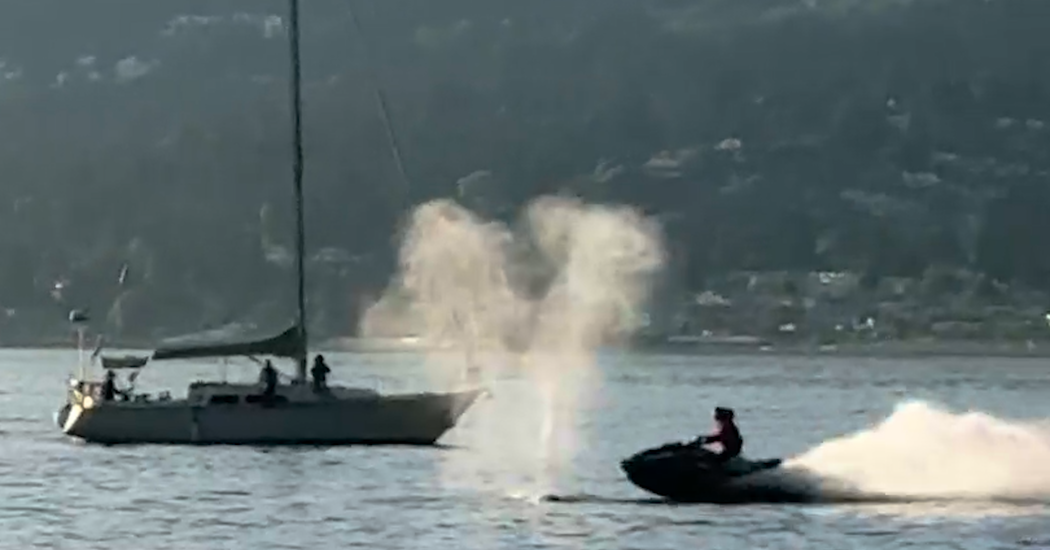
A personal watercraft struck an adult gray whale that had just breached off Vancouver, British Columbia, on Monday, according to local officials and a video of the collision that was posted online.
In the 21-second video, the fast-moving watercraft can be seen slamming into the whale as a portion of the animal breaks the surface of the waters of Burrard Inlet, launching the vehicle and its driver into the air.
The operator of the watercraft, a Sea-Doo, suffered a leg injury, according to the Royal Canadian Marine Search and Rescue, a volunteer-run organization that assisted in rescuing the driver, who has not been identified.
B.C. Emergency Health Services said it had received a call about a person in the water in need of medical assistance. The patient was in the hospital in “serious but stable condition,” according to a statement on Wednesday afternoon from a spokesman, Brian Twaites.
The Vancouver Police Department said that it was working with a federal agency, Fisheries and Oceans Canada, to investigate the strike and that it “cannot confirm any injuries to the whale.” On Wednesday, the federal agency said it had last seen the whale on Tuesday and that it had been “observed feeding, moving normally and appeared to be in good condition.”
Kevin Connolly, who recorded the video after noticing the whale during a run, said he and other people had seen the animal surface many times after the collision, suggesting the animal had not been seriously harmed.
Mr. Connolly, a 31-year-old systems engineer at Clio, a legal technology company, said he had been out for run on Monday night when he noticed dozens of people watching something in the water near the sea wall in Stanley Park, which juts into the water north of downtown Vancouver.
So he decided to stop, he said. That’s when he saw the gray whale, a species he said had been seen frequently recently, about 50 meters away.
He and the other people along the sea wall were filming the whale, which he estimated was surfacing every 30 seconds, when they noticed the Sea-Doo, Mr. Connolly said in a phone interview on Wednesday.
“We’re all just kind of standing there recording, and out of nowhere you just hear this loud, roaring Jet Ski come flying down,” he said.
“I think everybody had the same thoughts in their head, like, ‘Why is this guy going so fast when there’s a whale in the area?’” he added.
Mr. Connolly said the watercraft sped past the whale — far too close for comfort. Then, two minutes later, he said, the craft approached again, before ramming into the animal seconds after it had shot water into the air. The impact sounded like a big bang, he said.
“It was shocking — I couldn’t actually believe the timing of it,” Mr. Connolly said. “Like, that’s such a huge body of water.”
Mr. Connolly, who moved to Vancouver two years ago from County Wexford, Ireland, said the Sea-Doo’s operator, who he said was a man, had gone “flying” after the accident and had seemed in real discomfort. “Did I just hit a whale?” Mr. Connolly said the man had shouted.
A small nearby boat, which is visible in the video, sailed over to the man to help him, Mr. Connolly said. A search and rescue team arrived soon after.
The waterways surrounding Vancouver are busy, said David Rosen, an assistant professor at the Institute for the Ocean and Fisheries at the University of British Columbia, and reports of sea vessels striking whales are not unheard-of, though usually those vessels are commercial and quite large, unlike Sea-Doos.
It was not clear whether the Sea-Doo’s operator had seen this particular whale before the collision. But Mr. Rosen, who said the animal had most likely stopped in Vancouver to feed on its way to northern Alaska from the species’ breeding grounds in Baja California, said it would not have been surprising if the driver had not.
“If you’re traveling at a high rate of speed, you’re less likely to see something in the water, particularly when you’re low,” he said.
Canadian regulations require boaters to stay 100 meters from a whale “in a resting position” or with a calf and 200 meters from all other whales, said Ben Stanford, a spokesman for Fisheries and Oceans Canada. All recreational vessels are also asked to reduce their speeds to less than seven knots when they are within 1,000 meters of a whale, he said.
“What is he doing traveling so quickly in that area for?” Mr. Rosen said. “You know, that’s just an accident waiting to happen.”