dailynewsnblog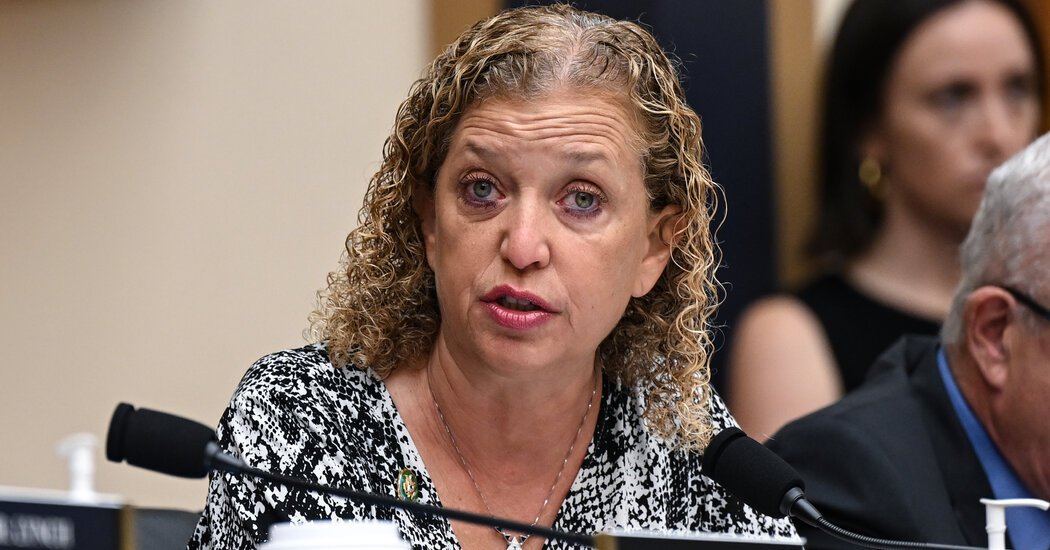
Representative Debbie Wasserman Schultz, a Democrat from Florida, said on Friday that she planned to run for re-election in a majority-minority district under the state’s newly redrawn congressional map.
The map created four additional Republican-leaning districts in part by eliminating her South Florida seat. Ms. Wasserman Schultz’s decision to run in Florida’s new 20th Congressional District, however, has stoked tensions with Black Democrats already reeling from Republican gerrymanders across the South that are likely to dilute or eliminate Black representation in Congress.
“We cannot let Trump destroy Broward County’s power,” Ms. Wasserman Schultz, who is serving in her 11th congressional term and is a former chairwoman of the Democratic National Committee, said in a video announcement.
She was referring to President Trump’s push for Republican governors and state legislatures around the country to engage in an unusual and highly partisan round of redistricting in the middle of the decade to help retain control of Congress. Gov. Ron DeSantis of Florida, a Republican, signed the state’s aggressively partisan new map on May 4, setting off a musical-chairs-style scramble among South Florida Democrats.
Two Democratic districts held by Ms. Wasserman Schultz and Representative Jared Moskowitz had been eliminated or largely redrawn. In an interview, Ms. Wasserman Schultz decried Republicans for taking what she called a “cynical, disrespectful” approach to redistricting.
“What they did on purpose was chop up Broward’s districts to smithereens,” she said, noting that it is the state’s most Democratic county.
Ms. Wasserman Schultz’s decision to run in the 20th District was not unexpected, given the limited options for her to seek re-election under the new map. But even before her announcement, she had upset some Black Democrats, who said the district deserved a Black representative. Ms. Wasserman Schultz is white. The district is majority-minority, meaning more than half of its residents are Black or Hispanic, though the Democratic electorate in the district is mostly Black.
Most of the district had been represented until recently by Sheila Cherfilus-McCormick, who resigned from office last month before a House panel was scheduled to consider expelling her. Ms. Cherfilus-McCormick, who is Black, has been indicted on criminal charges of embezzling $5 million in federal disaster aid and using it for her campaign. She has denied the accusation and pleaded not guilty. She has also said that she is running in the 20th District, as are several other Black Democrats.
One of them is Luther Campbell, known as Uncle Luke from 2 Live Crew, a hip-hop group from the 1980s and 1990s. Mr. Campbell, a music producer and former youth football coach, said last week that it was “appalling” for Ms. Wasserman Schultz to be considering a run in that district.
“I will drag her,” he told Politico.
Another Black candidate, Elijah Manley, said on Friday that Ms. Wasserman Schultz is “carpetbagging.” She is “everything that’s wrong with the Democratic establishment,” he wrote on X.
In response to the criticism, Ms. Wasserman Schultz said in the interview that she already represents a majority-minority district, where a plurality of voters are Hispanic, and has a proven track record of helping diverse communities. Her announcement video included supportive clips from a number of people, including several Black activists and officials. She also emphasized her seniority and experience.
The Republican Party portrayed Ms. Wasserman Schultz as “abandoning her home district” because she would lose. The congresswoman has long lived in Weston, a city west of Fort Lauderdale that is in the new, Republican-leaning 22nd District.
“Instead of facing voters after years of backing Democrats’ failed agenda, Wasserman Schultz is running scared,” Maureen O’Toole, a spokeswoman for the National Republican Congressional Committee, said in a statement.
Republican state lawmakers approved Florida’s new map hours after the Supreme Court issued a decision that weakened the landmark 1965 Voting Rights Act. The court found that Louisiana lawmakers had unconstitutionally relied on race when they created a majority-Black district; the decision set off a race to redraw maps in Southern states.
Ms. Wasserman Schultz could have run in Florida’s new 25th Congressional District, which extends along the coast from Miami-Dade to Palm Beach Counties. But that district is Republican-leaning, while the 20th District is safely Democratic.
Running in the 25th District would have most likely pitted Ms. Wasserman Schultz against Mr. Moskowitz, a longtime friend. Mr. Moskowitz has not formally announced where he plans to seek re-election, other than to say he intends to run in the district that overlaps with most of his current district. Only the 25th fits that description.
Several voting rights groups have sued Florida over its new map, saying it violates a ban on political gerrymandering in the state’s Constitution. A circuit judge in Tallahassee has not yet ruled.
Florida has 28 congressional districts; the new map cuts the number of Democratic-leaning districts from eight to four.
Ms. Wasserman Schultz led the national Democratic Party from 2011 to 2016. She resigned after a trove of leaked emails suggested that party officials had derided Senator Bernie Sanders’s presidential primary campaign against Hillary Clinton while insisting that they were neutral in the race.