dailynewsnblog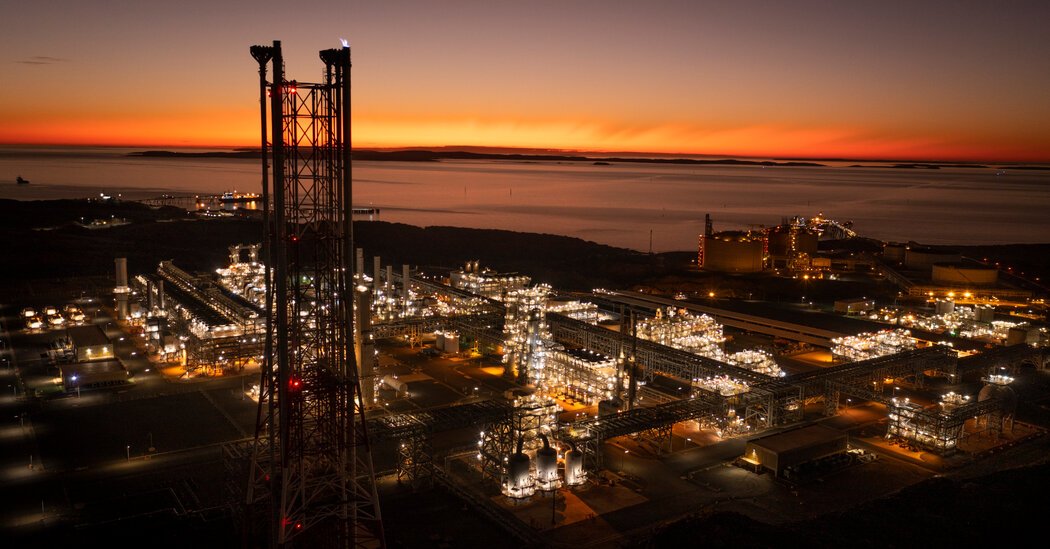
Earlier this year, a moment in an otherwise dry parliamentary hearing on budget estimates went viral in Australia.
A senator asked how the tax the country collects on beer sales compares with the revenue raised from the Petroleum Resources Rent Tax, which was designed to give taxpayers a cut of the profits coming from the country’s offshore deposits of natural gas and oil. Beer was expected to bring in about 2.7 billion Australian dollars, or $1.9 billion, a treasury official said in response. The tax on energy companies? $1.1 billion.
“How do we live in a country, one of the biggest gas exporters in the world, and we’re getting more tax from beer?” the senator, David Pocock, asked.
The exchange in early February marked a potent moment in a long-running push to get Australia’s giant natural gas industry to pay more into public coffers. The debate was back in Parliament this week, with new urgency from the energy crisis ricocheting from the Iran war.
Many Australians are asking why they are paying drastically more in their energy bills while natural gas producers are profiting from a spike in prices caused by the disruptions to the global supply from the Middle East.
Australia is the world’s third-largest exporter of liquefied natural gas, after the United States and Qatar, most of which it sells to Asia. But despite the vast quantities of gas extracted and sold, mostly from federal waters offshore, the industry has only had to pay a small fraction of its revenue as a resource rent tax, because of generous credits to offset the industry’s investments into exploration and production facilities.
With the natural gas production infrastructure in Qatar heavily damaged by the war, Australia’s gas exporters stand to profit even more in the coming months.
“Those resources are the property of the people of Australia,” Ken Henry, an economist and former treasury secretary, said Tuesday before a Senate committee conducting an inquiry on taxing Australia’s gas resources.
“If we want to ensure that present generations and future generations of Australians get fair value from the commercialization of these finite stocks of natural resources, created millions of years ago, then we have to ensure they get more tax revenue,” said Mr. Henry, now serving as the chair of the Australian Climate and Biodiversity Foundation, a not-for-profit environmental group.
Gas producers have pointed to the billions of dollars they have paid in corporate and other taxes, contributing to the country’s economy, warning that additional taxes would make Australia less competitive for future investment.
The Australian Energy Producers, an industry group, has said that more taxation would “leave Australia more exposed to future shocks” by undermining its domestic capacity.
The specter of a new tax — one proposal is a 25 percent levy on all exports — has also been met with concern from Japan, which has heavily invested in Australia’s gas industry and depends on it for 40 percent of its supply.
In Australia, Prime Minister Anthony Albanese’s government has asked the Treasury to model different methods of imposing more tax on fossil fuel producers’ wartime profits to help counterbalance other effects of the war, the Australian Broadcasting Corporation, the public broadcaster, reported last month.
Other countries have imposed a so-called “windfall tax” at times of price spikes to tap energy producers’ soaring profits and ease the pain elsewhere in the economy, particularly in the aftermath of Russia’s full-scale invasion of Ukraine.
In Australia, think tanks, environmental and civil society organizations, economists and some politicians have long sought changes to what they have contended is a sweetheart deal for gas producers. The conflict in the Middle East has given the campaign momentum ahead of the unveiling of the country’s federal budget.
The Australia Institute, a research group that has been pushing for an overhaul, said based on its own calculations that only 1.6 percent of the gas industry’s revenue had been paid under the Petroleum Resources Rent Tax in the past decade. Advocates for higher taxes have pointed to countries like Norway and Qatar, where far higher proportions of gas revenue go to public benefit.
Rod Sims, chair of the nonprofit Superpower Institute, said Australia was an outlier in how much it taxes profits made off resources obtained from public lands. Even compared with the United States, which provides tax credits for oil and gas producers, Australia takes less of a cut, Mr. Sims said, citing the institute’s own analysis.
“We in Australia are almost uniquely positioned as the country that has taken the least share of the profitability of our resources,” he said in an interview. “It is absolutely extraordinary.”
Kevin Morrison, an analyst with the Institute for Energy Economics and Financial Analysis, said the war in Iran and the effects being felt by average citizens in their household budgets will probably highlight the issue in a way that may not have resonated previously.
“We’re suffering here, we’re paying much more. Why should these guys make more money off it?” Mr. Morrison said.