dailynewsnblog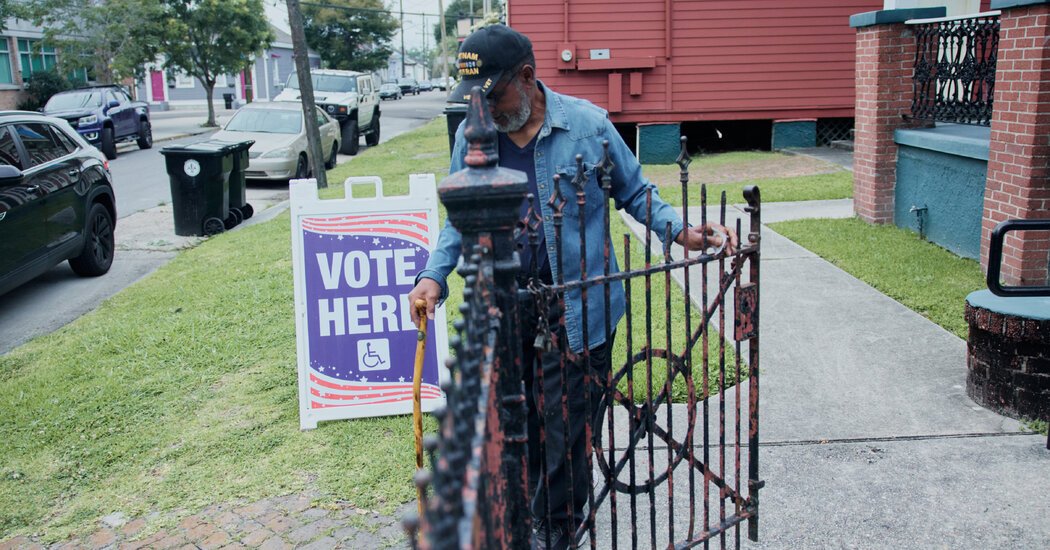
Jacob Russell, a chemistry student at Louisiana State University, arrived at his Baton Rouge polling place on Saturday and cast his votes as planned: picking candidates in the Senate and House primary elections and weighing in on a series of constitutional amendments.
But his choice of House candidate will not count. Instead, Mr. Russell and voters throughout Louisiana will have to return to the polls in November to cast their ballots again.
“Principle,” Mr. Russell, 20, said when asked why he still voted for his choice of House candidate. “It was there. They’re going somewhere, even if it’s not counted.”
The confusing ballot in Saturday’s election came after the Supreme Court rejected the state’s current map as an illegal racial gerrymander. Gov. Jeff Landry, a Republican, then delayed House elections so lawmakers could draw new district lines. But ballots were printed before the court’s decision, and voters could still make their choice for the House known, even though it wouldn’t count.
In the muddled aftermath of the Supreme Court ruling — which weakened the Voting Rights Act of 1965 and created a swell of partisan moves across the South — some voters said they were demonstrating how much they value their vote.
Louisiana, with its map thrown out by the court, has been at the center of that partisan scramble to redraw districts. Mr. Landry was the first to delay House primaries for a new map; at least one other state has followed suit.
In Republican-led Southern states, where significant constituencies of Black voters had elected Democrats under the current maps, the moves to carve up those districts have led to confusion and frustration in a year where control of Congress hinges on just a few seats.
Voters in Louisiana were the first to confront the ruling’s fallout, since early voting in Louisiana began just days after the Supreme Court decision. Signs at polling locations were displayed explaining Mr. Landry’s move to delay the House primaries, while officials pushed for voters to still turn out.
Already, the State Senate has approved a plan to redraw one of the state’s two majority-Black districts, a seat currently held by Representative Cleo Fields, a Democrat. If approved by the House, the new map would change the district lines in a way that hands Republicans a structural advantage toward flipping the seat.
“I don’t know what November will bring,” said Lois Jordan, 67, after casting her vote Saturday morning in Baton Rouge. What was clear, she added, was that “we all need to vote.”
Other Southern states have taken steps to use new district lines. In Alabama, which is still pushing a court to allow it to use a map previously rejected as a violation of the landmark voting rights law, the governor has moved four House primary elections to August. Tennessee has approved a new congressional map that advantages Republicans in flipping the state’s lone Democratic seat. And South Carolina has taken initial steps to consider its district lines in the coming days.
Daniel Griffith, senior director of policy for the Secure Democracy Foundation, a nonpartisan election policy group, called it a “confusing and ever-changing” environment for not only voters, but even officials and election watchers steeped in the details of election procedure. And he, like other experts, cautioned that the new elections and ballots could further strain costs and workloads in an already busy midterm election cycle.
There is little precedent for splitting up ongoing elections in modern American history, outside of special elections to replace incumbents who have died or resigned. Legal challenges over both the new elections and mid-decade redistricting have piled up, though courts have so far shown little interest in siding with the challengers.
Republicans view the delayed election as a necessity in Louisiana because the Supreme Court ruled its congressional map unconstitutional. Democrats have accused them of undermining Black political power and depressing turnout not only by delaying the House elections, but also by forcing through a new map that dilutes a district with a majority of Black voters.
“We don’t have a map under which our voters can vote on,” Mr. Landry said in an interview broadcast on the CBS program “60 Minutes.” Thousands of absentee votes that were already cast before the ruling, he said, “are discarded, and those voters will vote again in November.”
“It’s not my fault,” he added. “If anybody has a grievance, take it to the United States Supreme Court.”
The changes to the House elections have exacerbated what was already poised to be a complicated day for voters. After a recent change by state lawmakers, there is now a closed party primary system, instead of its usual open contest where the top two candidates advanced to a general election, regardless of party, if there was no outright winner.
The Senate incumbent, Bill Cassidy, has raised concerns that voters who are unaffiliated with a party may not realize that they have to request a Republican ballot to vote in that particular primary. Those voters are seen as more likely to support Mr. Cassidy, a Republican who has been a target of both President Trump and Mr. Landry, than any of his conservative opponents. (And, in a twist, the new House primaries in November will revert to the traditional open primary system.)
“It’s unfortunate because the system should be made to serve the voter, not asking the voter to serve the system,” Mr. Cassidy said, speaking at a campaign event in Baton Rouge. “And there’s been decision after decision made that makes the voter the servant of the system that’s wrong.”
He later showed reporters a handful of text messages from supporters who said that they had not understood the new primary system and were unable to vote for him.
Other lawmakers were laboring to educate voters and ensure they cast votes on Saturday in both the Senate race and in a series of constitutional amendments. Representative Julia Letlow, who is running against Mr. Cassidy, said in an interview that “voters understand things change, things happen, it’s a fluid situation, so I’ve been doing my best to get the word out there.”
A spokeswoman for Representative Troy Carter, Democrat of Louisiana, said about a third of the calls to his office from constituents had been related to questions about voting and whether their votes would even matter. On Monday, he convened a town hall in New Orleans to walk constituents through the implications of the Supreme Court decision and encourage them to turn out at the polls.
Mr. Carter, in a brief interview after the forum, said the Supreme Court decision stripped away tools that intended to protect voters from discrimination, but added that “voting rights still exist.” He said he was urging people to vote in every race on the ballot.
Among some voters, confusion over how the elections would be handled had given way to frustration over the possibility of new district lines and concerns that they may not be able to elect a representative of their choice.
“It’s crazy,” said Cynthia Taylor, 49, a caregiver in Baton Rouge. But, she added, there was little question about whether she would come out to vote on Saturday.
“As a matter of fact, I’m going to get other people to come out and vote,” she said. “Let me call my daughter.”
Michael Gold contributed reporting from Baton Rouge, La.