dailynewsnblog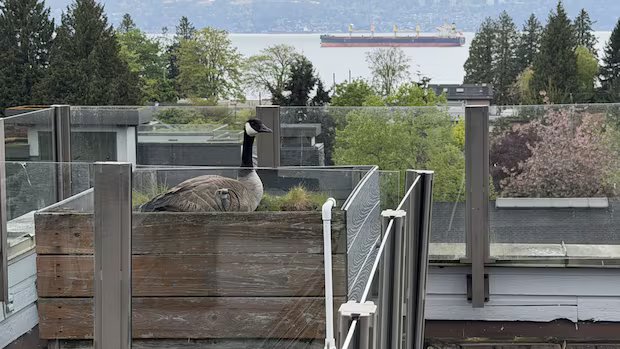

Listen to this article
Estimated 4 minutes
The audio version of this article is generated by AI-based technology. Mispronunciations can occur. We are working with our partners to continually review and improve the results.
A Vancouver man who called for aid after discovering a family of geese nesting on his rooftop isn’t alone in his experience, according to a rescue group.
The Wildlife Rescue Association of B.C. (WRABC) said it’s responding to calls regarding the large birds nearly every day at this point in the spring, and that it’s important to get rescuers involved early in case the geese need help.
In Cecil Hershler’s case, it began with a mother goose settling into a vegetable box on the roof of his four-storey Vancouver home about two weeks ago.
At first, Hershler said he didn’t think too much of it and went about cleaning his outdoor space.
“I said, ‘Well, it’s there, it’s not bothering me. I’m not going to bother it,'” he told Michelle Eliot, guest host of CBC’s On The Coast.

But Hershler was told by some visiting guests that the goose shouldn’t be ignored, because it could be nesting.
He ended up calling WRABC, who told him to watch over the mother goose and let them know when the eggs hatched.
A week or so later, he was greeted with the raucous “clacking and honking” sounds of eight goslings and their father.
“There was the mom and dad now, and the father was pretty aggressively protective,” Hershler said.
“You know, he was hissing and, you know, running at you with the wings raised.”

Hershler’s wife ended up calling rescuers again, who made a plan to relocate the geese.
Linda Bakker, the co-executive director of WRABC, said a nesting goose family will usually sit in the nest for around 24 hours after the goslings first hatch.
“But then they need to go to a food source and a water source,” she explained.
“So they jump off the rooftop or the balcony, the mom first, and then she calls the babies down and off they go.”

But in the case of Hershler’s rooftop, rescuers determined it was too high for the goslings to get down safely — which is why they jumped into action.
Hershler said a volunteer rescuer scooped up the goslings a few at a time into a special container. Then, they were taken down and placed in Hershler’s driveway.
Eventually, the mother and father goose flew down to be with the goslings, and volunteers shepherded the family to the nearby pond at Jericho Beach Park.

What to do if you discover a nest
If geese do nest in a dangerous environment, they can be moved only by a professional with a permit from the Canadian Wildlife Service. Geese are protected under the Migratory Birds Convention Act.
Bakker said the association is receiving calls about geese every day around this time of year, and that there were probably four rescue situations happening every day over the last six to eight weeks.
While not every nesting goose family requires the intervention of rescuers, Bakker said Hershler did everything right by getting them involved early and not interfering with the birds.
She said people who discover a nesting goose should take pictures and keep a safe distance.
“As soon as they start building a nest, they are protected. So you cannot remove any nesting material. You’ll have to wait until after the summer to clean it up,” she said.
On The Coast11:35How eight goslings were relocated after hatching on a rooftop garden
Cecil Hershler described how volunteers relocated a Canada goose family after eight goslings hatched on his rooftop garden. Linda Bakker, co-executive director of the Wildlife Rescue Association of B.C., describes how common incidents like this are.