dailynewsnblog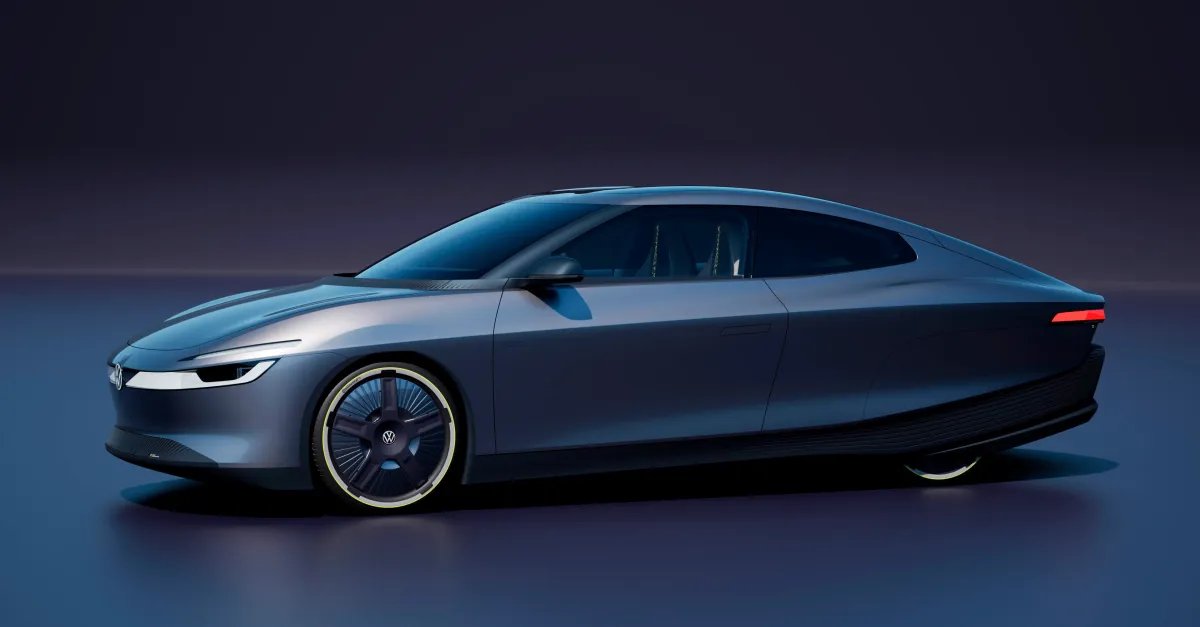
No, that’s not a Tesla Cybercab. That’s Volkswagen’s Mission Efficiency, the world’s slipperiest electric vehicle. The near-production 2+2 seat electric coupe prototype was built on VW’s MEB+ platform, incorporating front-wheel drive components from the upcoming ID. Polo and ID. Cross models.
True to its name, the mission of Mission Efficiency is to break records. With a drag coefficient of a scant 0.158, the prototype claims to be the world’s most aerodynamic road-approved vehicle. It also claims to have broken the record for energy efficiency, consuming 6.48kWh of energy per 100 kilometers during a constant-speed (68 km/h) test-drive on flat terrain with secondary features like AC deactivated. And lastly, the Mission Efficiency is “the most economical near-production electric car in its class” thanks to its platform sharing with the ID. Polo.
What does all this mean in practical terms? Well, think vast distances traveled with little thought paid to charging stops. Volkswagen recently completed a real-world 1,278.36 km (794.34 miles) trip from Wolfsburg to Vienna on a single charge of Mission Efficiency’s 54.9 kWh (net) battery. The EV used only 6.89 kWh/100 km (7.51 kWh/100 km including charging losses) at an average speed of 67.72 km/h — and still arrived at its destination with 164 km of range remaining.
Given the prototype’s teardrop shape and wheel coverings, it’s not difficult to imagine the Mission Efficiency breaking all of these record. This won’t win any design awards nor cause any stampedes at your local VW dealership. This was designed to slide through air molecules with barely a disturbance. The underbody is covered, the windows frameless, and the door handles flush.
In fact, it gains efficiency the faster it goes. A helpful comparison is VW’s ID. Polo, with which the Mission Efficiency shares its 99 kW front-wheel electric motor, high-voltage battery, aluminum structure, and high-strength carbon fiber materials. At speeds above 80 km/h, the prototype uses over 30 percent less energy than the ID. Polo. At 140 km/h, it consumes the same energy as an ID. Polo traveling at 100 km/h.
Where VW couldn’t optimize for aerodynamics, it slashed weight. The paneling is more lightweight, while the infotainment system is decidedly “bring-your-own device,” including a portable Bluetooth speaker and a smartphone/tablet dock in place of a central touchscreen. Integrated solar panels on the roof can supply up to 30 km of added range for all the auxiliary electronics.
The takeaway is that VW isn’t relying on some super exotic motor and battery to achieve these record-breaking numbers. It’s really a design challenge. This is basically just a re-bodied ID. Polo supermini out there blazing its way into the history books.
And it’s not just some design challenge that will get filed away and forgotten. Automakers across the industry are wracking their brains over how to boost efficiency as a way to attract more people to the EV life. Ford is using design challenges to shave drag off its new, next-gen EV truck. Everyone from Mercedes to Audi to Porsche is obsessing over aero. The question is: What makes it into production? And how will consumers respond to these slippery shaped vehicles?